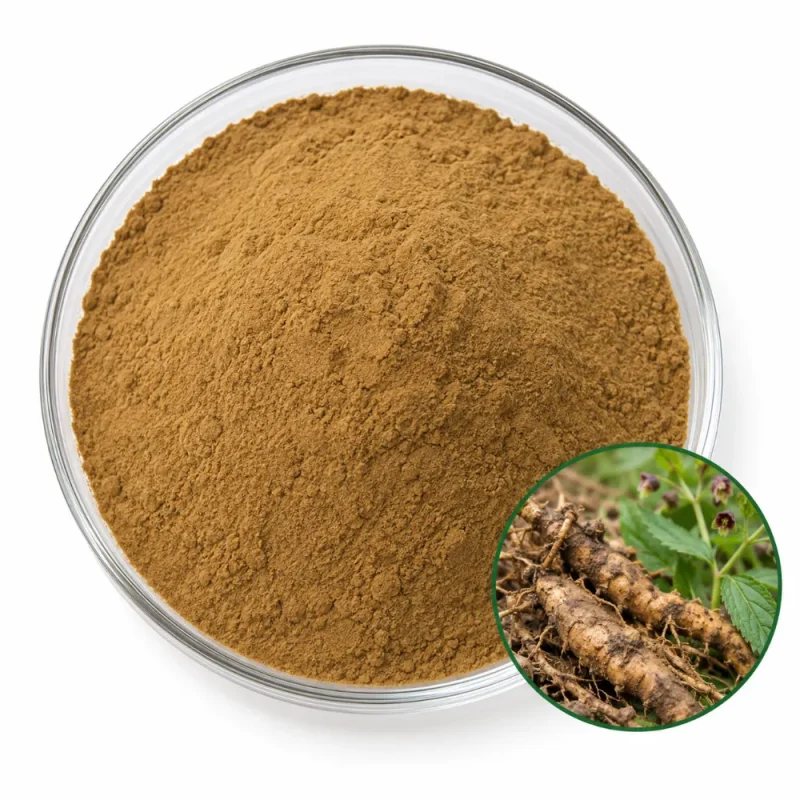
Scrophularia Ningpoensis Extract 5–20% Iridoid Glycosides

Scrophularia ningpoensis extract is prepared from the root of figwort, Scrophularia ningpoensis Hemsl., the plant sold in Chinese medicine as xuan shen, a perennial of the family Scrophulariaceae. Ethanol extraction concentrates the iridoid glycosides of the root, and the concentrate is dried to a light brown powder that dissolves in water.

Total iridoid glycosides are measured by HPLC, with a primary grade of 20% and a lower grade of 5%. The powder is 80 mesh. The 20% grade suits capsules and tablets, while the 5% grade suits drink powders and bulk blends of Scrophularia ningpoensis extract.

Figwort Iridoid Standardization & Grades

Iridoids are cyclopentane-pyran monoterpenoids, and in plants they usually occur as glycosides. The root of Scrophularia ningpoensis carries harpagide and harpagoside, with phenylpropanoid glycosides such as angoroside C and acteoside (verbascoside) as a second family. The extract is standardized to iridoid glycosides because they are the characteristic and measurable class of the root, and because HPLC can resolve them from the phenylpropanoids.

The botanical entity is Scrophularia ningpoensis Hemsl., and the part is the root. Harpagoside is also found in devil’s claw, a different plant of another family, so the presence of that compound alone does not identify the root. The same root is supplied as a 10:1 ratio extract with no marker figure, Scrophularia Ningpoensis Extract Powder, and as the milled root, Scrophularia Root Powder.

Scrophularia ningpoensis extract is made from root that has been washed, sliced and dried, then extracted and concentrated. The extraction step removes most of the starch and sugar of the root and keeps the glycosides, so the same root gives a powder that is several times richer in iridoids than the dried slices. The process also removes part of the bitter taste, though a clear bitterness remains in the stronger grade.

GradeAssay & MethodWhere It Fits
5% Iridoid GlycosidesHPLCDrink powders, bulk blends
20% Iridoid GlycosidesHPLCCapsules and tablets, small fill

The 20% grade carries four times the iridoid load per gram, so a capsule or tablet reaches its target with a small charge. The 5% grade is bulkier and dissolves into a drink with less color and less bitterness, which matters in powders that are tasted directly. A formulator can move between the grades by weight alone, since both are read on the same HPLC basis.

Figwort Iridoid Analysis & Purity Risks

An HPLC assay separates the individual iridoid glycosides and reads each against a reference standard. The total is the sum of the compounds counted, so two certificates are comparable only when they list the same compounds and the same basis. An HPLC iridoid total cannot be converted into a UV total of another class such as total flavonoids.

The data record for this product names two further markers, harpagoside and acteoside. They are used here as identity peaks and are described without numbers. Harpagoside is an iridoid and sits inside the main figure, while acteoside belongs to the phenylpropanoid family and sits outside it. The relative height of the two shows how the lot was extracted, since a higher share of water in the solvent favors the phenylpropanoids.

Purity risks follow from the material class. Other Scrophularia species, such as Scrophularia buergeriana, are used as regional substitutes for the root, and they differ in their iridoid pattern. The defined part is the root, and the aerial parts carry a different set of glycosides. In traditional processing the root is sweated until it turns black. A darker, over-sweated lot has lost part of its iridoid fraction, because iridoid glycosides are sensitive to heat and enzymes.

Sample preparation uses a polar solvent with sonication, followed by filtration. Iridoid glycosides hydrolyze slowly in acid, so the sample solution is kept near neutral pH and injected without delay.

Typical Specifications

Specification ItemProduct Information
Latin NameScrophularia ningpoensis
Plant PartRoot & Rhizome
ProcessingEthanol Extraction
Compound ClassIridoids, Terpenoids
Common NameFigwort Root, Xuan Shen
Ingredient TypeStandardized Extract
Marker Compound(s)Iridoid glycosides (harpagide, harpagoside)
Primary Grade20% Iridoid Glycosides (HPLC)
Available Grades5% · 20% Iridoid Glycosides (HPLC)
AppearanceLight Brown powder
Solubility / DispersibilityWater Soluble
Quality Parameters
Moisture (LOD)≤5.0%
Total Ash≤5.0%
Particle Size80 mesh
Heavy MetalsLead ≤2 ppm · Arsenic ≤1 ppm · Cadmium ≤1 ppm · Mercury ≤0.1 ppm
MicrobiologyTPC ≤1,000 cfu/g · Yeast & Mold ≤100 cfu/g · E. coli Negative · Salmonella Negative/25 g
Shelf Life24 months in unopened original packaging, cool and dry storage

Applications by Grade

20% Grade for Capsule Fills

The 20% grade reaches its iridoid target in a small capsule fill. The powder is hygroscopic and mildly sticky, so a dry filling room and a flow agent keep the hopper from bridging, and a check weight at the start of each run confirms the fill.

5% Grade in Drink Powders

The 5% grade dissolves in cold water to a clear light brown drink with a mild bitter edge, which is typical of Scrophularia ningpoensis extract. Citrus and berry flavor bases cover the bitterness, and the drink is adjusted to a mildly acidic pH, since iridoid glycosides are more stable there than in alkaline water.

20% Grade in Tablet Blends

Tablets of the 20% grade need a dry binder and a lubricant. A film coat blocks moisture and covers the brown core. Hardness is rechecked after storage because the glycoside-rich solid softens in humid rooms and the edges of the tablet chip.

5% Grade for Gummy Bases

Gummies take the 5% grade as a larger-inclusion ingredient. Add it after the main cook, since prolonged heating darkens the color and degrades iridoids, and disperse it in a portion of the syrup first to prevent lumps.

20% Grade for Stick-Pack Mixes

Stick-pack mixes carry the 20% grade with a bulking carrier so the filler can weigh an accurate dose. The powder dissolves, but the bitter note persists at higher doses, so a sweetener or flavor system is part of the mix design.

5% Grade for Powder Premixes

Premixes of the 5% grade carry the extract into larger dry blends. Sift it with the bulking ingredient first and mix in two steps, because the sugary fraction clumps when it picks up moisture and shows as dark specks in a pale blend.

Technical & Quality Considerations

Scrophularia ningpoensis extract is a light brown powder with a faint sweet, caramel-like root scent and a bitter taste. It is water soluble, and the solution is clear brown. Iridoid glycosides are the less stable fraction. Strong acid, alkali and heat open the iridoid ring, and a solution that is held hot for long periods darkens, so the extract is added late in a thermal process.

Enzymes of the root, if any activity survives extraction, also hydrolyze iridoid glycosides. Dry storage and a sealed liner keep the powder inactive. The phenylpropanoid fraction chelates iron, and the powder darkens on contact with carbon steel, so stainless surfaces and low-iron fillers are the better choice.

The powder takes up moisture from the air and cakes in humid storage, which also darkens the color. A tight liner with desiccant, stored cool, prevents the powder from setting into lumps. A change of grade on the line calls for a fresh check weight, because the two powders differ widely in bulk. Compare each lot with a retained sample for the depth of the brown tone, and read the scent, because a burnt note means the root was dried too hot.

Scrophularia ningpoensis extract also reacts with reducing sugars during heat processing, a Maillard-type browning that deepens the color of a hot-filled drink. Where a pale appearance matters, the extract is dosed after the heat step, and the pH of the finished drink is held in the mildly acidic range.

Packaging & Commercial Supply

Essencefield supports product evaluation, formulation trials, commercial orders, and ongoing ingredient supply. Packaging, storage, and shipping arrangements are determined by product characteristics, order quantity, stability requirements, and destination-market needs.

Supply ItemGeneral Information
SampleAvailable upon request for formulation, testing, and supplier evaluation
Order Quantities100 g · 1 kg · 5 kg · 25 kg · 100 kg · 500 kg · Bulk
Sample Lead TimeTypically 5–7 days after sample confirmation
Production Lead TimeTypically 15–30 days after order and specification confirmation
PackagingSuitable protective inner packaging with bags, cartons, drums, or other appropriate outer packaging
StorageStore in tightly sealed, suitable protective packaging in a cool, dry environment. Protect from moisture, heat, and direct sunlight. Specific storage conditions follow the approved product specification.
DocumentationCOA · Product Specification · TDS · SDS · Applicable declarations (as applicable)

Final order quantities, lead times, packaging, documentation, and shipping arrangements are confirmed according to the selected product and commercial requirements.

Request Ingredient Specifications & Quote

Share your target specification, application, quantity, and documentation needs. We’ll help confirm suitable options, samples, and commercial supply details.