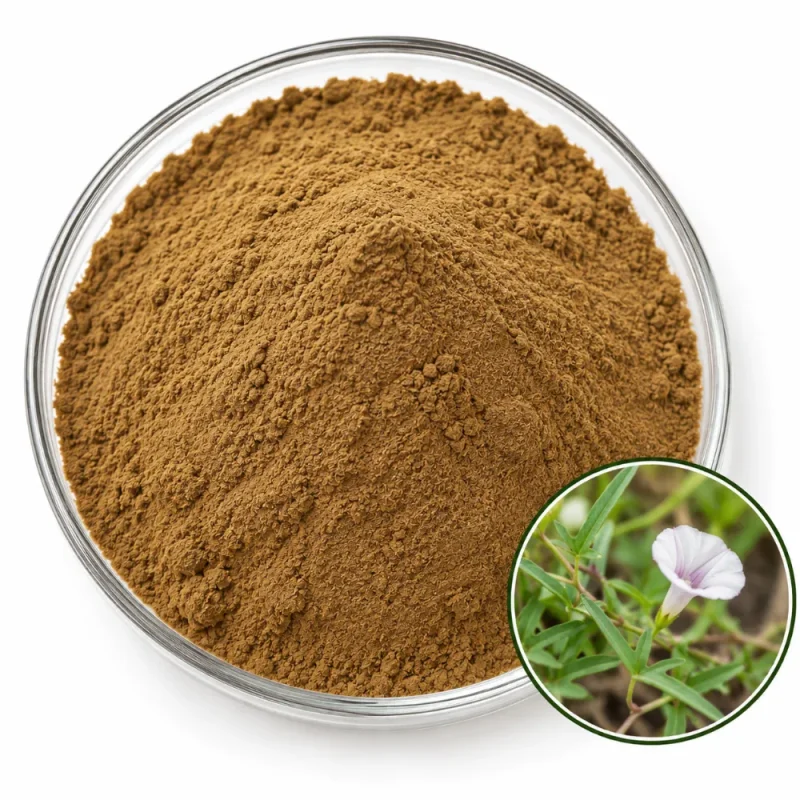
Shankhpushpi Extract 2.5% Bitters

Shankhpushpi extract is prepared from the aerial parts of Convolvulus pluricaulis Wall. ex Choisy, a small creeping herb of the family Convolvulaceae that grows across the Indian subcontinent. Ethanol extraction concentrates the bitter fraction of the herb, and the concentrate is dried to a light brown powder.

The extract is offered as a single grade of 2.5% bitters. The powder is 80 mesh and slightly soluble in water. It suits capsules, tablets, herbal blends and dissolved-and-suspended formats where a shankhpushpi extract with a stated bitters figure is specified.

Shankhpushpi Bitters Standardization & Grades

Bitters are not one chemical class. The term groups the compounds that give a plant extract its bitter taste, and in a herb such as this one it covers alkaloids, glycosides and phenolic constituents that are bitter to the palate. Shankhpushpi extract is standardized to a bitters figure because the taste is a recognized quality marker of the herb in traditional practice, and because it gives the formulator a single number for calculating the inclusion rate.

The botanical entity is Convolvulus pluricaulis, and the part is the aerial portion of the plant, with leaves, stems and flowers. The name shankhpushpi is applied in different regions to several unrelated plants, among them Evolvulus alsinoides, Clitoria ternatea and Canscora decussata. The botanical name on the specification is what fixes the identity. The same herb is supplied as a 10:1 ratio extract with no marker figure, Shankhpushpi Extract Powder, and as the milled herb, Shankhpushpi Powder.

This is a single grade, so there is no grade table. The 2.5% powder is the form to use when the formula requires a numerical bitters figure, and inclusion rates are calculated from it. The shankhpushpi extract is made from herb that has been cleaned of roots and foreign plant matter, extracted, filtered and concentrated, so the powder is several times richer in the bitter fraction than the dried herb.

Shankhpushpi Bitters Analysis & Purity Risks

A bitters percentage is defined by a measurement route, and several routes exist. A bitter fraction can be isolated by partition and weighed, read by a color reaction against a reference compound, or estimated from the HPLC peaks of the characteristic bitter constituents. These routes count different things. A result is comparable only with another result obtained by the same route, and a bitters figure cannot be converted into a total alkaloid or total phenolic figure.

Since the figure is defined by its route, identity is checked in parallel. An HPLC fingerprint of the herb shows its phenolic acids and flavonoids, and thin-layer chromatography against an authentic reference shows the alkaloid group, with convolvine as the best-known constituent of the genus. A sensory check of the bitterness against a retained lot is a routine control.

Purity risks follow from the material class. Because several plants are sold as shankhpushpi, a lot is verified against the botanical name by microscopy and fingerprint. The aerial parts are the defined material, and root or woody stem dilutes the bitter fraction. The herb is typically collected from wild populations as well as from cultivation, so soil and dust carry-over is checked by ash and heavy metals as part of the standard lot review.

Harvest timing matters. Plants collected while flowering carry more bitter constituents than plants gathered after seed set, and an extract made from late material is plainer in taste and lighter in color.

Typical Specifications

Specification ItemProduct Information
Latin NameConvolvulus pluricaulis
Plant PartLeaf & Herb
ProcessingEthanol Extraction
Compound ClassPolyphenols
Common NameShankhpushpi
Ingredient TypeStandardized Extract
Marker Compound(s)Bitters
Primary Grade2.5% Bitters
AppearanceLight Brown powder
Solubility / DispersibilitySlightly Soluble in Water
Quality Parameters
Moisture (LOD)≤5.0%
Total Ash≤5.0%
Particle Size80 mesh
Heavy MetalsLead ≤2 ppm · Arsenic ≤1 ppm · Cadmium ≤1 ppm · Mercury ≤0.1 ppm
MicrobiologyTPC ≤1,000 cfu/g · Yeast & Mold ≤100 cfu/g · E. coli Negative · Salmonella Negative/25 g
Shelf Life24 months in unopened original packaging, cool and dry storage

Applications by Grade

Capsule Fills at 2.5%

The 2.5% powder fills two-piece capsules at moderate fill weight. It is hygroscopic and mildly sticky once it has taken up humidity, so a dry filling room and a flow agent keep the hopper from bridging, and a check weight at the start of each run confirms the fill.

Tablet Blends with Herbal Extracts

Tablets of the 2.5% powder need a dry binder and a lubricant. The bitter taste is strong, so a film coat both masks the taste on the tongue and limits moisture pickup. Hardness is rechecked after storage because herbal extracts soften in humid rooms.

Herbal Powder Premixes

Premixes carry the 2.5% shankhpushpi powder with other herb extracts in a bulking carrier. Sift it with the carrier first and mix in two steps, because the small share of a sticky extract spreads unevenly if it is added in a single charge to a large batch.

Tea-Style Granules

Granules for hot water take the 2.5% powder as a dissolved-and-suspended ingredient. Sweeteners and warm spices such as cardamom or ginger blend with the herbal note, and a faint haze in the cup is normal given the slight solubility.

Syrup and Liquid Concentrates

Syrup bases carry the 2.5% powder dispersed in a thick, sugar-rich liquid. The slight solubility means that part of the powder stays suspended, so the bottle label calls for shaking, and the syrup is checked for settling over shelf life.

Soft-Chew Bases

Soft chews take the 2.5% powder where the bitter edge is covered by a strong flavor such as citrus or mango. Add it after the main cook, because long heating darkens the color and raises the bitterness, and disperse it in part of the syrup first.

Technical & Quality Considerations

Shankhpushpi extract is a light brown powder with a mild herbal scent and a pronounced bitter taste. It is slightly soluble in water, so a solution turns hazy brown, with the more polar constituents dissolved and the remaining fraction in suspension. Wetting agents, milling and a viscous carrier improve dispersion in aqueous bases, and a pre-wetted slurry added to the batch avoids floating lumps.

The bitter principles are mostly stable at moderate heat, but prolonged heating at low pH can change the taste profile. Phenolic constituents bind iron, so the powder darkens on contact with carbon steel, and stainless equipment with low-iron fillers is preferred. The powder takes up moisture from the air and cakes in humid storage, which also intensifies the bitter smell.

Sealed liners with desiccant and cool storage keep the extract free flowing. Compare each lot with a retained sample for color, bitterness and odor, since the tone moves between tan and greenish brown with the share of leaf in the harvested herb. A change of filling lot on the line also calls for a new check weight.

Packaging & Commercial Supply

Essencefield supports product evaluation, formulation trials, commercial orders, and ongoing ingredient supply. Packaging, storage, and shipping arrangements are determined by product characteristics, order quantity, stability requirements, and destination-market needs.

Supply ItemGeneral Information
SampleAvailable upon request for formulation, testing, and supplier evaluation
Order Quantities100 g · 1 kg · 5 kg · 25 kg · 100 kg · 500 kg · Bulk
Sample Lead TimeTypically 5–7 days after sample confirmation
Production Lead TimeTypically 15–30 days after order and specification confirmation
PackagingSuitable protective inner packaging with bags, cartons, drums, or other appropriate outer packaging
StorageStore in tightly sealed, suitable protective packaging in a cool, dry environment. Protect from moisture, heat, and direct sunlight. Specific storage conditions follow the approved product specification.
DocumentationCOA · Product Specification · TDS · SDS · Applicable declarations (as applicable)

Final order quantities, lead times, packaging, documentation, and shipping arrangements are confirmed according to the selected product and commercial requirements.

Request Ingredient Specifications & Quote

Share your target specification, application, quantity, and documentation needs. We’ll help confirm suitable options, samples, and commercial supply details.