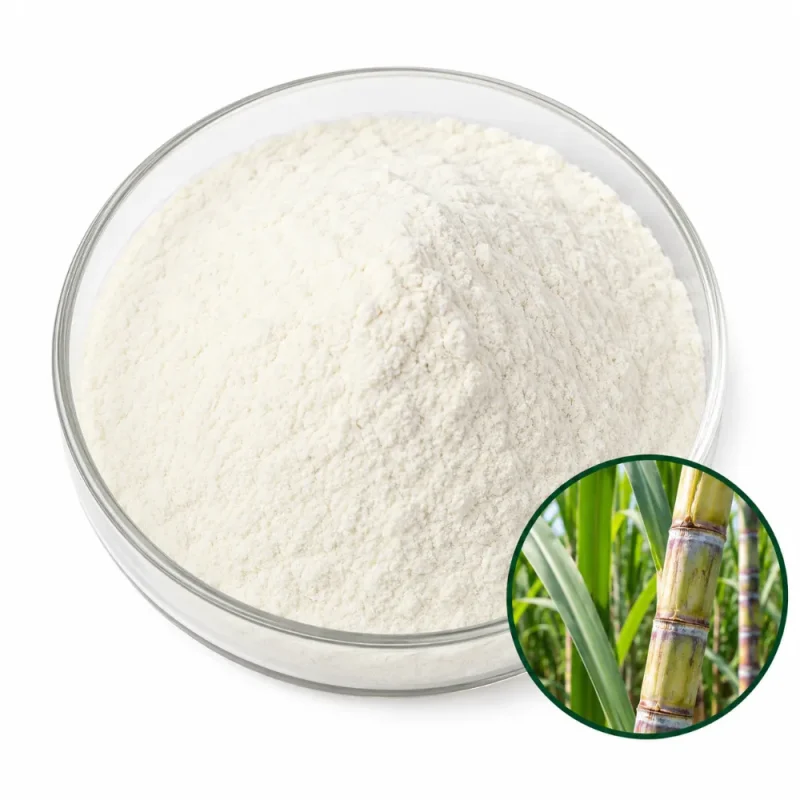
Sugar Cane Wax Extract 60–90% Octacosanol

Sugar cane wax extract is prepared from the wax of the sugar cane stem, Saccharum officinarum L., a tall grass of the family Poaceae. The crude wax is recovered from the rind and press residue, refined with ethanol, and dried to a light yellow powder rich in long-chain fatty alcohols.

Octacosanol is measured by gas chromatography, with a primary grade of 90% and a lower grade of 60%. The powder is 80 mesh and insoluble in water. The 90% grade suits capsules and softgel suspensions, while the 60% grade suits oil-phase systems and blends.

Octacosanol Standardization & Grades

Octacosanol is a straight-chain saturated fatty alcohol with 28 carbons, and it is the principal constituent of the alcohol fraction of sugar cane wax. The wax also holds triacontanol, hexacosanol and other long-chain alcohols, along with wax esters, aldehydes, sterols and fatty acids. Raw cane wax contains only a small share of free alcohols, and the rest is esterified, so a high-strength octacosanol powder needs saponification and fractionation of the crude wax.

The botanical entity is Saccharum officinarum L., and the material is the epicuticular wax of the stem. Sugar cane wax extract is standardized to octacosanol because the single compound is the quality marker, and a gas chromatography result gives a transparent figure. A different, related product is Policosanol, which is defined as the mixture of long-chain alcohols from C24 to C34 and reports its total. The pure compound is also supplied as Octacosanol.

GradeAssay & MethodWhere It Fits
60% OctacosanolGCOil-phase systems, blends
90% OctacosanolGCCapsules and softgel suspensions

The 90% grade carries half as much again as the 60% grade per gram, so a capsule or softgel reaches its target with a smaller fill. The 60% grade carries more of the accompanying long-chain alcohols and sterols, and its lower melting behavior makes it easier to blend into warm oil phases. Both are read on the same GC basis.

Octacosanol Analysis & Purity Risks

Gas chromatography separates the long-chain alcohols by chain length and reads each as a separate peak. The alcohols are not volatile enough for direct injection at the quantities involved, so the sample is first converted to a trimethylsilyl derivative, and an internal standard is added. The figure belongs to one compound and not to a class, and it is reported on a dry basis.

The key analytical point is the difference between octacosanol and policosanol. A policosanol assay adds up all the long-chain alcohols, while an octacosanol assay counts only the C28 peak. A product described as 90% policosanol can therefore carry a much lower octacosanol share, and the two figures must not be compared. For this product the figure is octacosanol alone.

The chromatographic profile gives identity. The ratio of C28 to the neighboring C26, C30 and C32 alcohols is characteristic of sugar cane wax and separates it from alcohols derived from rice bran wax, beeswax or synthetic sources, whose chain-length patterns are different.

Purity risks follow from the material class. Crude wax is a mixture of esters, aldehydes, resins and pigments, and incomplete refining leaves color, odor and a lower assay. The wax melts at a relatively high temperature, so a mislabeled low-melting lot suggests contamination with softer fats. Residual solvent is controlled in production, and the finished powder is dry and nearly odorless.

A further point concerns color and odor. Fully refined cane wax alcohols are nearly white and odorless, while lightly refined material carries the green-yellow tint and the faint grassy scent of the rind. The appearance of the powder is therefore a quick visual guide to refining depth, and sugar cane wax extract at the 60% grade is expected to be slightly more yellow than the 90% grade.

Typical Specifications

Specification ItemProduct Information
Latin NameSaccharum officinarum
Plant PartBark & Stem
ProcessingEthanol Extraction
Compound ClassPhytosterols
Common NameSugar Cane Wax Extract, Cane Wax Octacosanol
Ingredient TypeStandardized Extract
Marker Compound(s)Octacosanol
Primary Grade90% Octacosanol (GC)
Available Grades60% · 90% Octacosanol (GC)
AppearanceLight Yellow powder
Solubility / DispersibilityInsoluble in Water
Quality Parameters
Moisture (LOD)≤5.0%
Total Ash≤5.0%
Particle Size80 mesh
Heavy MetalsLead ≤2 ppm · Arsenic ≤1 ppm · Cadmium ≤1 ppm · Mercury ≤0.1 ppm
MicrobiologyTPC ≤1,000 cfu/g · Yeast & Mold ≤100 cfu/g · E. coli Negative · Salmonella Negative/25 g
Shelf Life24 months in unopened original packaging, cool and dry storage

Applications by Grade

90% Grade for Capsule Fills

The 90% grade reaches its octacosanol target in a small capsule fill. The waxy powder is slightly static and can smear on warm equipment, so a cool filling room and a flow agent keep the hopper from bridging and the fill weight steady.

60% Grade in Oil-Phase Systems

Oil-based liquids and drops use the 60% grade melted into warm oil. The octacosanol does not stay dissolved on cooling, so the system is designed as a fine suspension, with a suspending agent and a slow cooling profile to avoid large crystals.

90% Grade for Softgel Suspensions

The 90% grade is milled into a vegetable oil phase for softgel fills. Particle size and viscosity are checked before encapsulation, because the dense waxy particles settle quickly and a drift in dose appears from the start to the end of the batch.

60% Grade in Tablet Blends

Tablets of the 60% grade need a hydrophilic binder and a wetting disintegrant, because the powder is hydrophobic and resists water. A film coat reduces dusting and hides the pale yellow core, and disintegration is rechecked after storage.

90% Grade for Powder Premixes

Premixes carry the 90% grade in a larger dry blend. The waxy particles clump when warm, so the blend is mixed in a cool room with part of the carrier first, and the finished premix is sieved before filling.

60% Grade for Bar and Chew Bases

Chewable bases and bars take the 60% grade in the fat phase, where it melts and spreads. The wax raises the melting point of the fat blend slightly, so the texture is checked after storage at warm and cool temperatures.

Technical & Quality Considerations

Sugar cane wax extract is a light yellow to cream powder, nearly odorless, with a waxy feel. It is insoluble in water, and an aqueous system shows a fine floating suspension. Wetting agents and emulsifiers improve dispersion, and an oil pre-dispersion added to the batch under high shear gives a more uniform result. The wax dissolves in hot oils and in non-polar solvents, and it re-solidifies on cooling.

Long-chain alcohols are chemically stable. They resist oxidation far better than unsaturated lipids, and the powder keeps well in sealed liners. The melting range of the powder, which is well above room temperature, means that the particles soften at warehouse temperatures that exceed that range. In a hot store the powder fuses into a hard cake, so cool storage and shipping are needed.

Sieving restores flow after mild caking, but a lot that has fused repeatedly is reviewed. Compare each lot with a retained sample for color, which moves between white and pale yellow with the refining depth, and run a new check weight when the line changes between the two grades, since they differ in bulk and in wax content.

Packaging & Commercial Supply

Essencefield supports product evaluation, formulation trials, commercial orders, and ongoing ingredient supply. Packaging, storage, and shipping arrangements are determined by product characteristics, order quantity, stability requirements, and destination-market needs.

Supply ItemGeneral Information
SampleAvailable upon request for formulation, testing, and supplier evaluation
Order Quantities100 g · 1 kg · 5 kg · 25 kg · 100 kg · 500 kg · Bulk
Sample Lead TimeTypically 5–7 days after sample confirmation
Production Lead TimeTypically 15–30 days after order and specification confirmation
PackagingSuitable protective inner packaging with bags, cartons, drums, or other appropriate outer packaging
StorageStore in tightly sealed, suitable protective packaging in a cool, dry environment. Protect from moisture, heat, and direct sunlight. Specific storage conditions follow the approved product specification.
DocumentationCOA · Product Specification · TDS · SDS · Applicable declarations (as applicable)

Final order quantities, lead times, packaging, documentation, and shipping arrangements are confirmed according to the selected product and commercial requirements.

Request Ingredient Specifications & Quote

Share your target specification, application, quantity, and documentation needs. We’ll help confirm suitable options, samples, and commercial supply details.