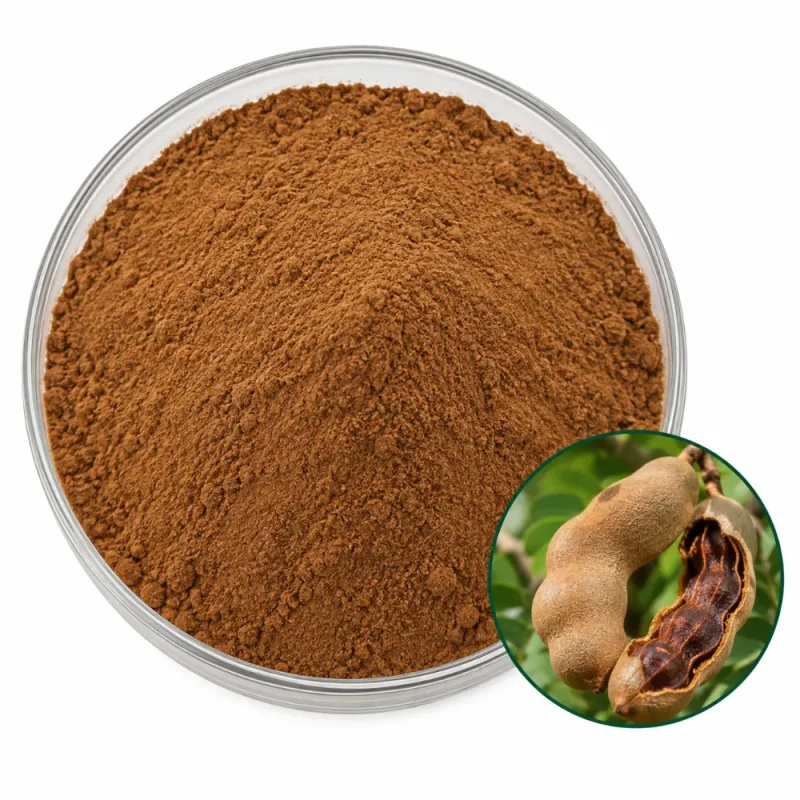
Tamarind Extract 10% Tartaric Acid

Water extraction of the fruit pulp of Tamarindus indica L., the tamarind tree of the family Fabaceae, gives this tamarind extract, which is standardized to its tartaric acid. The pulp extract is filtered and concentrated, and the concentrate is dried to a light brown powder that dissolves readily in water.

The extract is offered as a single grade of 10% tartaric acid, measured by HPLC. The powder is 80 mesh. It suits sour drink powders, confectionery coatings, capsules and tablets where a tamarind-derived organic acid figure is specified.

Tamarind Tartaric Acid Standardization & Grades

Tartaric acid is a dihydroxy dicarboxylic acid, and tamarind pulp is one of the few fruit sources in which it is the dominant acid. Most fruits are led by citric or malic acid, and grape is the other well-known tartaric fruit. The pulp of tamarind also holds reducing sugars, pectin, polyphenols and a small share of malic acid. The extract is standardized to tartaric acid because it is the acid that gives tamarind its sharp, clean sourness, and because HPLC can measure it directly.

The botanical entity is Tamarindus indica L., and the part is the fruit pulp. The seed kernel is a different material, tamarind kernel powder, which is a thickener made from the seed endosperm and not a pulp extract. The same pulp is supplied as a 10:1 ratio extract with no marker figure, Tamarind Extract Powder, and as the dried pulp, Tamarind Powder.

This is a single grade, so there is no grade table. The 10% powder is the one the specification is written around, and inclusion rates are calculated from the tartaric acid figure. The pulp is soaked, extracted with water, strained to remove fiber and seeds, concentrated and dried. The water extract keeps the acids and sugars of the pulp, and the powder is a sour, sticky material, not a bland one.

Tamarind Tartaric Acid Analysis & Purity Risks

HPLC separates tartaric acid from malic, citric and other organic acids and from the sugars of the pulp, and it reads the acid as a single peak against a reference standard. The method is run on an ion-exclusion or reversed-phase column with UV detection at a low wavelength, because organic acids absorb weakly. The result is a specific compound, not a total acidity, and it is stated on a dry basis.

A titratable acidity figure behaves differently. Titration counts every acid in the sample, so it reads higher than the tartaric acid by HPLC, and the two cannot be converted into each other. The HPLC figure also differs from the free acid plus its salts, since tamarind pulp carries tartaric acid partly as potassium hydrogen tartrate. The HPLC basis for this product is the acid, and the method is chosen to include or exclude the salt consistently.

Purity risks follow from the material class. Added tartaric acid, a cheap synthetic or winemaking byproduct, can be used to raise the figure of a weak pulp extract. The pulp fingerprint, with the pattern of malic acid, sugars and polyphenols that accompany natural tartaric acid, is therefore read alongside. The pulp is the defined part, and extracts of kernel or seed coat have a very different composition.

Pulp lots differ by region and harvest. Sweet and sour tamarind types exist, and the extract made from a sweet type carries less acid per gram of pulp.

A last point concerns sugars. Tamarind pulp is about half sugar by weight, and a water extract keeps a large share of them, so the powder is sticky and hygroscopic. A tamarind extract that has been treated to remove part of the sugar is paler and less sticky, and the tartaric acid figure of the finished powder is higher for the same pulp.

Typical Specifications

Specification ItemProduct Information
Latin NameTamarindus indica
Plant PartFruit & Berry
ProcessingWater Extraction
Common NameTamarind, Tamarind Pulp Extract
Ingredient TypeStandardized Extract
Marker Compound(s)Tartaric acid
Primary Grade10% Tartaric Acid (HPLC)
AppearanceLight Brown powder
Solubility / DispersibilityWater Soluble
Quality Parameters
Moisture (LOD)≤5.0%
Total Ash≤5.0%
Particle Size80 mesh
Heavy MetalsLead ≤2 ppm · Arsenic ≤1 ppm · Cadmium ≤1 ppm · Mercury ≤0.1 ppm
MicrobiologyTPC ≤1,000 cfu/g · Yeast & Mold ≤100 cfu/g · E. coli Negative · Salmonella Negative/25 g
Shelf Life24 months in unopened original packaging, cool and dry storage

Applications by Grade

Sour Drink Powders

The 10% tamarind extract dissolves in cold water to a clear brown, sharply sour drink. It works with cola, tea, spice and tropical flavor systems, and it replaces part of the citric acid in a mix, so the acid balance is recalculated rather than added on top.

Confectionery Sanding and Coatings

Sour sanding for gummies and hard candy takes the 10% powder blended with sugar. The powder is hygroscopic and sticky, so the blend is kept dry, and the sanded product is packed with a moisture barrier to prevent weeping.

Capsule Fills at 10%

Capsules take the 10% powder at moderate fill weight. The acidic, hygroscopic solid cakes easily, so a dry filling room, a flow agent and prompt sealing of the filled capsules prevent sticking and shell softening during the run.

Effervescent Tablets and Granules

Effervescent formats use the 10% powder as part of the acid system with a bicarbonate base. The tartaric acid partly replaces other acids, and the foaming rate and the taste are checked together in the final glass before the formula is released.

Tablet Blends

Tablets of the 10% powder need a dry binder and a lubricant. A film coat limits moisture pickup, which otherwise softens the acid-rich compact, and hardness is rechecked after storage. Stainless tooling is preferred, because acid attacks plain steel.

Stick-Pack Seasoning Mixes

Stick-pack seasoning and sour-flavor mixes carry the 10% powder with a bulking carrier. The brown color and sour note suit chili-lime and spice blends, and the pack interior is inspected for caking at the seal.

Technical & Quality Considerations

Tamarind extract is a light brown powder with a fruity, sour, slightly caramel-like scent. It is water soluble, and the solution is clear brown with a low pH. Tartaric acid is stable to heat in solution, while the sugars of the pulp darken in a Maillard-type reaction during long hot-holding, so heat-sensitive formulas add the extract late.

The powder is strongly hygroscopic. In humid air it turns sticky, then cakes into a hard mass. Sealed, moisture-barrier liners with desiccant are used, drums are reopened for as short a time as possible, and cool storage slows the browning. Carbon steel and aluminum are attacked by the acidity, so stainless contact surfaces are used.

Tartaric acid also reacts with calcium and potassium, and a fine crystalline precipitate forms in some mineral-rich waters and bases. The intended water and base are therefore tested for clarity. Compare each lot with a retained sample for color and sourness, and run a new check weight whenever the filling line is restarted.

Packaging & Commercial Supply

Essencefield supports product evaluation, formulation trials, commercial orders, and ongoing ingredient supply. Packaging, storage, and shipping arrangements are determined by product characteristics, order quantity, stability requirements, and destination-market needs.

Supply ItemGeneral Information
SampleAvailable upon request for formulation, testing, and supplier evaluation
Order Quantities100 g · 1 kg · 5 kg · 25 kg · 100 kg · 500 kg · Bulk
Sample Lead TimeTypically 5–7 days after sample confirmation
Production Lead TimeTypically 15–30 days after order and specification confirmation
PackagingSuitable protective inner packaging with bags, cartons, drums, or other appropriate outer packaging
StorageStore in tightly sealed, suitable protective packaging in a cool, dry environment. Protect from moisture, heat, and direct sunlight. Specific storage conditions follow the approved product specification.
DocumentationCOA · Product Specification · TDS · SDS · Applicable declarations (as applicable)

Final order quantities, lead times, packaging, documentation, and shipping arrangements are confirmed according to the selected product and commercial requirements.

Request Ingredient Specifications & Quote

Share your target specification, application, quantity, and documentation needs. We’ll help confirm suitable options, samples, and commercial supply details.