
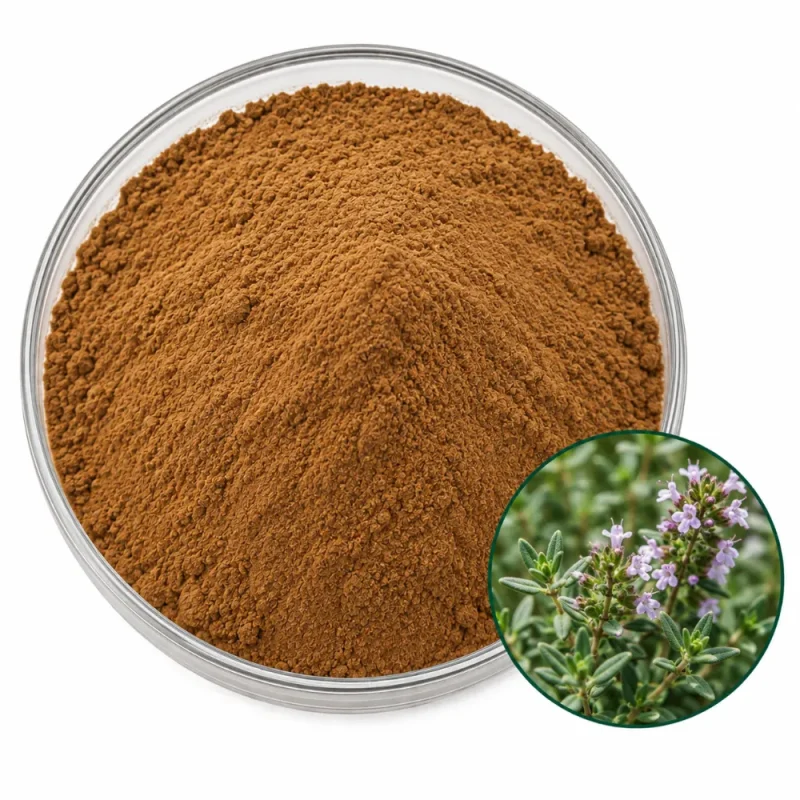
Rosmarinic Acid and Thymol Standardization & Grades
Rosmarinic acid and thymol are very different compounds that share one plant. Rosmarinic acid is a caffeic acid ester, polar and non-volatile, and it travels with the phenolic fraction of the leaf. Thymol is a monoterpene phenol, the main component of the essential oil of common thyme chemotypes, with carvacrol, p-cymene and gamma-terpinene as companions. The extract carries both markers because they describe two halves of the herb: its phenolic acids and its aromatic oil.
The botanical entity is Thymus vulgaris L., and the part is the aerial herb, with leaves and flowering tops. Wild thyme (Thymus serpyllum) and lemon thyme are other species with different oil compositions. The same herb is supplied as a 10:1 ratio extract with no marker figure, Thyme Extract Powder, and as the milled herb, Thyme Powder.
| Grade | Assay & Method | Where It Fits |
|---|---|---|
| 1% Rosmarinic Acid / Thymol | HPLC | Herbal blends, larger inclusion |
| 20% Rosmarinic Acid / Thymol | HPLC | Capsules and tablets, small fill |
The two markers are measured as separate HPLC peaks, and the figure on a certificate names the compound that it refers to. They are not added to each other. The 20% grade carries twenty times the marker load per gram of the 1% grade, so a capsule reaches its target with a small fill. The 1% grade keeps more of the leaf’s character and fits blends in which the herbal aroma is welcome.
The extract is made from dried herb that is rubbed free of stems, extracted and concentrated. Thymol is volatile, so drying and concentration conditions are kept gentle, and the finished powder keeps a smaller aromatic fraction than the herb it came from.


