
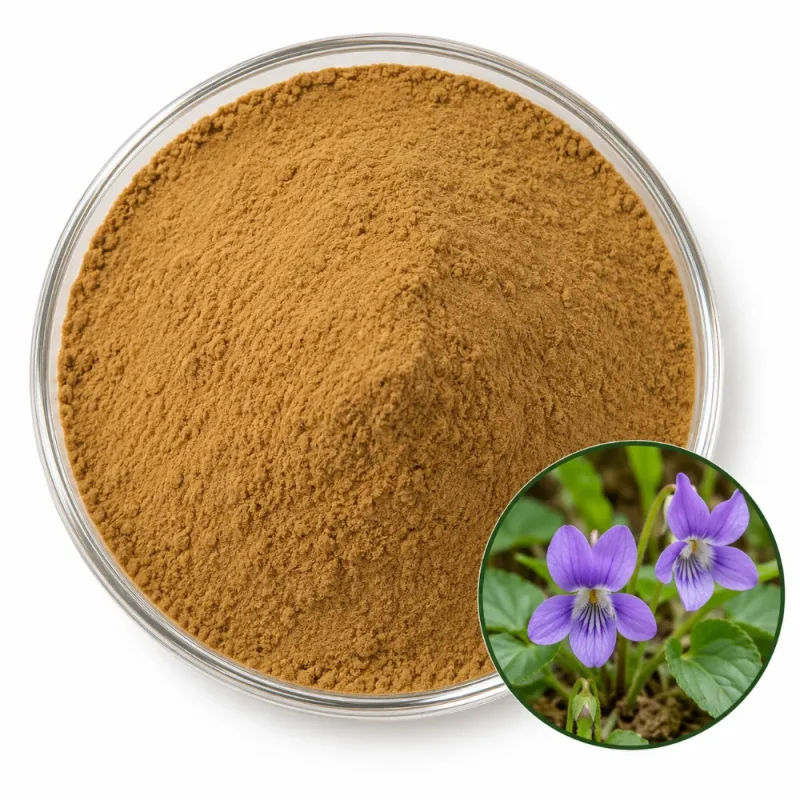
Viola Flavonoid Standardization & Grades
Flavonoids are phenolic compounds built on a diphenylpropane skeleton. The herb of Viola yedoensis is rich in flavone C-glycosides, among them violanthin and isoorientin, which have the sugar attached directly to carbon and not through oxygen. It also carries coumarins such as aesculetin and dimeric coumarins, terpenoids and phenolic acids. More than a hundred compounds have been isolated from the plant. Viola yedoensis extract is standardized to total flavonoids because the class is prominent, stable and measurable by a routine UV method.
The botanical entity is Viola yedoensis Makino, and the part is the aerial herb. Zi hua di ding is a name shared by several unrelated small herbs in Chinese practice, and Viola yedoensis is the one named on the specification. The same herb is supplied as a 10:1 ratio extract with no marker figure, Viola Yedoensis Extract Powder.
| Grade | Assay & Method | Where It Fits |
|---|---|---|
| 5% Total Flavonoids | UV | Blends, larger inclusion |
| 20% Total Flavonoids | UV | Capsules and tablets, small fill |
The 20% grade carries four times the flavonoid load per gram, so a capsule or a tablet reaches its target with a small charge. The 5% grade is bulkier and keeps more of the herb’s own character. Both are read on the same UV basis, so scaling between them is a matter of weight.
The extract is made from dried herb that is cleaned of roots and weeds, cut and extracted. The concentrate is filtered and dried, and the process leaves behind the cellulose and chlorophyll-rich fiber that make up most of the herb mass.


