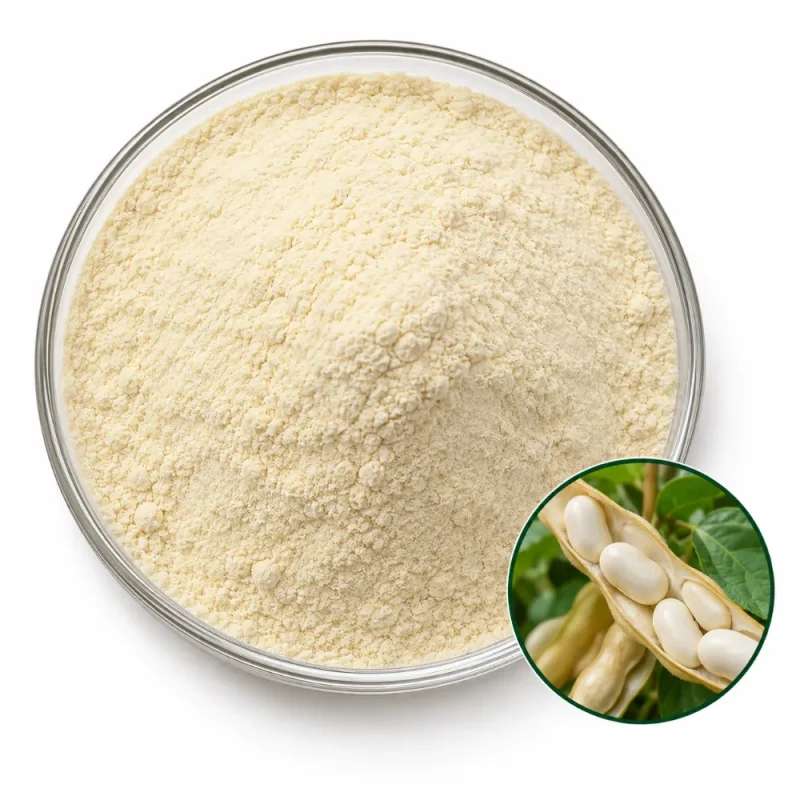
White Kidney Bean Extract 3,000–20,000 units/g

Water extraction of the seed of Phaseolus vulgaris L., the common bean of the family Fabaceae, gives this white kidney bean extract, which is taken from white-seeded varieties. The extract is standardized by its alpha-amylase inhibitory activity and dried to a light yellow powder that dissolves in water.

Activity is measured by an enzymatic assay of alpha-amylase inhibition, with a primary grade of 20,000 units per gram and a lower grade of 3,000 units per gram. The powder is 80 mesh. The higher grade suits capsules and tablets, while the lower grade suits dry blends.

Alpha-Amylase Inhibitor Standardization & Grades

The seed of the common bean stores a family of proteins that inhibit the starch-digesting enzyme alpha-amylase. The best-known is phaseolamin, a glycoprotein of about 50 kDa that binds the enzyme and blocks its active site. The extract is standardized by the activity of this protein, because the protein is not a small molecule with a fixed mass fraction, and activity is the property that identifies the material. A mass percentage would not describe it.

The botanical entity is Phaseolus vulgaris L., and the part is the seed. White, red, kidney and black beans all belong to the same species, and they differ in seed coat. White-seeded types are chosen here because the seed coat holds fewer pigments and the extract is paler. The same species is supplied as a 10:1 ratio extract with no marker figure, White Kidney Bean Extract Powder, and as milled bean, Kidney Bean Powder and Black Bean Powder.

GradeAssay & MethodWhere It Fits
3,000 units/gEnzymatic (alpha-amylase inhibition)Dry blends, larger inclusion
20,000 units/gEnzymatic (alpha-amylase inhibition)Capsules and tablets, small fill

The 20,000 units per gram grade carries more than six times the activity of the 3,000 grade, so a capsule or tablet reaches its target with a small charge. The lower grade is bulkier and fits blends where the extract is one component among several. Both grades are read by the same enzymatic method, so scaling is a matter of weight.

The extract is made by soaking and extracting the ground seed with water, separating the protein-rich fraction, and drying it at moderate temperature. Unlike a small molecule, an inhibitor protein loses its activity when it is heated hard, so the drying conditions define the final unit value.

Alpha-Amylase Inhibitor Analysis & Purity Risks

The assay is enzymatic. A measured amount of the extract is incubated with a known amount of alpha-amylase, usually of porcine pancreatic origin, and a starch substrate is then added. The remaining enzyme activity is read from the amount of reducing sugar formed or from the color of a starch-iodine complex, and the loss of activity relative to a control is converted to units. The definition of one unit varies between laboratories, depending on the enzyme source, the substrate, the temperature and the pH.

Because the unit is method-defined, a value in units per gram can be compared only with another value on the same definition. It cannot be converted into a mass percentage or into an HPLC figure, and it cannot be compared with a different laboratory’s units. For that reason the method is fixed and the enzyme lot is controlled.

Identity relies on more than activity. Gel electrophoresis of the extract shows the characteristic bands of the bean inhibitor subunits, and protein content gives context. Other legumes contain amylase inhibitors too, and wheat has its own, so the bean-specific band pattern separates the origin.

Purity risks follow from the material class. Raw beans also contain lectins, which must be inactivated, and the process is designed to keep the inhibitor active while the lectin is removed or reduced. The seed is the defined part, and pods and leaves are not accepted. Activity falls with heat, extreme pH and storage in humid air.

Typical Specifications

Specification ItemProduct Information
Latin NamePhaseolus vulgaris
Plant PartSeed & Grain
ProcessingWater Extraction
Common NameWhite Kidney Bean
Ingredient TypeStandardized Extract
Marker Compound(s)Alpha-amylase inhibitor protein (phaseolamin)
Primary Grade20,000 units/g Alpha-Amylase Inhibition (enzymatic)
Available Grades3,000 · 20,000 units/g Alpha-Amylase Inhibition (enzymatic)
AppearanceLight Yellow powder
Solubility / DispersibilityWater Soluble
Quality Parameters
Moisture (LOD)≤5.0%
Total Ash≤5.0%
Particle Size80 mesh
Heavy MetalsLead ≤2 ppm · Arsenic ≤1 ppm · Cadmium ≤1 ppm · Mercury ≤0.1 ppm
MicrobiologyTPC ≤1,000 cfu/g · Yeast & Mold ≤100 cfu/g · E. coli Negative · Salmonella Negative/25 g
Shelf Life24 months in unopened original packaging, cool and dry storage

Applications by Grade

20,000 Units Grade for Capsule Fills

The 20,000 units per gram grade of white kidney bean extract reaches its activity target in a small capsule fill. The pale protein-rich powder is hygroscopic and mildly static, so a dry filling room and a flow agent prevent bridging, and a check weight at the start of each run confirms the fill.

3,000 Units Grade in Dry Blends

The 3,000 units grade of white kidney bean extract blends with other bean and seed powders in dry mixes. Mix it with part of the carrier before the main charge, and keep the blend away from heat sources, since a hot mixer chamber can lower the activity of a protein.

20,000 Units Grade in Tablet Blends

Tablets of white kidney bean extract at the 20,000 units grade need a dry binder and a lubricant. Compression heat is limited by running the press at a moderate speed, and a film coat protects the protein-rich tablet from moisture, which also causes loss of activity.

3,000 Units Grade for Stick-Pack Mixes

Stick-pack mixes of white kidney bean extract use the 3,000 units grade at higher gram weight with a bulking carrier. The protein dissolves in cool water, and a hot drink is avoided because heat denatures it, so the label directs the user to stir into a cool or room-temperature liquid.

20,000 Units Grade for Granulated Formats

Granulated formats take the 20,000 units grade through dry compaction, which avoids the heat and water that wet granulation needs. The granule is packed in a moisture barrier, because humid storage lowers the activity of the stored protein.

3,000 Units Grade for Cool-Process Bars

Cold-pressed bars take the 3,000 units grade in the dry fraction before the binder is added. The process avoids baking, because oven temperatures inactivate the protein, and the pale yellow color is hidden by cocoa or nut bases.

Technical & Quality Considerations

White kidney bean extract is a light yellow powder with a mild, beany scent. White kidney bean extract is sold by activity, not by mass percentage. It is water soluble, and the solution is slightly hazy, because part of the protein fraction is in a colloidal state. The activity of the inhibitor depends on its folded structure. Heat above moderate temperatures, strong acid and strong alkali unfold the protein, and the units are lost in a way that cannot be recovered.

Proteins also react with reducing sugars during heating in a Maillard-type reaction, which browns the color and lowers activity. A formula that contains syrup or honey and is heat-treated needs a before-and-after activity test. Protein-binding polyphenols from other ingredients, such as tea or berry extracts, can form complexes with the inhibitor, so a compatibility trial is run with them.

The powder takes up moisture and cakes in humid storage. Keep it in sealed liners with desiccant, in cool conditions. Compare each lot with a retained sample for color and scent, and take a new check weight whenever the filling line changes between the two grades, because they differ greatly in bulk.

Packaging & Commercial Supply

Essencefield supports product evaluation, formulation trials, commercial orders, and ongoing ingredient supply. Packaging, storage, and shipping arrangements are determined by product characteristics, order quantity, stability requirements, and destination-market needs.

Supply ItemGeneral Information
SampleAvailable upon request for formulation, testing, and supplier evaluation
Order Quantities100 g · 1 kg · 5 kg · 25 kg · 100 kg · 500 kg · Bulk
Sample Lead TimeTypically 5–7 days after sample confirmation
Production Lead TimeTypically 15–30 days after order and specification confirmation
PackagingSuitable protective inner packaging with bags, cartons, drums, or other appropriate outer packaging
StorageStore in tightly sealed, suitable protective packaging in a cool, dry environment. Protect from moisture, heat, and direct sunlight. Specific storage conditions follow the approved product specification.
DocumentationCOA · Product Specification · TDS · SDS · Applicable declarations (as applicable)

Final order quantities, lead times, packaging, documentation, and shipping arrangements are confirmed according to the selected product and commercial requirements.

Request Ingredient Specifications & Quote

Share your target specification, application, quantity, and documentation needs. We’ll help confirm suitable options, samples, and commercial supply details.