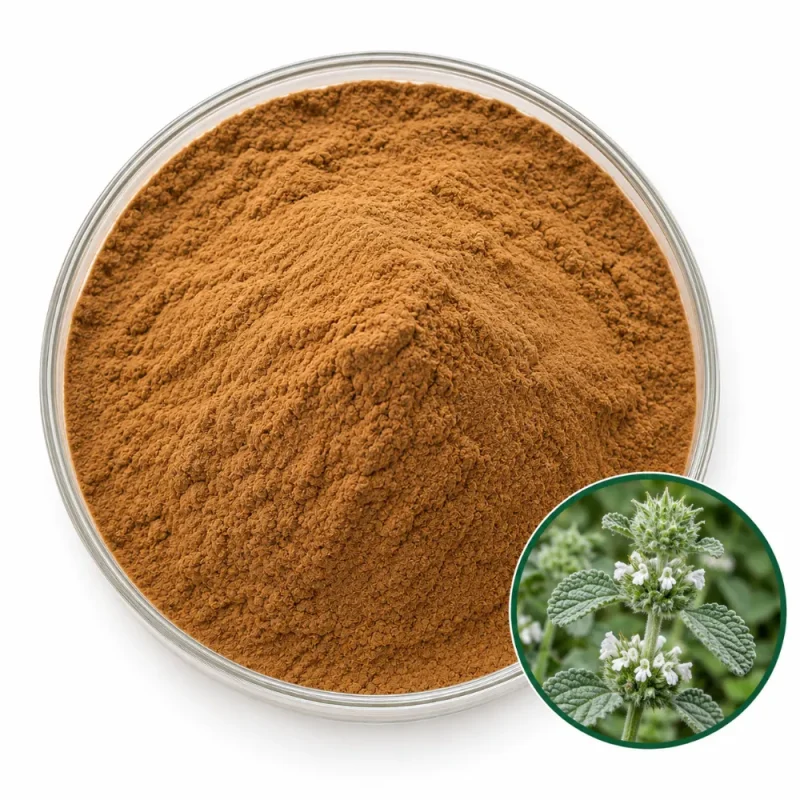
Horehound Extract Powder

Horehound extract is made from the aerial parts of Marrubium vulgare, the white horehound, meaning the leaves and flowering tops with the root excluded. Water extraction concentrates the soluble herb fraction, and the liquor is dried into a light brown powder that disperses in water.

The extract is supplied at a 10:1 ratio and milled to 80 mesh, with no marker percentage declared. It is a plain herb extract of the named species, and no powder, marker grade or pure compound of horehound is listed beside it.

Marrubium vulgare Identity & Plant Part

The botanical entity is Marrubium vulgare L., white horehound, a perennial of the Lamiaceae with woolly white stems, wrinkled gray-green leaves and whorled clusters of small white flowers. The part used is the aerial part, meaning leaf and flowering top. The root is not part of this ingredient. Black horehound, Ballota nigra, and the water horehound called bugleweed, Lycopus, are separate plants that share part of the name. Labdane diterpene lactones with a bitter taste, phenolic acids and flavonoids are the constituent families of horehound, named here without figures.

What 10:1 Means for Horehound

A 10:1 figure on a horehound extract states how concentrated the extract is against the herb. It is not a marrubiin level, although marrubiin is the best-known bitter principle of the plant and the reason for most searches. Marrubiin is thought to form from a precursor during drying and extraction, so measured levels depend on handling, and a plain ratio extract does not state one. A buyer who needs a marrubiin figure will not find it here. A buyer who names the species, the aerial part and the ratio can use this horehound extract as it is.

Typical Specifications

Specification ItemProduct Information
Latin NameMarrubium vulgare
Plant PartLeaf & Herb
ProcessingWater Extraction
Common NameWhite Horehound
Ingredient TypeRatio Extract
Extract Ratio10:1
AppearanceLight brown powder
Solubility / DispersibilityWater Dispersible
Quality Parameters
Moisture (LOD)≤5.0%
Total Ash≤5.0%
Particle Size80 mesh
Heavy MetalsLead ≤2 ppm · Arsenic ≤1 ppm · Cadmium ≤1 ppm · Mercury ≤0.1 ppm
MicrobiologyTPC ≤1,000 cfu/g · Yeast & Mold ≤100 cfu/g · E. coli Negative · Salmonella Negative/25 g
Shelf Life24 months in unopened original packaging, cool and dry storage

Application Areas

Herb Extract Capsules

Horehound extract goes into two-piece capsules as a light brown powder with a faint herbal note and a pronounced bitter taste. A flow aid in the premix keeps fine particles from bridging, and capsules spare the user the bitterness of the loose powder.

Candy-Style Lozenge Compressions

Horehound is an old candy flavor, and compressed lozenges with honey, anise or lemon flavors suit its bitter note. Granulate with isomalt first, because the fine powder takes up moisture and sticks to the punches. A sharp, clean candy-style bitterness is the expected result, not a defect.

Herbal Tea-Style Sachets

In tea-style mixes the extract gives a hazy, amber-brown liquid with a bitter herbal taste. It combines with peppermint, lemon balm or ginger blends that mask the bitterness, and a carrier keeps the small dose even in each sachet.

Chewable Gummy Bases

Gummies cover the bitterness with citrus, honey or herbal liqueur flavors, and the extract is added late in the cook to limit heat exposure. Test the taste after a week, since bitter notes become more noticeable as sweetness fades.

Dry Drink Mix Sticks

Sticks carry the extract with acid and sweetener in a dry mix, giving a repeatable dose. The woolly herb origin does not affect the extract, which is a fine, free-flowing powder when dry and stored in sealed liners.

Formulation Notes

Horehound extract is a light brown powder with a mild, musky, herbal aroma and a strong, lingering bitter taste. Stirred into water, the powder gives a hazy amber-brown liquid, and fine particles settle slowly on standing. The bitterness is the dominant sensory point and carries through any liquid blend.

Weigh the horehound extract in a dry room because the powder is hygroscopic and cakes once moisture is absorbed. Reseal the pack after each draw, and keep scoops dry. For capsule work, blend the powder with a free-flowing carrier, and in drinks stir it into the dry base before any liquid goes in.

Herb extracts of the mint family are prone to darkening in humid storage. Keep horehound extract away from heat, rotate older packs first, and use sealed liners, because a darker powder at the surface is the first visible sign that the open pack has taken up moisture.

Packaging & Commercial Supply

Essencefield supports product evaluation, formulation trials, commercial orders, and ongoing ingredient supply. Packaging, storage, and shipping arrangements are determined by product characteristics, order quantity, stability requirements, and destination-market needs.

Supply ItemGeneral Information
SampleAvailable upon request for formulation, testing, and supplier evaluation
Order Quantities100 g · 1 kg · 5 kg · 25 kg · 100 kg · 500 kg · Bulk
Sample Lead TimeTypically 5–7 days after sample confirmation
Production Lead TimeTypically 15–30 days after order and specification confirmation
PackagingSuitable protective inner packaging with bags, cartons, drums, or other appropriate outer packaging
StorageStore in tightly sealed, suitable protective packaging in a cool, dry environment. Protect from moisture, heat, and direct sunlight. Specific storage conditions follow the approved product specification.
DocumentationCOA · Product Specification · TDS · SDS · Applicable declarations (as applicable)

Final order quantities, lead times, packaging, documentation, and shipping arrangements are confirmed according to the selected product and commercial requirements.

Request Ingredient Specifications & Quote

Share your target specification, application, quantity, and documentation needs. We’ll help confirm suitable options, samples, and commercial supply details.