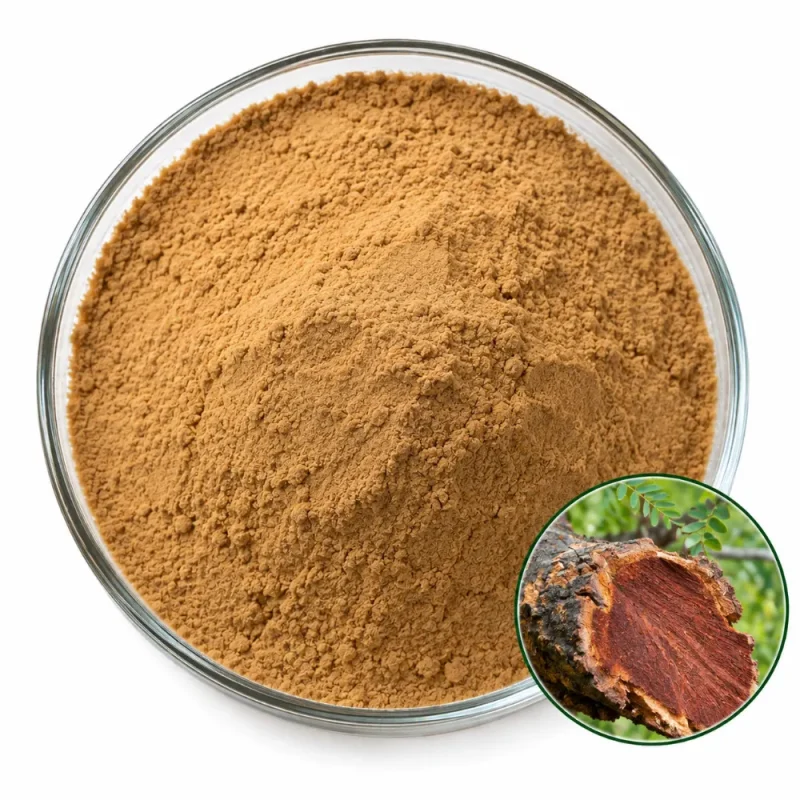
Acacia catechu Extract 10–50% Catechin

Black catechu, the dark heartwood extract of Acacia catechu, known in South Asia as khair or kattha, is the basis of this extract, which uses neither the gum nor the leaves of other Acacia trees. Ethanol extraction concentrates the flavan-3-ols of the heartwood, and the liquor is dried to a light brown powder.

The primary grade is 50% catechin by HPLC, with 10% as the lower end of the range. The powder is 80 mesh and slightly soluble in water. The 50% grade serves capsules and tablets with a small fill weight, while the 10% grade suits dry blends and tea-style mixes that keep more of the astringent tannin matrix.

Catechin Standardization & Grades

Catechin is a flavan-3-ol, the simple building block of condensed tannins, and it is the lead monomer of acacia catechu heartwood. The grade is defined by catechin because it is abundant, stable in the dry state and resolved cleanly by HPLC. The botanical entity is Acacia catechu, a name that taxonomic revisions have partly replaced with Senegalia catechu, and the part used is the heartwood, which the master data groups with bark and stem.

GradeAssay & MethodWhere It Fits
10% CatechinHPLCDry blends and tea-style mixes
50% CatechinHPLCCapsules and tablets with small fill

Grade choice follows dose, fill weight and astringency. The 50% grade holds five times the catechin load per gram of the 10% grade, so a capsule reaches its target in a smaller fill, and the powder is lighter in color and less tannic. The 10% grade retains more of the condensed tannins and epicatechin dimers and gives a stronger, drier astringency and a darker tone. The unstandardized sibling is the Acacia catechu Extract Powder, made from the same heartwood with no catechin figure.

The name acacia causes frequent confusion. Gum arabic comes from other Acacia trees and has no relation to the heartwood extract, and gambir, sometimes called pale catechu, is obtained from a different plant, Uncaria gambir. Buyers who compare catechu extract quotes should check the species, the part and the compound name, because a catechin figure from tea or gambir is a different ingredient.

A catechin percentage also needs a definition. Catechin exists as a pair of stereoisomers, catechin and epicatechin, and the figure may mean one of them or the sum. The percentage is therefore meaningful only when the compounds counted are named alongside it.

Catechin Analysis & Purity Risks

The marker is measured by HPLC, which separates catechin from epicatechin, the gallated catechins and the tannin oligomers on a reversed-phase column, identifies each peak by retention time and UV spectrum, and quantifies against a reference standard. A UV tannin or total polyphenol reading counts every phenolic compound, including the large tannin fraction, and is not comparable with the HPLC catechin figure.

The fingerprint of catechu heartwood shows catechin as the dominant peak, epicatechin next and a broad hump of condensed tannins that does not resolve into peaks. The size of that hump tells how tannic the lot is: the 50% grade shows a small hump and the 10% grade a large one. Catechin can epimerize under heat, which shifts some of it into other stereoisomers, so a lot processed at high temperature shows a changed isomer ratio.

Sample preparation uses acidified aqueous methanol, followed by filtration. Tannins bind to some filter materials and to proteins, so low results can reflect losses at the laboratory rather than a weak lot, and a spiked standard checks the loss.

Purity risks follow from the botany and trade. Catechu from Uncaria gambir is also traded as a catechin source, and the heartwood of other Acacia and Senegalia species can resemble it, so a catechin figure alone does not prove origin. A named species, the heartwood as the stated part and a tannin-hump fingerprint protect identity better than a percentage.

Typical Specifications

Specification ItemProduct Information
Latin NameAcacia catechu
Plant PartBark & Stem
ProcessingEthanol Extraction
Compound ClassCatechins, Flavonoids, Polyphenols
Common NameBlack Catechu, Khair, Cutch
Ingredient TypeStandardized Extract
Marker Compound(s)Catechin (flavan-3-ol of Acacia catechu heartwood)
Primary Grade50% Catechin (HPLC)
Available Grades10% · 50% Catechin (HPLC)
AppearanceLight Brown powder
Solubility / DispersibilitySlightly Soluble in Water
Quality Parameters
Moisture (LOD)≤5.0%
Total Ash≤5.0%
Particle Size80 mesh
Heavy MetalsLead ≤2 ppm · Arsenic ≤1 ppm · Cadmium ≤1 ppm · Mercury ≤0.1 ppm
MicrobiologyTPC ≤1,000 cfu/g · Yeast & Mold ≤100 cfu/g · E. coli Negative · Salmonella Negative/25 g
Shelf Life24 months in unopened original packaging, cool and dry storage

Applications by Grade

50% Grade for Compact Capsules

The 50% grade delivers a catechin target in a small capsule fill. The light brown powder is fine and a little hygroscopic, so a dry filling room and a flow agent help the hopper feed evenly, and capsule weights should be checked at the start of each run.

50% Grade in Tablet Blends

Tablets of the high grade need a dry binder and an absorbent, because the polyphenol powder takes up moisture and softens compacts. Run a compression trial on the full blend, check hardness after storage, and consider a film coat that limits moisture uptake.

10% Grade for Astringent Tea Blends

At 10% the extract is dosed by weight in herbal tea blends, where the tannins give a dry, puckering mouthfeel. Pair it with licorice or mint, which soften the astringency, and keep the dose modest because the sensation builds with each sip.

10% Grade for Dry Herbal Compounds

Dry compounds use the lower grade beside other bark and heartwood powders. Pre-mix it with a bulking agent so the tannic powder does not clump, and screen the blend before filling, since moisture uptake produces hard lumps that are difficult to break down.

50% Grade for Powder Sticks

Sticks carry the high grade with fruit acids and sweeteners. The powder is only slightly soluble, giving a light brown suspension, and the acids keep the catechin stable and lift the flavor. Check protein-containing bases for haze, as tannins bind proteins.

Technical & Quality Considerations

The extract is a light brown powder with a faint woody odor and a strongly astringent, slightly bitter taste. It is slightly soluble in water, so a solution looks cloudy and tan, and the tannin fraction can form a haze on cooling. Catechin dissolves better in warm water and in alcohol, and the choice of solvent changes how much of the tannin hump goes into solution.

Catechins oxidize in neutral and alkaline conditions, giving brown pigments, and they complex with iron to form dark blue-black compounds. Use stainless steel, keep the pH acidic and avoid long holds at high temperature. At production scale, screen the Acacia catechu extract before dosing, pre-mix it with a portion of the carrier and keep the drum closed, since the tannic powder cakes in humid rooms.

Tannins bind proteins, so milk-based, collagen or plant-protein drinks are likely to turn cloudy or precipitate with this powder. Test such bases in small lots before scaling up. Compare each lot with a retained sample for color, astringency and flow, and clean equipment well between this powder and pale products to avoid staining.

An Acacia catechu extract is checked by dissolving a sample in warm water and noting color, haze and astringency. A dark brown, strongly puckering solution suggests a high tannin share, while a pale solution points to a refined lot. Keep a retained sample of each Acacia catechu extract lot, and compare the catechin and epicatechin peaks, because their ratio shifts when catechins epimerize during heating.

Packaging & Commercial Supply

Essencefield supports product evaluation, formulation trials, commercial orders, and ongoing ingredient supply. Packaging, storage, and shipping arrangements are determined by product characteristics, order quantity, stability requirements, and destination-market needs.

Supply ItemGeneral Information
SampleAvailable upon request for formulation, testing, and supplier evaluation
Order Quantities100 g · 1 kg · 5 kg · 25 kg · 100 kg · 500 kg · Bulk
Sample Lead TimeTypically 5–7 days after sample confirmation
Production Lead TimeTypically 15–30 days after order and specification confirmation
PackagingSuitable protective inner packaging with bags, cartons, drums, or other appropriate outer packaging
StorageStore in tightly sealed, suitable protective packaging in a cool, dry environment. Protect from moisture, heat, and direct sunlight. Specific storage conditions follow the approved product specification.
DocumentationCOA · Product Specification · TDS · SDS · Applicable declarations (as applicable)

Final order quantities, lead times, packaging, documentation, and shipping arrangements are confirmed according to the selected product and commercial requirements.

Request Ingredient Specifications & Quote

Share your target specification, application, quantity, and documentation needs. We’ll help confirm suitable options, samples, and commercial supply details.