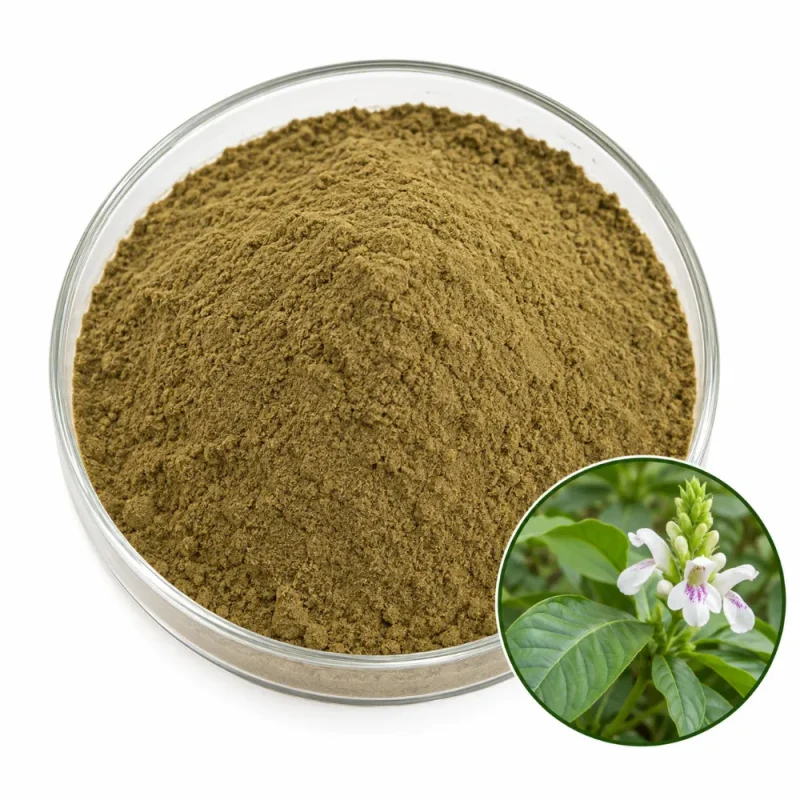
Adhatoda vasica Extract 1% Vasicine

The leaves of Adhatoda vasica, the Malabar nut known as vasaka or adulsa in South Asian herbal practice, are the source of this extract, which does not use the roots, the flowers or the unrelated plants sold under similar local names. Ethanol extraction concentrates the quinazoline alkaloids of the leaf, and the liquor is dried to a light brown powder.

The grade is 1% vasicine by HPLC. The powder is 80 mesh and slightly soluble in water. It is meant for capsules, tablets and dry blends in which the quinazoline alkaloid has to be quantified as a named compound and the rest of the leaf matrix is kept as a bitter, tannin-bearing background.

Vasicine Standardization & Grades

Vasicine, also known as peganine, is the lead alkaloid of vasaka leaf: a quinazoline alkaloid with a tricyclic ring system and a hydroxyl group. It is the standardization target because it is characteristic of the genus and resolved cleanly by HPLC. The leaf also carries vasicinone, vasicinol and other related alkaloids. The botanical entity is Adhatoda vasica Nees, a name that GBIF treats as a synonym of Justicia adhatoda, and the part used is the leaf.

The specification has a single grade, so there is no ladder to choose from, and the decision concerns dose planning and matrix. At 1% vasicine, the Adhatoda vasica powder is a whole-leaf extract in which the marker is a minor component. A capsule needs a generous fill to reach a target, and the remaining weight consists of chlorophyll, tannins, flavonoids and soluble sugars. A second measure, total alkaloids, is recorded in the data but is not published as a separate figure here.

Siblings from the same plant are the unstandardized Adhatoda Vasica Extract Powder, which carries no alkaloid figure, and the purified Vasicine 90–98%, which is the compound itself and not an extract. A formulator who needs a high vasicine load per gram should consider the purified compound. One who wants the leaf profile around a defined alkaloid level will find this grade a better fit.

Buyers who compare vasaka extract quotes should check the name, the part and the compound. Vasicine, vasicinone and the total alkaloids are three different numbers, and the leaf and root of the plant differ in their alkaloid content. The part is therefore as important as the percentage when two quotes are placed side by side.

Vasicine Analysis & Purity Risks

The marker is measured by HPLC, which separates vasicine from vasicinone, vasicinol and the other alkaloids on a reversed-phase column, identifies each peak by retention time and UV spectrum and quantifies vasicine against a reference standard. A colorimetric total alkaloid reading counts every basic compound that reacts and cannot name vasicine, so it is not comparable with the HPLC value.

Vasicine is not a stable compound under all conditions. It oxidizes in air and light to vasicinone, the corresponding ketone. The ratio of the two peaks reveals how the leaf was dried and the extract stored. A lot with a small vasicine peak and a large vasicinone peak has been exposed to oxidative conditions, and the 1% figure then describes only part of the original alkaloid pool.

Sample preparation uses acidified methanol or ethanol, so that the alkaloids dissolve as salts, followed by sonication and filtration. Chlorophyll and tannins can foul the column, so a cleanup step improves peak shape, and samples should be protected from light and analyzed promptly.

Purity risks follow from the botany. Other Justicia and Adhatoda species are used locally under related names. The leaves of Peganum harmala also contain vasicine-type alkaloids, so a vasicine figure alone does not prove that the source is vasaka. A named species, the leaf as the stated part and a fingerprint of the quinazoline alkaloids protect identity better than a single percentage.

Typical Specifications

Specification ItemProduct Information
Latin NameAdhatoda vasica
Plant PartLeaf & Herb
ProcessingEthanol Extraction
Compound ClassAlkaloids
Common NameVasaka, Malabar Nut, Adulsa
Ingredient TypeStandardized Extract
Marker Compound(s)Vasicine (quinazoline alkaloid of Adhatoda vasica leaf)
Primary Grade1% Vasicine (HPLC)
AppearanceLight Brown powder
Solubility / DispersibilitySlightly Soluble in Water
Quality Parameters
Moisture (LOD)≤5.0%
Total Ash≤5.0%
Particle Size80 mesh
Heavy MetalsLead ≤2 ppm · Arsenic ≤1 ppm · Cadmium ≤1 ppm · Mercury ≤0.1 ppm
MicrobiologyTPC ≤1,000 cfu/g · Yeast & Mold ≤100 cfu/g · E. coli Negative · Salmonella Negative/25 g
Shelf Life24 months in unopened original packaging, cool and dry storage

Applications by Grade

1% Grade for Capsule Fills

The single 1% grade is dosed by weight in capsules, and a typical formula needs a generous fill to reach a vasicine target. The light brown powder is fine and slightly sticky, so a flow agent and a dry filling room keep the hopper feeding evenly.

Tablet Blends With Leaf Extracts

Tablets suit the grade when it is blended with other leaf extracts at moderate inclusion. The tannin and chlorophyll content makes the powder slightly sticky, so a dry binder, an absorbent and a short compression trial show whether hardness holds after storage.

Dry Herbal Compounds

Dry compounds combine the Adhatoda vasica extract with other leaf and root powders in measured ratios. Pre-mix it with a bulking agent so the fine brown powder spreads evenly, and screen the blend before filling. The bitter, sticky leaf matrix tends to form small lumps.

Lozenge and Chewable Bases

Lozenges and chewable tablets disguise the bitter taste with honey, licorice or menthol flavors. Add the vasaka powder at low temperature, since heat accelerates oxidation of vasicine, and run a taste trial on the finished base before fixing the dose.

Powder Sachets With Herbal Flavors

Sachets combine the extract with ginger, tulsi or citrus powders in a flavored base. The powder is only slightly soluble and leaves a green-brown haze with a bitter edge, so recommend warm water, gentle stirring and an adequate sweetener level.

Technical & Quality Considerations

The Adhatoda vasica extract is a light brown powder with a faint grassy, slightly pungent odor and a distinctly bitter taste. It is slightly soluble in water, so a solution looks cloudy and tan with a green tinge, and the alkaloids dissolve better in dilute acid as salts. The bitterness is a defining sensory feature and generally requires flavor masking.

Vasicine oxidizes to vasicinone in air and light, so protect the powder from both, keep the drum closed and cool and avoid long holds at elevated temperature during wet processing. Chlorophyll fades from green toward olive and brown under light and acid. At production scale, screen the Adhatoda vasica extract before dosing and pre-mix it with a portion of the carrier.

The tannins of the leaf bind proteins and iron, so milk-based or protein-fortified drinks may turn hazy, and iron-containing equipment darkens the product. Compare each lot with a retained sample for color, odor and flow, record the date the drum was opened and clean equipment between this powder and pale, neutral-tasting products.

An Adhatoda vasica extract is checked by color, bitterness and the ratio of vasicine to vasicinone. A light brown powder with a clear vasicine peak is typical, while a darker lot with a large vasicinone peak shows oxidation. Keep a retained sample of each Adhatoda vasica extract lot, and protect partly used drums from light, since vasicine slowly converts when the powder is exposed.

Packaging & Commercial Supply

Essencefield supports product evaluation, formulation trials, commercial orders, and ongoing ingredient supply. Packaging, storage, and shipping arrangements are determined by product characteristics, order quantity, stability requirements, and destination-market needs.

Supply ItemGeneral Information
SampleAvailable upon request for formulation, testing, and supplier evaluation
Order Quantities100 g · 1 kg · 5 kg · 25 kg · 100 kg · 500 kg · Bulk
Sample Lead TimeTypically 5–7 days after sample confirmation
Production Lead TimeTypically 15–30 days after order and specification confirmation
PackagingSuitable protective inner packaging with bags, cartons, drums, or other appropriate outer packaging
StorageStore in tightly sealed, suitable protective packaging in a cool, dry environment. Protect from moisture, heat, and direct sunlight. Specific storage conditions follow the approved product specification.
DocumentationCOA · Product Specification · TDS · SDS · Applicable declarations (as applicable)

Final order quantities, lead times, packaging, documentation, and shipping arrangements are confirmed according to the selected product and commercial requirements.

Request Ingredient Specifications & Quote

Share your target specification, application, quantity, and documentation needs. We’ll help confirm suitable options, samples, and commercial supply details.