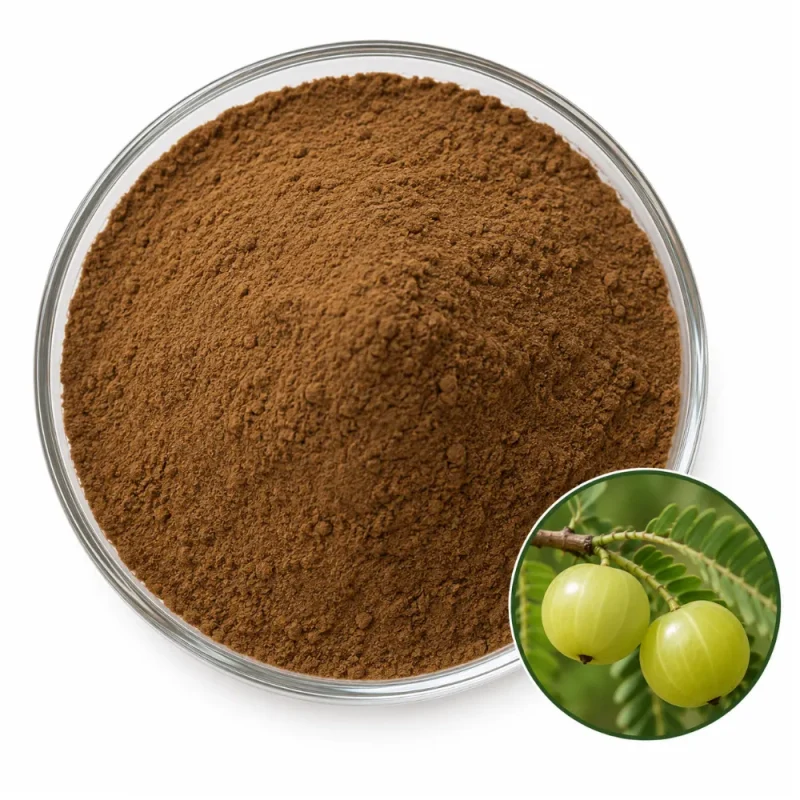
Amla Extract 40% Tannins

Amla extract is prepared from the fruit of Phyllanthus emblica, the Indian gooseberry, and not from the leaves or from the unrelated European gooseberry. Ethanol extraction takes up the hydrolyzable tannins of the fruit, and the liquor is dried to a light brown powder that dissolves in water.

The grade is 40% tannins by UV, a colorimetric total. The powder is 80 mesh and water soluble. A single grade is supplied, which suits capsules, tablets and dry blends that need a defined tannin load from a fruit extract with a sour, astringent profile.

Tannin Standardization & Grades

Tannins are polyphenols that bind proteins and give plant tissue its astringency. Amla fruit holds mainly hydrolyzable tannins, esters of gallic acid and ellagic acid with a sugar core, and the compounds named emblicanin A and B and punigluconin belong to this group. Free gallic acid and ellagic acid are also present in smaller amounts. The grade reports the total tannin content of the extract and does not name a single compound. The botanical entity is Phyllanthus emblica L., a tree of the family Phyllanthaceae, and the part used is the fruit.

The grade is a single level at 40%, so the choice is between amla materials and not between tiers. Amla fruit is also supplied as a 10:1 ratio extract, the Amla Extract Powder, as a spray-dried fruit powder, the Amla Powder, and as a freeze-dried powder, the Freeze-Dried Amla Powder. Those forms hold the fruit matrix with its fiber, sugars and acids and carry no tannin figure. The 40% grade is a tannin concentrate that supplies a defined polyphenol load from a small fill and is more astringent than the whole fruit. Amla extract is therefore a different tool from amla powder, and amla extract at 40% should be dosed by its tannin figure, not by fruit weight.

Tannin Analysis & Purity Risks

The tannin figure is measured by UV. This is a colorimetric method: a reagent reacts with phenolic hydroxyl groups to give a colored product, and the absorbance is read against a reference compound such as gallic acid or tannic acid. The result counts every compound that gives the reaction, and it is not an HPLC result for emblicanins or for gallic acid.

Colorimetric tannin assays do not agree with each other. A procedure that measures all phenols and one that measures the fraction that binds a protein give different numbers for the same extract, because the second leaves out phenols that do not bind. The reference compound and the reaction conditions also matter, so a figure of 40% is comparable only with another figure measured in the same way.

Amla chemistry has a particular feature. The fruit is rich in ascorbic acid, and in the fruit it is stabilized by association with tannin. Ascorbic acid is a reducing agent that responds in many colorimetric phenol assays and can raise the reading, so a tannin figure and a vitamin C figure from the same extract do not add up.

Purity risks follow from naming and from tannin chemistry. The English name gooseberry is used for unrelated fruits, and amla is a different plant from the European gooseberry. Tannins from other sources, such as gallnut or tara, give a similar colorimetric reading, so a fixed species, a fixed part and a fingerprint of the fruit tannins protect identity better than the UV total alone.

Typical Specifications

Specification ItemProduct Information
Latin NamePhyllanthus emblica
Plant PartFruit & Berry
ProcessingEthanol Extraction
Compound ClassPolyphenols
Common NameAmla, Indian Gooseberry, Emblica
Ingredient TypeStandardized Extract
Marker Compound(s)Tannins (hydrolyzable tannins, chiefly emblicanins)
Primary Grade40% Tannins (UV)
AppearanceLight Brown powder
Solubility / DispersibilityWater Soluble
Quality Parameters
Moisture (LOD)≤5.0%
Total Ash≤5.0%
Particle Size80 mesh
Heavy MetalsLead ≤2 ppm · Arsenic ≤1 ppm · Cadmium ≤1 ppm · Mercury ≤0.1 ppm
MicrobiologyTPC ≤1,000 cfu/g · Yeast & Mold ≤100 cfu/g · E. coli Negative · Salmonella Negative/25 g
Shelf Life24 months in unopened original packaging, cool and dry storage

Applications by Grade

Single Grade for Dense Capsules

The single grade delivers a tannin load from a small fill. The light brown powder is highly astringent and hygroscopic, so fill in a dry room, add a glidant for hopper flow and keep a desiccant in the closure of the bottle.

Tannin Powder in Tablet Blends

Tablets of the extract need a dry binder and a lubricant, because tannin powders take up water and stick to punches. Keep the blend away from iron-bearing equipment, which turns tannin-rich powders dark on contact.

Fruit Extract in Drink Powders

The extract dissolves in water to a clear amber drink with a sour, astringent taste. A sweetener and a fruit flavor soften the dryness, and the drink must be kept away from milk or protein, which tannins bind and cloud.

Fruit Extract in Gummy Premixes

Gummy premixes accept the powder in modest amounts. Tannins can bind pectin or gelatin and stiffen the gel, so add the powder late, at a low temperature and a mild pH, and test the clarity and the set before scale-up.

Fruit Extract in Effervescent Tablets

Effervescent tablets work with a soluble tannin powder because it dissolves fully. Keep the compression room dry to stop the acid and base from reacting early, and test the color of the solution, which can darken if iron is present.

Fruit Extract in Stick Packs

For amla, for amla, stick packs carry the powder with a flow agent and a sweet carrier. Seal the packs in moisture-barrier film, since the hygroscopic powder clumps at the seal, and check the dissolved drink for haze after a few minutes.

Technical & Quality Considerations

The extract is a light brown powder with a faint fruity odor and a sour, bitter, astringent taste. It is water soluble, and solutions are amber to brown and clear. The tannins bind proteins, so the extract clouds milk drinks and hardens the texture of protein bars over time. They also form dark complexes with iron and copper, which is the reason why stainless steel and glass are the right contact materials.

Hydrolyzable tannins break down in hot, wet conditions. Water and heat release gallic acid and ellagic acid, which changes both the taste and the UV reading. A long hot hold in a liquid system will therefore lower the astringency and shift the color to a deeper brown, and neutral to mildly acidic bases keep the profile closer to the lot as supplied.

Moisture is the main handling risk. The powder cakes quickly in humid air, so control humidity in weighing and filling and keep the drum sealed between uses. Compare each lot with a retained sample for color, taste and tannin reading, and plan clean-down time after an amla run, because tannin stains persist on plastic and steel. A sealed liner and a cool, dry store keep the powder free-flowing, and a test of the dissolved powder in the real drink base, with the sweetener and flavor in place, shows whether the astringency is acceptable at the target dose.

Packaging & Commercial Supply

Essencefield supports product evaluation, formulation trials, commercial orders, and ongoing ingredient supply. Packaging, storage, and shipping arrangements are determined by product characteristics, order quantity, stability requirements, and destination-market needs.

Supply ItemGeneral Information
SampleAvailable upon request for formulation, testing, and supplier evaluation
Order Quantities100 g · 1 kg · 5 kg · 25 kg · 100 kg · 500 kg · Bulk
Sample Lead TimeTypically 5–7 days after sample confirmation
Production Lead TimeTypically 15–30 days after order and specification confirmation
PackagingSuitable protective inner packaging with bags, cartons, drums, or other appropriate outer packaging
StorageStore in tightly sealed, suitable protective packaging in a cool, dry environment. Protect from moisture, heat, and direct sunlight. Specific storage conditions follow the approved product specification.
DocumentationCOA · Product Specification · TDS · SDS · Applicable declarations (as applicable)

Final order quantities, lead times, packaging, documentation, and shipping arrangements are confirmed according to the selected product and commercial requirements.

Request Ingredient Specifications & Quote

Share your target specification, application, quantity, and documentation needs. We’ll help confirm suitable options, samples, and commercial supply details.