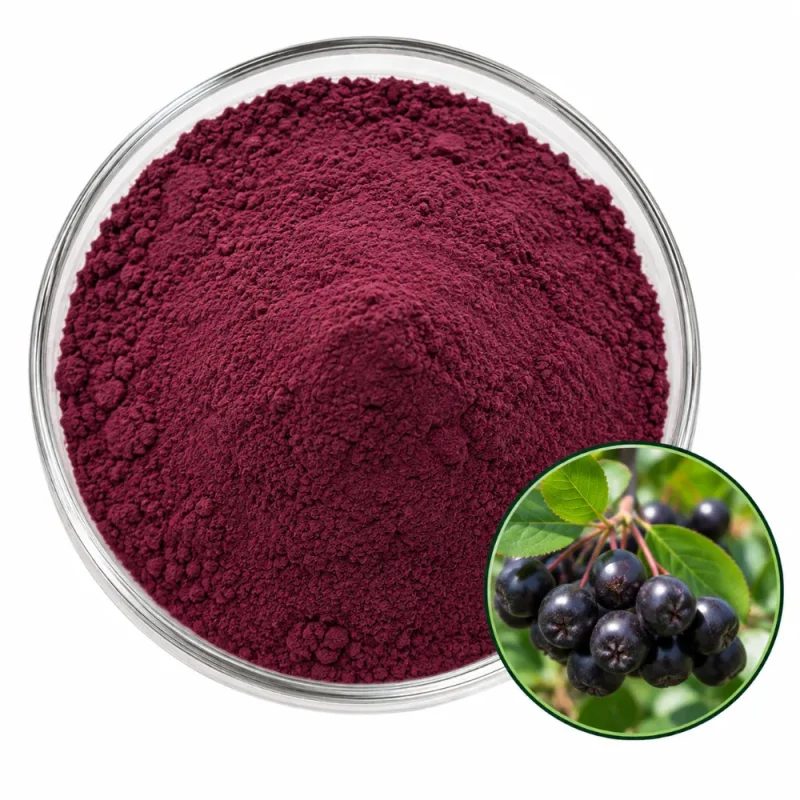
Aronia Extract 25% Anthocyanins

The ripe dark berries of Aronia melanocarpa, the black chokeberry of eastern North America, are the only source of this extract, which uses neither the leaves nor the red chokeberry Aronia arbutifolia. Ethanol extraction concentrates the anthocyanins of the berry skin and flesh, and the liquor is dried to a purple-red, water-soluble powder.

The grade is 25% anthocyanins by UV using the pH differential method. The powder is 80 mesh. It is meant for capsules, drink sticks, beverage bases and gummy premixes in which an intensely colored, astringent berry pigment is wanted at a defined strength.

Anthocyanin Standardization & Grades

Black chokeberry has one of the highest anthocyanin contents among temperate berries, and its pigment profile is unusual. Cyanidin-3-galactoside is the dominant pigment, accompanied by cyanidin-3-arabinoside, cyanidin-3-glucoside and cyanidin-3-xyloside. Nearly all aronia anthocyanins are cyanidin derivatives, which gives the extract a deep, bluish red color. The botanical entity is Aronia melanocarpa (Michx.) Elliott, and the part used is the fruit.

The page carries a single grade, so there is no ladder to choose from, and the decision concerns format and taste. At 25%, anthocyanins are the dominant colorant of the powder, and the rest consists of procyanidins, chlorogenic acids, sugars and fruit acids. Aronia is also very astringent, because the berry holds a high level of procyanidins, and this character remains in the extract.

The same berry is supplied as the dried and milled Aronia Berry Powder and the freeze-dried Freeze-Dried Aronia Berry Powder, which carry the whole fruit with its fiber and carry no anthocyanin figure. A formulator who wants color intensity at a small dose will choose the extract, while one who wants a fruit powder with fiber and flavor will choose the berry powders.

Buyers who compare aronia extract quotes should check the species and the method. Black chokeberry, red chokeberry and the hybrid purple chokeberry differ in pigment content, and the pH differential method counts only monomeric anthocyanins, so the figure is a pigment value, not a total polyphenol value.

Anthocyanin Analysis & Purity Risks

The grade is measured by UV with the pH differential method. The sample is read at two pH values, one strongly acidic and one near pH 4.5, and the difference in absorbance at the pigment maximum counts only the monomeric anthocyanins that change color with pH. The result is usually expressed as an equivalent of a reference pigment, most often cyanidin-3-glucoside, so the reference should be known when quotes are compared.

The method counts all cyanidin glycosides together and cannot tell them apart. An HPLC profile resolves cyanidin-3-galactoside from the arabinoside, glucoside and xyloside, and it is a different measurement that cannot be converted into the UV total. The HPLC pattern is the more useful identity test, because the galactoside-dominant pattern is characteristic of aronia.

Polymeric pigments, which form when anthocyanins condense with procyanidins during storage or heating, do not change color with pH and are not counted by the method. A heated or old lot therefore reads lower than its visual color suggests, which is why a deep color alone does not prove a high anthocyanin value.

Purity risks follow from the raw material. Elderberry, black currant, bilberry and purple carrot carry similar pigments and read alike in a UV test, so the figure alone does not prove an aronia origin. A named species, the fruit as the stated part and an anthocyanin fingerprint with a galactoside-dominant pattern protect identity better than a percentage.

Typical Specifications

Specification ItemProduct Information
Latin NameAronia melanocarpa
Plant PartFruit & Berry
ProcessingEthanol Extraction
Compound ClassAnthocyanins, Flavonoids, Polyphenols
Common NameAronia, Black Chokeberry
Ingredient TypeStandardized Extract
Marker Compound(s)Anthocyanins (mainly cyanidin-3-galactoside of Aronia melanocarpa fruit)
Primary Grade25% Anthocyanins (UV, pH differential)
AppearancePurple Red powder
Solubility / DispersibilityWater Soluble
Quality Parameters
Moisture (LOD)≤5.0%
Total Ash≤5.0%
Particle Size80 mesh
Heavy MetalsLead ≤2 ppm · Arsenic ≤1 ppm · Cadmium ≤1 ppm · Mercury ≤0.1 ppm
MicrobiologyTPC ≤1,000 cfu/g · Yeast & Mold ≤100 cfu/g · E. coli Negative · Salmonella Negative/25 g
Shelf Life24 months in unopened original packaging, cool and dry storage

Applications by Grade

25% Grade for Compact Capsules

The single 25% grade supplies a pigment target in a small capsule fill. The purple-red powder is hygroscopic and stains, so use a dry filling room and dedicated scoops, and check fill weights at the start of each run because the powder bridges in narrow hoppers.

25% Grade in Drink Sticks

Because the powder is water soluble, the grade dissolves in one stir into a deeply colored, astringent solution that is red in acid and bluish near neutral. Balance it with sweetener and fruit acid, which also keep the shade bright.

Acidic Beverage Bases

Acidic beverage bases suit aronia well, because cyanidin glycosides are reddest and most stable at low pH. Add the powder late and cool, keep pasteurization short and protect the finished drink from light, since all anthocyanins fade under strong illumination.

Gummy Premixes

Gummies can carry the extract added after the cook, which protects the pigment from long heat. A low-pH pectin gel keeps the red color, and the berry astringency is softened by sugar and fruit flavors, while starch-based gels near neutral pH turn dull.

Dry Beverage Color Blends

Dry drink powders use the grade as a natural dark red colorant at low inclusion. Pre-blend it with a bulking agent first, and verify blend uniformity, because even a trace of intense powder exposes poor mixing.

Technical & Quality Considerations

The extract is a purple-red powder with a tart berry odor and a strongly astringent taste. In water the powder dissolves into a dark solution that is red in strong acid, violet around pH 5 to 6 and bluish when alkaline. At intermediate pH the color fades because the pigment forms a colorless hemiketal that returns on acidification.

Anthocyanins degrade with heat, light, oxygen and ascorbic acid, and iron or aluminum ions dull the color. Procyanidins bind proteins and can form haze in milk-based or plant-protein drinks, so test those bases early. At production scale, sieve the aronia extract before dosing, since it cakes in humid rooms, and pre-mix it with a portion of the carrier.

The pigment stains, so clean mixers and hoppers promptly and use a dedicated scale and scoop. Compare each lot with a retained sample for color and flow, keep the drum closed, cool and dry, and record the date it was opened. An open drum picks up moisture, loses flow and darkens slowly, so use older lots first.

An aronia extract is checked by color in dilute acid and by the pattern of its cyanidin glycosides. A deep red solution with a clear galactoside peak is typical, and a brownish tone suggests degradation. Keep a retained sample of every aronia extract lot, and compare the HPLC profile of later lots with it, since the galactoside-dominant pattern is the quickest way to confirm the berry.

Packaging & Commercial Supply

Essencefield supports product evaluation, formulation trials, commercial orders, and ongoing ingredient supply. Packaging, storage, and shipping arrangements are determined by product characteristics, order quantity, stability requirements, and destination-market needs.

Supply ItemGeneral Information
SampleAvailable upon request for formulation, testing, and supplier evaluation
Order Quantities100 g · 1 kg · 5 kg · 25 kg · 100 kg · 500 kg · Bulk
Sample Lead TimeTypically 5–7 days after sample confirmation
Production Lead TimeTypically 15–30 days after order and specification confirmation
PackagingSuitable protective inner packaging with bags, cartons, drums, or other appropriate outer packaging
StorageStore in tightly sealed, suitable protective packaging in a cool, dry environment. Protect from moisture, heat, and direct sunlight. Specific storage conditions follow the approved product specification.
DocumentationCOA · Product Specification · TDS · SDS · Applicable declarations (as applicable)

Final order quantities, lead times, packaging, documentation, and shipping arrangements are confirmed according to the selected product and commercial requirements.

Request Ingredient Specifications & Quote

Share your target specification, application, quantity, and documentation needs. We’ll help confirm suitable options, samples, and commercial supply details.