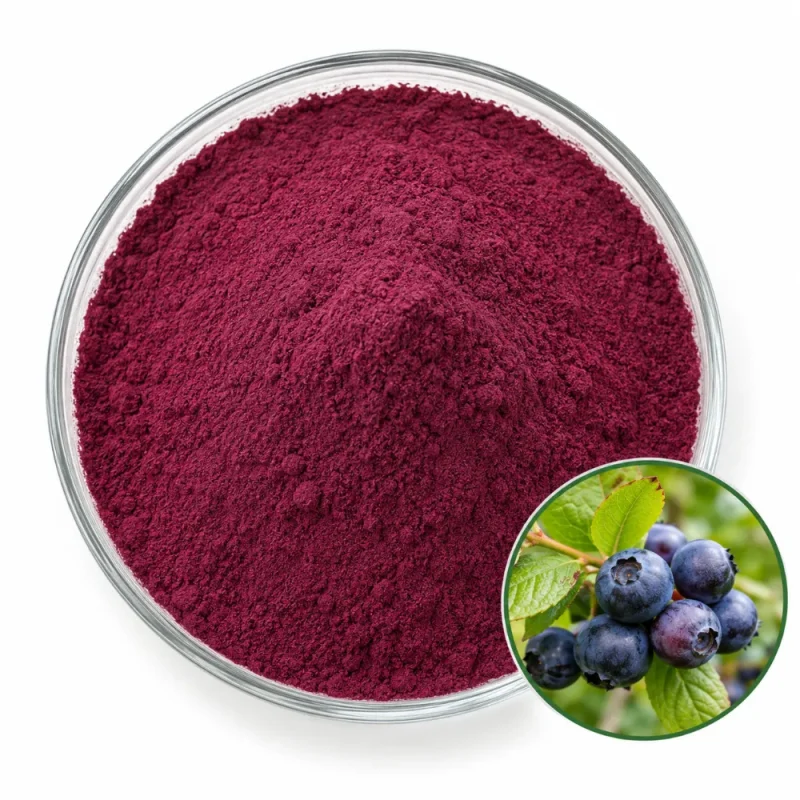
Berry Anthocyanin Extract 10–25% Anthocyanins

Berry anthocyanin extract is prepared here from the fruit of Vaccinium myrtillus, the wild European bilberry, and not from cultivated highbush blueberry or from lingonberry. Ethanol extraction concentrates the anthocyanins of the dark skin and flesh, and the liquor is dried to a purple-red, water-soluble powder.

The primary grade is 25% anthocyanins by UV using the pH differential method, with 10% as the lower end of the range. The powder is 80 mesh. The 25% grade serves capsules and drink sticks with a small fill, while the 10% grade suits beverage bases and gummy premixes where color is wanted at a higher gram dose.

Anthocyanin Standardization & Grades

Anthocyanins are the water-soluble pigments behind the red, purple and blue colors of berries. Bilberry holds a broad set of about fifteen anthocyanins, built on five aglycones, namely delphinidin, cyanidin, petunidin, peonidin and malvidin, each combined with glucose, galactose or arabinose. The page standardizes to the summed class, because the fruit carries many related pigments. The botanical entity is Vaccinium myrtillus L., and the part used is the fruit.

GradeAssay & MethodWhere It Fits
10% AnthocyaninsUV (pH differential)Beverage bases and gummy premixes
25% AnthocyaninsUV (pH differential)Capsules and drink sticks with small fill

The grades differ in color strength and fill weight, so the dose per serving decides which one fits. The 25% grade carries two and a half times the pigment load per gram of the 10% grade, so it reaches a target in a smaller fill. It also colors a base intensely at low inclusion. The 10% grade keeps more of the berry sugars and fruit acids and gives a softer, more diluted color. The same berry is also supplied under its own name as the single-grade Bilberry Extract 25% Anthocyanins and the ratio-based Bilberry Extract Powder, while the related species is graded in Lingonberry Extract 10–25% Anthocyanins.

The difference from the single-grade bilberry extract is range and wording: two strengths are offered under a berry-anthocyanin name, so buyers who need to match an existing formula should compare the grade rather than the title. Buyers who compare quotes should also check the species behind a berry anthocyanin label, because blueberry, bilberry and lingonberry have different pigment profiles and prices.

The pH differential method counts only monomeric anthocyanins and cannot name individual pigments, so the figure is a pigment value and not a total polyphenol value. A formulator who needs a defined delphinidin share should request an HPLC profile alongside the UV figure.

Anthocyanin Analysis & Purity Risks

Both grades are read by UV using the pH differential approach. Absorbance is read at the pigment maximum in strong acid and near pH 4.5, and the difference counts only monomeric anthocyanins, which change color with pH. The result is usually expressed as an equivalent of a reference pigment such as cyanidin-3-glucoside, which should be known when quotes are compared.

The reading is a total and does not break the class into individual pigments. An HPLC profile resolves the delphinidin, cyanidin, petunidin, peonidin and malvidin glycosides, and it is a different measurement that is not interchangeable with the UV total. Wild bilberry is distinguished from cultivated blueberry by a higher share of delphinidin and cyanidin glycosides and a lower share of malvidin types, so the profile is the more useful identity test.

Polymeric pigments, which form when anthocyanins degrade or condense during heating and storage, do not change color with pH and are therefore not counted. A heated or old lot reads lower than its visual color suggests, which is why deep color alone does not prove a high anthocyanin figure.

Purity risks follow from the raw material. Blueberry, black currant, elderberry and black carrot carry similar pigments and read alike in a UV test, so the figure does not prove a bilberry origin. A named species, the fruit as the stated part and an anthocyanin fingerprint protect identity better than a percentage.

Typical Specifications

Specification ItemProduct Information
Latin NameVaccinium myrtillus
Plant PartFruit & Berry
ProcessingEthanol Extraction
Compound ClassAnthocyanins, Flavonoids, Polyphenols
Common NameBilberry, European Blueberry
Ingredient TypeStandardized Extract
Marker Compound(s)Anthocyanins (delphinidin, cyanidin and related glycosides of Vaccinium myrtillus fruit)
Primary Grade25% Anthocyanins (UV, pH differential)
Available Grades10% · 25% Anthocyanins (UV, pH differential)
AppearancePurple Red powder
Solubility / DispersibilityWater Soluble
Quality Parameters
Moisture (LOD)≤5.0%
Total Ash≤5.0%
Particle Size80 mesh
Heavy MetalsLead ≤2 ppm · Arsenic ≤1 ppm · Cadmium ≤1 ppm · Mercury ≤0.1 ppm
MicrobiologyTPC ≤1,000 cfu/g · Yeast & Mold ≤100 cfu/g · E. coli Negative · Salmonella Negative/25 g
Shelf Life24 months in unopened original packaging, cool and dry storage

Applications by Grade

25% Grade for Compact Capsules

A small capsule fill is enough for the 25% grade to reach a pigment target. The purple-red powder is hygroscopic and stains, so work in a dry room with dedicated scoops, and check fill weights at the start of each run because the berry anthocyanin powder bridges in narrow hoppers.

25% Grade in Drink Sticks

The high grade dissolves in water with a single stir, giving an intensely colored solution that is red in acid and violet near neutral. A sour flavor with citric acid keeps the shade bright, and a small stick dose already colors a full glass.

10% Grade for Berry Beverage Bases

Acidic beverage bases suit the lower grade, because the pigments are reddest and most stable at low pH. Add it late and cool, keep pasteurization short and protect the finished drink from light, since all anthocyanins fade under strong illumination.

10% Grade for Gummy Premixes

In gummies the lower grade is stirred in after the cook, so the pigment avoids a long hot hold. A low-pH pectin gel keeps the red-violet color, while starch-based gels near neutral pH turn bluish and dull, so set the acid level before choosing the dose.

25% Grade in Tablet Blends

Tablets made with the high grade need a dry binder and a film coat that protects against moisture, because the hygroscopic powder softens the compacts. Its strong color also speckles pale blends, so an opaque coating and a mixing trial to check color uniformity are advised.

Technical & Quality Considerations

The berry anthocyanin extract is a purple-red powder with a faint fruity odor and a mildly tart, astringent taste. The berry anthocyanin powder dissolves in water to a deeply colored solution; below about pH 3 it is red, near pH 5 to 6 violet and in alkaline conditions bluish. At intermediate pH the pigment forms a colorless hemiketal and the color fades, but acidification reverses this.

Heat, light, oxygen and ascorbic acid break anthocyanins down, and iron or aluminum dulls the shade. Use stainless steel, add the berry anthocyanin extract late in the process and keep heat treatment short. On the production line, screen the powder before dosing and pre-mix it with part of the carrier, because it cakes in humid rooms.

Clean-down is a practical issue because the pigment stains. Rinse mixers and hoppers promptly, use a dedicated scale and scoop, and compare each lot with a retained sample for color and flow. Keep the drum closed, cool and dry, and record the date it was opened, so that older lots are used first.

A berry anthocyanin extract is checked by color in an acid and in a near-neutral buffer, where the shade should move from red to violet. Keep a retained sample of every berry anthocyanin extract lot, and use an HPLC profile to confirm the delphinidin and cyanidin glycosides that separate bilberry from cultivated blueberry, since the UV figure alone cannot show the source.

Packaging & Commercial Supply

Essencefield supports product evaluation, formulation trials, commercial orders, and ongoing ingredient supply. Packaging, storage, and shipping arrangements are determined by product characteristics, order quantity, stability requirements, and destination-market needs.

Supply ItemGeneral Information
SampleAvailable upon request for formulation, testing, and supplier evaluation
Order Quantities100 g · 1 kg · 5 kg · 25 kg · 100 kg · 500 kg · Bulk
Sample Lead TimeTypically 5–7 days after sample confirmation
Production Lead TimeTypically 15–30 days after order and specification confirmation
PackagingSuitable protective inner packaging with bags, cartons, drums, or other appropriate outer packaging
StorageStore in tightly sealed, suitable protective packaging in a cool, dry environment. Protect from moisture, heat, and direct sunlight. Specific storage conditions follow the approved product specification.
DocumentationCOA · Product Specification · TDS · SDS · Applicable declarations (as applicable)

Final order quantities, lead times, packaging, documentation, and shipping arrangements are confirmed according to the selected product and commercial requirements.

Request Ingredient Specifications & Quote

Share your target specification, application, quantity, and documentation needs. We’ll help confirm suitable options, samples, and commercial supply details.