
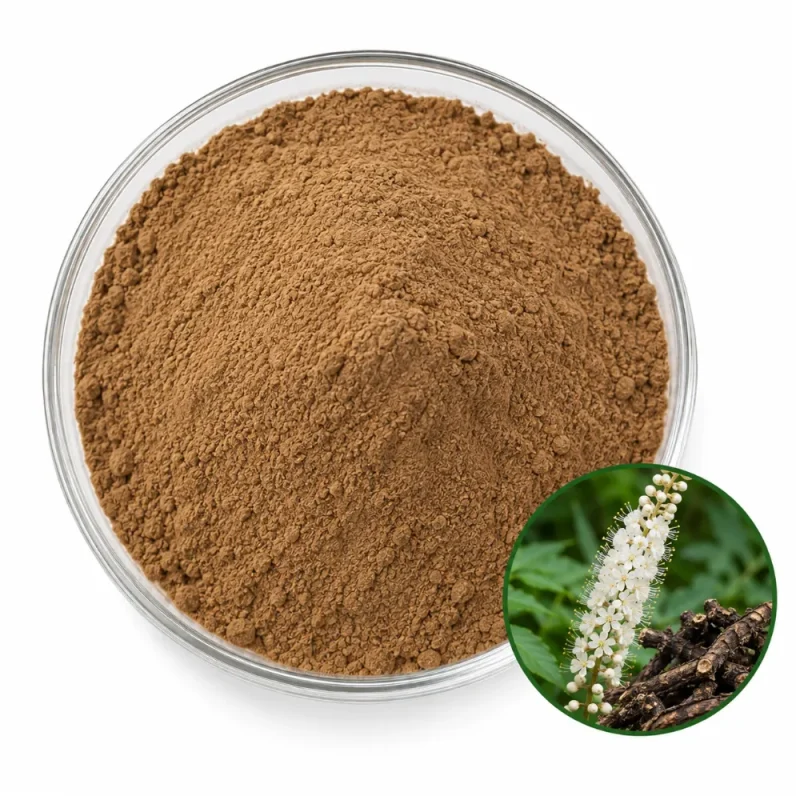
Triterpene Glycoside Standardization & Grades
Black cohosh rhizome holds a family of cycloartane triterpene glycosides, among them actein and 23-epi-26-deoxyactein, together with phenolic acids such as the cimicifugic and fukinolic acids. The grade reports the triterpene glycosides as a class total, and the phenolic acids are not counted. The botanical entity is Actaea racemosa L., a member of the Ranunculaceae also known by the older name Cimicifuga racemosa, and the part used is the rhizome with its roots.
| Grade | Assay & Method | Where It Fits |
|---|---|---|
| 2.5% Triterpene Glycosides | UV | Blended powders and tea-style mixes |
| 8% Triterpene Glycosides | UV | Capsules and tablets with small fill |
The two grades differ by about a factor of three. The 8% grade is a glycoside concentrate that supplies a defined load from a small fill. The 2.5% grade is closer to the rhizome, with more of the phenolic acids, starch and fiber, so black cohosh extract at this level suits blended powders and tea-style mixes. The same plant is also supplied as a 10:1 ratio extract, the Black Cohosh Extract Powder, and as a milled root, the Black Cohosh Root Powder. Blue cohosh, Caulophyllum thalictroides, belongs to a different family and is unrelated. Black cohosh extract at 8% is a glycoside concentrate, and black cohosh at 2.5% stays near the rhizome. Both are extracts of one species and one plant part, and they differ in concentration, not in identity. The plant grows in the woodlands of eastern North America.


