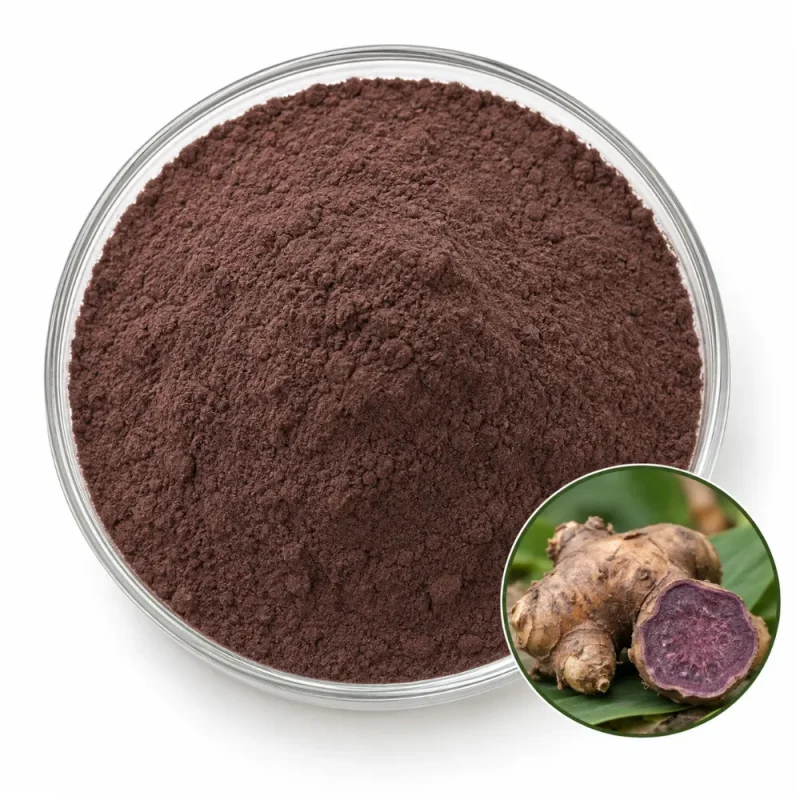
Black Ginger Extract 10% Total Methoxyflavones

Black ginger extract is prepared from the rhizome of Kaempferia parviflora, the dark-fleshed ginger relative of Thailand, and not from true ginger, from kencur or from turmeric. Ethanol extraction takes up the methoxylated flavones of the rhizome, and the liquor is dried to a brown powder.

The grade is 10% total methoxyflavones by HPLC. The powder is 80 mesh and insoluble in water. A single grade is supplied, which suits capsules, tablets and oil-based fills that need a defined fat-soluble flavonoid load from a rhizome extract in a fine powder.

Methoxyflavone Standardization & Grades

Polymethoxyflavones are flavones in which most of the hydroxyl groups are replaced by methoxy groups. The three main members in black ginger are 5,7-dimethoxyflavone, 5,7,4′-trimethoxyflavone and 3,5,7,3′,4′-pentamethoxyflavone. The methoxy groups make these molecules fat soluble, which is why ethanol extracts them and water does not. The grade names the total of these compounds and not a single member. The botanical entity is Kaempferia parviflora Wall. ex Baker, a plant of the Zingiberaceae native to Thailand, and the part used is the rhizome.

The grade is a single level at 10%, so there is no tier to choose between. The choice is between rhizome materials. Black ginger is also supplied as a 10:1 ratio extract, the Black Ginger Extract Powder, which carries no marker figure. The standardized extract is a concentrate of the flavone fraction, and the data for this product lists 5,7-dimethoxyflavone as a secondary marker that is read beside the total. Black ginger is a different plant from ordinary ginger and from kencur, and none of the three is a substitute for another. Black ginger extract at 10% is a flavone concentrate, and the grade describes that fraction only, not the whole rhizome.

Methoxyflavone Analysis & Purity Risks

The total is measured by HPLC against reference standards for the named flavones. The methoxylated flavone skeleton absorbs ultraviolet light strongly, so a UV detector gives clean peaks. A colorimetric flavonoid total would not respond well to fully methoxylated flavones, because the assay relies on free hydroxyl groups, and it cannot be converted into an HPLC result.

The chromatogram of a black ginger extract shows a small group of dominant peaks, and 5,7-dimethoxyflavone is among the largest. The data for this product lists it as a secondary marker, and the proportion of the individual flavones is a fingerprint of the species. A study of Thai rhizomes found that the 5,7-dimethoxyflavone content differs between collection sites, so the pattern is a better identity check than a single member.

Sample preparation uses an alcohol diluent, because the flavones dissolve poorly in water. The powder is dissolved, filtered and injected on a reversed-phase column with a gradient. The reference standards define the peaks, and the sum of the named compounds is reported as the total.

Purity risks follow from the genus. Kaempferia galanga, known as kencur, has a rhizome in which ethyl p-methoxycinnamate is the leading oil constituent, and it is a different material with a different marker. Ordinary ginger, Zingiber officinale, and turmeric, Curcuma longa, are other rhizomes with other chemistry. A stated species, the rhizome as the part and the flavone pattern are the first identity checks.

Typical Specifications

Specification ItemProduct Information
Latin NameKaempferia parviflora
Plant PartRoot & Rhizome
ProcessingEthanol Extraction
Compound ClassFlavonoids, Polyphenols
Common NameBlack Ginger, Thai Ginseng, Krachai Dum
Ingredient TypeStandardized Extract
Marker Compound(s)Polymethoxyflavones (5,7-dimethoxyflavone, 5,7,4′-trimethoxyflavone, pentamethoxyflavone)
Primary Grade10% Total Methoxyflavones (HPLC)
AppearanceBrown powder
Solubility / DispersibilityInsoluble in Water
Quality Parameters
Moisture (LOD)≤5.0%
Total Ash≤5.0%
Particle Size80 mesh
Heavy MetalsLead ≤2 ppm · Arsenic ≤1 ppm · Cadmium ≤1 ppm · Mercury ≤0.1 ppm
MicrobiologyTPC ≤1,000 cfu/g · Yeast & Mold ≤100 cfu/g · E. coli Negative · Salmonella Negative/25 g
Shelf Life24 months in unopened original packaging, cool and dry storage

Applications by Grade

10% Grade for Compact Capsules

The grade delivers a flavone load from a small fill, which suits capsules and tablets. The brown powder is fat soluble and cohesive, so a glidant helps hopper flow, and a cool, dry filling room limits smearing on the pins.

Methoxyflavone Powder in Tablet Blends

Tablets need an absorbent filler and a dry binder, because the lipophilic fraction softens compacts and sticks to punches. Run a compression trial on the full blend and check the hardness after storage in a warm room.

Rhizome Extract in Softgel Fills

Softgel fills carry the powder as a milled suspension in oil, where the fat-soluble flavones stay in contact with the oil phase. Particle size and a suspending agent decide whether the fill stays uniform, and a cool oil phase protects the powder.

Rhizome Extract in Oil Suspensions

Oil-based drops and liquid fills accept the powder as a fine dispersion. The dark brown solid does not dissolve in oil, so settle the suspension with a viscosity builder, and test the fill for sediment after storage.

Rhizome Extract in Dry Botanical Blends

Dry blends combine the powder with other rhizome and root extracts. Pre-blend it with a portion of the carrier, since the dark brown powder tints pale blends and can leave specks if it is added in one step.

Rhizome Extract in Stick Packs

Stick packs carry the powder at a low fill with a flow agent and a fine carrier. The powder is insoluble in water and gives a hazy brown suspension, so a suspension aid and a note to stir are needed in the cup.

Technical & Quality Considerations

The extract is a brown powder with a spicy, earthy rhizome odor and a pungent, bitter taste. It is insoluble in water, so water-based systems hold black ginger extract only as a fine suspension that settles without stirring. The methoxylated flavones are stable at normal processing temperatures and resist oxidation better than flavones that carry free hydroxyl groups, so the main stability risk is physical and not chemical.

For production, sieve the powder before blending to break up soft agglomerates, and add a glidant, since the lipophilic particles cling to hoppers and filling machines. Fold the extract into a portion of the carrier before the final mix. Fill capsules in a cool room, because warm air softens the oily fraction and the powder will smear on the pins.

Compare each lot with a retained sample for color, odor and the flavone peaks in the chromatogram. The dark powder stains mixers and hoppers, so schedule clean-down time after a black ginger run, and keep the drum sealed in a cool, dry store. A retained sample from each lot, tested again near the end of shelf life, shows whether the packaging holds the flavone figure, which is stable, and the odor, which can fade or turn stale. Taste trials with the intended coat or flavor system settle the usable dose, because the pungent edge of the rhizome carries through at higher fills.

Black ginger extract is dense and dark, so a test blend shows how much it tints a capsule shell or a coated tablet, and an opaque shell avoids visible dark specks through a translucent capsule.

Packaging & Commercial Supply

Essencefield supports product evaluation, formulation trials, commercial orders, and ongoing ingredient supply. Packaging, storage, and shipping arrangements are determined by product characteristics, order quantity, stability requirements, and destination-market needs.

Supply ItemGeneral Information
SampleAvailable upon request for formulation, testing, and supplier evaluation
Order Quantities100 g · 1 kg · 5 kg · 25 kg · 100 kg · 500 kg · Bulk
Sample Lead TimeTypically 5–7 days after sample confirmation
Production Lead TimeTypically 15–30 days after order and specification confirmation
PackagingSuitable protective inner packaging with bags, cartons, drums, or other appropriate outer packaging
StorageStore in tightly sealed, suitable protective packaging in a cool, dry environment. Protect from moisture, heat, and direct sunlight. Specific storage conditions follow the approved product specification.
DocumentationCOA · Product Specification · TDS · SDS · Applicable declarations (as applicable)

Final order quantities, lead times, packaging, documentation, and shipping arrangements are confirmed according to the selected product and commercial requirements.

Request Ingredient Specifications & Quote

Share your target specification, application, quantity, and documentation needs. We’ll help confirm suitable options, samples, and commercial supply details.