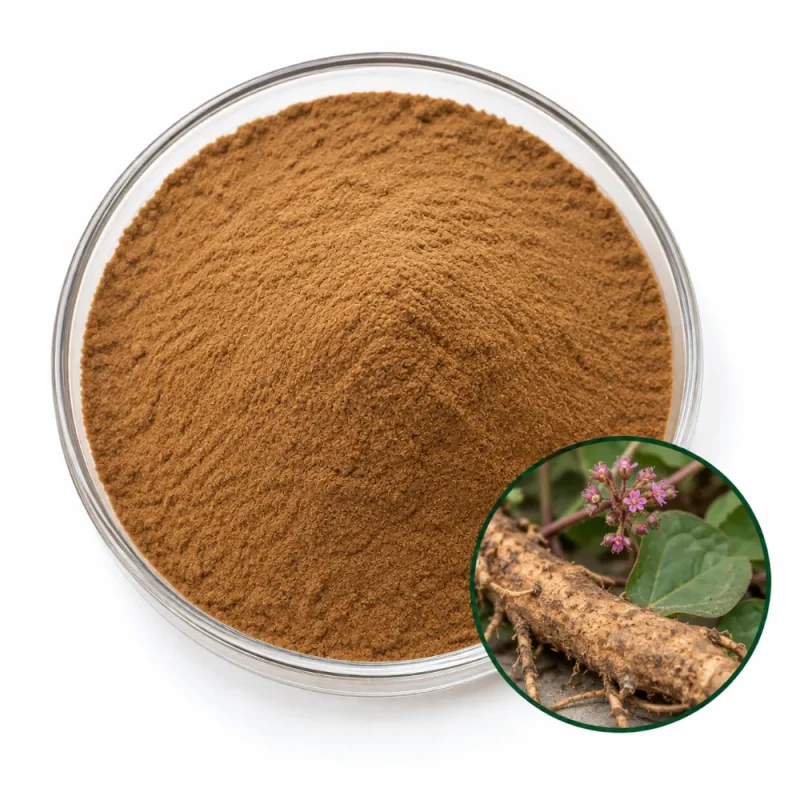
Boerhavia diffusa Extract 20–40% Saponins

The root of Boerhavia diffusa, the spreading hogweed called punarnava in Ayurvedic practice, is the source of this extract, which does not use the aerial herb or the white-flowered substitute Trianthema portulacastrum that is also sold under the Sanskrit name. Ethanol extraction concentrates the saponin fraction of the root, and the liquor is dried to a light brown, water-soluble powder.

The primary grade is 40% saponins by UV, with 20% as the lower end of the range. The powder is 80 mesh. The 40% grade serves capsules and drink sticks with a small fill, while the 20% grade suits tea-style blends and dry compounds that keep more of the root matrix.

Saponin Standardization & Grades

The best known compounds of punarnava root are the rotenoid boeravinones, the alkaloid punarnavine and the lignan liriodendrin, but the grade here is defined by the saponin class, which the root also carries and which a colorimetric assay reads as a whole. The page therefore describes the figure as a class value and does not tie it to a single named saponin. The botanical entity is Boerhavia diffusa L., and the part used is the root, which the master data groups with roots and rhizomes.

GradeAssay & MethodWhere It Fits
20% SaponinsUVTea-style blends and dry compounds
40% SaponinsUVCapsules and drink sticks with small fill

Dose, fill weight and the share of root matrix wanted in the blend decide the grade. The 40% grade holds twice the saponin load per gram of the 20% grade, so a capsule reaches its target with a smaller fill. The 20% grade keeps more of the sugars, potassium salts and minor alkaloids of the root and gives a darker, sweeter and more hygroscopic powder. Siblings from the same plant are the unstandardized Boerhavia diffusa Extract Powder and the dried and milled Punarnava Powder.

Buyers who compare Boerhavia diffusa extract quotes should check what the percentage describes. A colorimetric saponin figure, an HPLC value for boeravinone B or a total alkaloid reading are three different statements about the same root, and none of them can be converted into another. The marker behind a number is therefore as informative as the number.

The word punarnava also has a regional spread. Red punarnava is Boerhavia diffusa and white punarnava is Trianthema portulacastrum in many Indian markets, and the two plants are chemically distinct. A botanical name and the root as the stated part are the clearest identity statement.

Saponin Analysis & Purity Risks

Both grades are measured by UV, a colorimetric method in which saponins react with an acid reagent and the developed color is read at a fixed wavelength against a reference compound. The result is a sum of responses, and the chosen reference changes the figure. An HPLC profile of the rotenoids is a different measurement and cannot be converted into the UV figure.

Colorimetric saponin assays respond to other compounds as well, notably sugars and sterols, and punarnava root is rich in soluble sugars and potassium salts. A well-run method partitions the saponins into an organic solvent before the reaction, which removes most of the interference, and a result from a method without cleanup should be read with caution.

The fingerprint of the root shows the boeravinones as a group of mid-polarity peaks, with punarnavine appearing as a basic compound that needs an acidic mobile phase. Because the fingerprint contains these characteristic compounds, it is the better identity test than the saponin total, which is common to many roots.

Purity risks follow from the botany and the trade. Trianthema portulacastrum is the usual substitute, and Boerhavia repens and Boerhavia erecta are close relatives that appear in local trade. A named species, the root as the stated part and a boeravinone fingerprint protect identity better than a total saponin percentage.

Typical Specifications

Specification ItemProduct Information
Latin NameBoerhavia diffusa
Plant PartRoot & Rhizome
ProcessingEthanol Extraction
Compound ClassSaponins
Common NameBoerhavia, Punarnava, Spreading Hogweed
Ingredient TypeStandardized Extract
Marker Compound(s)Saponins (total saponin class of Boerhavia diffusa root)
Primary Grade40% Saponins (UV)
Available Grades20% · 40% Saponins (UV)
AppearanceLight Brown powder
Solubility / DispersibilityWater Soluble
Quality Parameters
Moisture (LOD)≤5.0%
Total Ash≤5.0%
Particle Size80 mesh
Heavy MetalsLead ≤2 ppm · Arsenic ≤1 ppm · Cadmium ≤1 ppm · Mercury ≤0.1 ppm
MicrobiologyTPC ≤1,000 cfu/g · Yeast & Mold ≤100 cfu/g · E. coli Negative · Salmonella Negative/25 g
Shelf Life24 months in unopened original packaging, cool and dry storage

Applications by Grade

40% Grade for Compact Capsules

The 40% grade delivers a saponin target in a small capsule fill. The light brown powder is hygroscopic because of its salts and sugars, so a dry filling room and a flow agent keep the hopper feeding evenly, and fill weights should be checked at the start of each run.

40% Grade in Drink Sticks

Because the powder is water soluble, the high grade dissolves in one stir into a lightly foaming, tan solution. Saponins foam when shaken, so recommend gentle stirring, and use ginger, lemon or mint flavors to cover the bitter, earthy note of the root.

20% Grade for Herbal Tea Blends

At 20% the extract is dosed by weight in herbal tea mixes, where the root’s mild sweetness and earthy taste blend with ginger, coriander and fennel. Blend in small dry lots, because the sticky powder clumps against dry leaf and settles in the bag.

20% Grade for Dry Herbal Compounds

In dry compounds the lower grade sits among other root powders. Pre-mix it with a bulking agent, and screen the blend before filling, since the salt-rich powder draws moisture from the air and forms hard lumps that resist breaking.

40% Grade in Tablet Blends

Tablets of the high grade need a dry binder and a moisture-protective film coat, because the saponin powder softens compacts in humid rooms. Trial-compress the full blend and test hardness after storage under the target climate.

Technical & Quality Considerations

The extract is a light brown powder with a faint earthy odor and a mildly bitter, slightly salty taste. The powder dissolves in water to a tan solution, clear to slightly hazy, and a shaken sample foams. The foam is stable and slow to collapse, which affects filling lines and shaker bottles, so test an anti-foam strategy early for liquid formats.

Saponins are stable at neutral pH and in dry form, while strong acid cleaves their sugar chains and strong alkali opens ester linkages. The rotenoids and lignans of the root darken in light and with iron, so use stainless steel and keep finished blends away from strong light. On the production line, the Boerhavia diffusa extract is screened before dosing and pre-mixed with a portion of the carrier.

Hygroscopicity is the main handling issue. Open drums only briefly, re-seal them with the liner in place and keep them in a cool, dry room. Compare each lot with a retained sample for color, odor, foaming behavior and flow, and record the date the drum was opened so that older lots are used first.

A Boerhavia diffusa extract is checked by solution color, foam and salt taste. A tan, lightly foaming and slightly salty solution is typical of the root, and a very sweet or sticky powder suggests sugar carryover. Keep a retained sample of each Boerhavia diffusa extract lot, and compare the boeravinone peaks of later lots with it, since that group, more than the saponin total, identifies the root.

Packaging & Commercial Supply

Essencefield supports product evaluation, formulation trials, commercial orders, and ongoing ingredient supply. Packaging, storage, and shipping arrangements are determined by product characteristics, order quantity, stability requirements, and destination-market needs.

Supply ItemGeneral Information
SampleAvailable upon request for formulation, testing, and supplier evaluation
Order Quantities100 g · 1 kg · 5 kg · 25 kg · 100 kg · 500 kg · Bulk
Sample Lead TimeTypically 5–7 days after sample confirmation
Production Lead TimeTypically 15–30 days after order and specification confirmation
PackagingSuitable protective inner packaging with bags, cartons, drums, or other appropriate outer packaging
StorageStore in tightly sealed, suitable protective packaging in a cool, dry environment. Protect from moisture, heat, and direct sunlight. Specific storage conditions follow the approved product specification.
DocumentationCOA · Product Specification · TDS · SDS · Applicable declarations (as applicable)

Final order quantities, lead times, packaging, documentation, and shipping arrangements are confirmed according to the selected product and commercial requirements.

Request Ingredient Specifications & Quote

Share your target specification, application, quantity, and documentation needs. We’ll help confirm suitable options, samples, and commercial supply details.