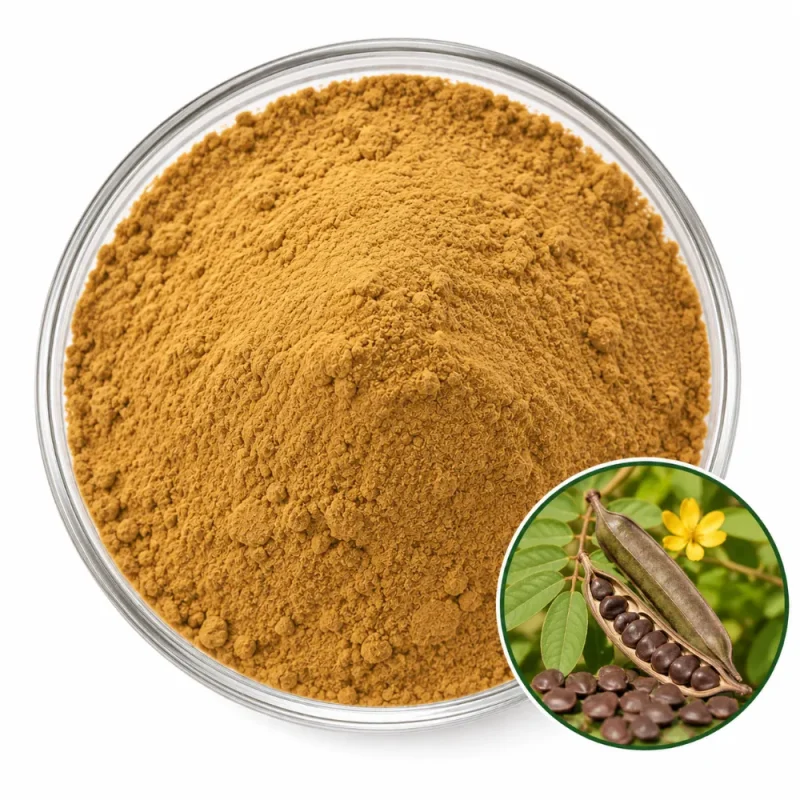
Cassia tora Extract 20–25% Glycosides

Cassia tora extract starts from the seed of Cassia tora, the sickle senna, whose small angular seeds are traded in Asia and Africa. Ethanol extraction takes up the anthraquinone and naphthopyrone glycosides of the seed, and the concentrate is dried to a light brown, slightly water-soluble powder.

The primary grade is 25% glycosides, with a 20% grade as the lower end, and the grade has no named assay method. The powder is 80 mesh. The 25% grade serves capsules and tablets that need a small fill, while the 20% grade serves dry blends in which a bulkier seed matrix is wanted.

Glycoside Standardization & Grades

Glycosides here means the sugar-bound anthraquinones and naphthopyrones of the seed, a class that includes chrysophanol, emodin and physcion glycosides and the toralactone-type naphthopyrone glycosides. The botanical entity is Cassia tora L., and the extract is standardized to this class because the glycosides are the soluble, characteristic fraction of the seed, while the free aglycones are a minor, less polar part that behaves differently in extraction.

GradeAssay & MethodWhere It Fits
20% GlycosidesClass figure, no named methodDry blends, higher inclusion
25% GlycosidesClass figure, no named methodCapsules and tablets, small fill

The two grades are close, so choice follows handling more than dose. The 25% grade gives a slightly smaller fill, and the 20% grade is a little bulkier and easier to blend dry. Cassia tora has no 10:1 extract or milled seed row in the catalog. The standardized extract is the form to use whenever a glycoside figure has to appear in the specification. Anthraquinone-type compounds are a regulated class in several regions, so label wording of the finished product is a regulatory decision.

Glycoside Analysis & Purity Risks

No single method defines a glycoside class, and the grade carries no named method. The figure is read as the sugar-bound fraction of the extract, as determined by the laboratory procedure that accompanies the lot. A common approach compares the anthraquinone content before and after hydrolysis, with the difference attributed to glycosides. A figure from one procedure is therefore not directly comparable with a figure from another, and it cannot be converted into an HPLC result for a single glycoside.

For identity, an HPLC fingerprint of the seed is read beside the class value. Toralactone-type naphthopyrone glycosides and emodin and chrysophanol glycosides give the pattern of this species, and a TLC or HPLC comparison with a reference extract confirms that the material is seed and not leaf.

Purity risks follow from the botanical group. Cassia tora is treated by plant databases as a synonym of Senna tora, and it is traded alongside Senna obtusifolia seed under the same cassia seed names, with Cassia occidentalis seed as a further substitute. A named species, a stated seed part and a fingerprint protect identity better than a glycoside percentage alone. Because the bound fraction is defined by the procedure, lots should be compared only when the same procedure has been used.

Seed condition also affects what the lab sees. Cassia tora seed is small, hard and rhomboid, and its coat holds a large share of the colored glycosides. Extraction yield and the apparent glycoside figure both depend on how finely the seed is milled and how long it is extracted. Seed lots stored warm and damp can partly hydrolyze their glycosides before extraction, shifting the bound fraction toward free aglycones and reducing the class figure that the extract can reach.

Typical Specifications

Specification ItemProduct Information
Latin NameCassia tora
Plant PartSeed & Grain
ProcessingEthanol Extraction
Compound ClassPolyphenols
Common NameCassia Tora, Sickle Senna
Ingredient TypeStandardized Extract
Marker Compound(s)Glycosides (anthraquinone and naphthopyrone glycosides of the seed)
Primary Grade25% Glycosides
Available Grades20% · 25% Glycosides
AppearanceLight Brown powder
Solubility / DispersibilitySlightly Soluble in Water
Quality Parameters
Moisture (LOD)≤5.0%
Total Ash≤5.0%
Particle Size80 mesh
Heavy MetalsLead ≤2 ppm · Arsenic ≤1 ppm · Cadmium ≤1 ppm · Mercury ≤0.1 ppm
MicrobiologyTPC ≤1,000 cfu/g · Yeast & Mold ≤100 cfu/g · E. coli Negative · Salmonella Negative/25 g
Shelf Life24 months in unopened original packaging, cool and dry storage

Applications by Grade

25% Grade for Compact Capsules

The 25% grade of Cassia tora extract reaches a glycoside target in a small fill, which suits compact capsules. The powder dusts and tints surfaces, so fill in a closed system and keep the dosing disc clean between lots.

20% Grade in Dry Blends

The 20% grade is bulky enough to carry in dry blends at a practical gram weight. Add it in stages to a free-flowing carrier, since a seed-derived solid of low density segregates when poured into a large blender at once.

25% Grade in Tablet Blends

Tablets of the 25% grade need a dry binder and a glidant, and a film coat limits color transfer and the bitter taste. Check hardness and disintegration after storage, because the glycoside-rich powder takes up moisture.

20% Grade in Sachet Premixes

Sachets of the 20% grade dilute the extract with a bulking carrier so the filler can weigh an accurate dose. Slight solubility leaves a mild haze, so the label should call for stirring, and the pouch should be foil-laminated to keep humidity out.

25% Grade for Contract Blending

Contract blenders use the 25% grade as a concentrated component in multi-ingredient powders when a defined glycoside level is wanted. Colored dust contaminates adjacent runs, so schedule it after dark-colored products and purge the line dry before a pale product.

20% Grade in Stick-Pack Powders

Stick packs of the 20% grade carry the extract at a gram weight the filler can meter. The fine brown powder is static-prone, so add a flow agent in small amounts and keep the packing room at moderate humidity.

Technical & Quality Considerations

Cassia tora extract is a light brown powder with a faint, roasted-seed odor and a bitter taste. It is slightly soluble in water, so a solution turns hazy yellow-brown, with the glycosides partly dissolved and the less polar fraction left in suspension. Glycosides are more stable than free aglycones to oxygen, but they hydrolyze under strong acid or prolonged heat, so acidic liquid formats and hot-fill processes need a short stability trial.

Anthraquinones also act as natural pH indicators, shifting from yellow-orange in acid toward red in alkaline media, so an alkaline excipient can deepen the color of the finished product. Scale-up starts with sieving, a premix with part of the carrier and a fill-weight check at each lot change. The material is mildly hygroscopic, so run tableting and encapsulation in a controlled-humidity room and keep drums sealed.

Dust is the practical handling issue. Use dedicated scoops and a closed charging system, wipe down balances after each weighing and record clean-down steps, because carry-over color is the usual complaint with this type of seed extract. Judge each lot against a retained sample before release.

The extract also carries some residual gum from the seed endosperm, so a suspension of Cassia tora extract looks a little more viscous than its solids content alone would suggest. That gum slows settling in a drink and helps binding in a tablet, but it delays disintegration, so dissolution should be checked after storage. Because the powder is slightly soluble only, a hot-water test in the laboratory overstates solubility, and a trial at the real serving temperature is the more reliable guide for a premix.

Packaging & Commercial Supply

Essencefield supports product evaluation, formulation trials, commercial orders, and ongoing ingredient supply. Packaging, storage, and shipping arrangements are determined by product characteristics, order quantity, stability requirements, and destination-market needs.

Supply ItemGeneral Information
SampleAvailable upon request for formulation, testing, and supplier evaluation
Order Quantities100 g · 1 kg · 5 kg · 25 kg · 100 kg · 500 kg · Bulk
Sample Lead TimeTypically 5–7 days after sample confirmation
Production Lead TimeTypically 15–30 days after order and specification confirmation
PackagingSuitable protective inner packaging with bags, cartons, drums, or other appropriate outer packaging
StorageStore in tightly sealed, suitable protective packaging in a cool, dry environment. Protect from moisture, heat, and direct sunlight. Specific storage conditions follow the approved product specification.
DocumentationCOA · Product Specification · TDS · SDS · Applicable declarations (as applicable)

Final order quantities, lead times, packaging, documentation, and shipping arrangements are confirmed according to the selected product and commercial requirements.

Request Ingredient Specifications & Quote

Share your target specification, application, quantity, and documentation needs. We’ll help confirm suitable options, samples, and commercial supply details.