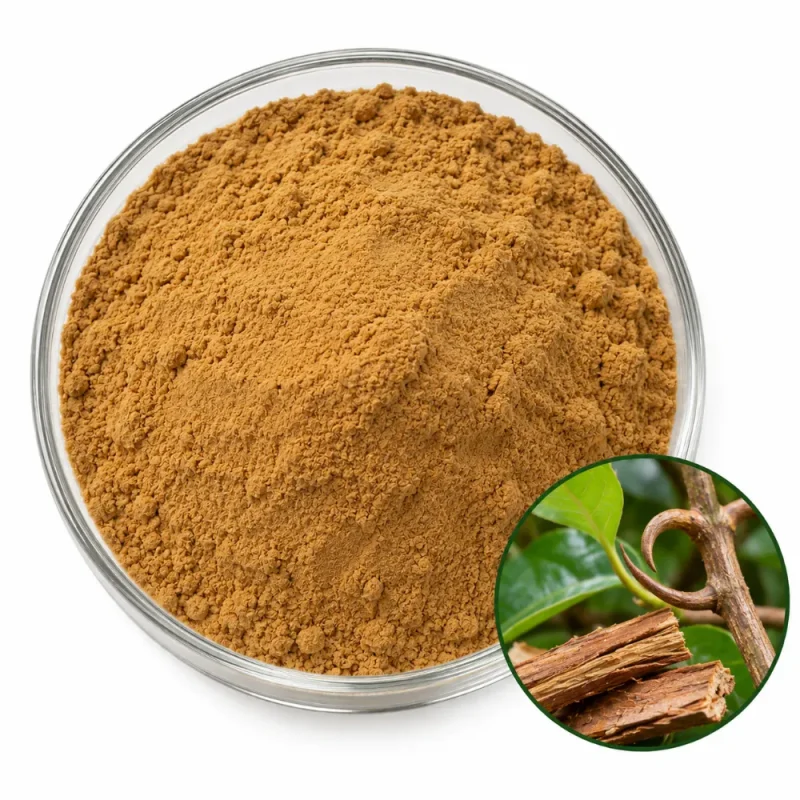
Cat’s Claw Extract 3–4% Total Alkaloids / POA-standardized grades

The inner bark of Uncaria tomentosa, a woody vine of the Amazon basin, is the only part used in cat’s claw extract, and thorns, leaf and root are excluded. Ethanol extraction takes up the oxindole alkaloids of the bark, and the concentrate is dried to a light brown powder.

The primary grade is 4% total alkaloids, with a 3% grade as the lower end, and no named assay method is attached to the grade. The powder is 80 mesh and slightly soluble in water. Both grades serve capsules and tablets, and the lower grade also suits dry blends in which the bark matrix is wanted.

Alkaloid Standardization & Grades

The alkaloids of cat’s claw are oxindole alkaloids, and they fall into two families. The pentacyclic oxindole alkaloids, abbreviated POA, include mitraphylline, isomitraphylline, speciophylline, uncarine F, pteropodine and isopteropodine. The tetracyclic family includes rhynchophylline and isorhynchophylline. The botanical entity is Uncaria tomentosa (Willd. ex Schult.) DC., and the extract is standardized to the total alkaloid fraction because it is the defining class of the bark and the one that distinguishes the species from non-alkaloid bark material.

GradeAssay & MethodWhere It Fits
3% Total AlkaloidsClass figure, no named methodDry blends, capsules at higher fill
4% Total AlkaloidsClass figure, no named methodCapsules and tablets

The two grades are close, so the choice follows fill weight and bark matrix more than dose. Cat’s claw is also supplied as a 10:1 ratio extract with no marker figure, the Cat’s Claw Extract Powder, and as milled bark, the Cat’s Claw Bark Powder. The product name refers to POA-standardized grades, but the published grade is the total alkaloid figure above. The standardized extract is the row to use when an alkaloid figure has to appear in the specification of the cat’s claw extract.

Alkaloid Analysis & Purity Risks

A total alkaloid figure can be obtained by acid-base extraction and gravimetric or titrimetric determination, or by summing alkaloid peaks in an HPLC run. The grade carries no named method, so the figure is read as the alkaloid fraction as determined by the laboratory procedure that accompanies the lot. Because a class figure depends on what is counted, it cannot be converted into a POA figure or compared with a number from a different procedure.

For identity, the HPLC fingerprint shows the oxindole alkaloid pattern of the bark, with the pentacyclic compounds as the characteristic cluster and the tetracyclic compounds as a second group. The ratio between the two families is part of the identity statement for the extract. A pattern with a clear pentacyclic cluster is the usual reference for Uncaria tomentosa bark.

Purity risks follow from chemistry and botany. Cat’s claw is known to occur in more than one chemotype, one dominated by pentacyclic and one by tetracyclic alkaloids, so a single total alkaloid percentage cannot show which family dominates. The species is also confused with Uncaria guianensis, a related vine, and with Uncaria rhynchophylla, which is traded for its tetracyclic alkaloids. In solution the pentacyclic alkaloids interconvert between isomers, which is why sample handling must be consistent.

Sample preparation for oxindole alkaloids calls for a basic or buffered extraction and prompt analysis. Long storage of a prepared sample in acid or at room temperature changes the isomer ratio and can make a lot look different from its own earlier result, so the sample sequence and holding time belong in the method description.

Raw material handling shapes the starting alkaloid level. The bark is stripped from wild or cultivated vines, and inner bark, outer bark and woody stem fragments differ in alkaloid concentration, so the separation of the bark from the wood before milling decides much of the final figure. Drying in shade rather than strong sun, and prompt milling of the dried bark, limit alkaloid loss. A cat’s claw extract made from bark held for long periods in humid storage shows a lower alkaloid figure and a stronger tannin character.

Typical Specifications

Specification ItemProduct Information
Latin NameUncaria tomentosa
Plant PartBark & Stem
ProcessingEthanol Extraction
Compound ClassAlkaloids
Common NameCat’s Claw, Una de Gato
Ingredient TypeStandardized Extract
Marker Compound(s)Total alkaloids (oxindole alkaloids of the bark)
Primary Grade4% Total Alkaloids
Available Grades3% · 4% Total Alkaloids
AppearanceLight Brown powder
Solubility / DispersibilitySlightly Soluble in Water
Quality Parameters
Moisture (LOD)≤5.0%
Total Ash≤5.0%
Particle Size80 mesh
Heavy MetalsLead ≤2 ppm · Arsenic ≤1 ppm · Cadmium ≤1 ppm · Mercury ≤0.1 ppm
MicrobiologyTPC ≤1,000 cfu/g · Yeast & Mold ≤100 cfu/g · E. coli Negative · Salmonella Negative/25 g
Shelf Life24 months in unopened original packaging, cool and dry storage

Applications by Grade

4% Grade for Standard Capsules

The 4% grade reaches an alkaloid target in a moderate fill, which suits two-piece capsules. The bark powder is fibrous and slightly bitter, so a flow agent keeps it moving through the hopper, and a sealed bottle limits moisture pickup.

3% Grade in Dry Blends

At the lower grade, dry blends carry the extract at a practical gram weight. The bark matrix is bulky and low in density, so add it in stages to a free-flowing carrier to avoid segregation during transport.

4% Grade in Tablet Blends

Tablets of the 4% grade need a dry binder because the fibrous bark extract compacts poorly alone. A film coat covers the bitter taste, and disintegration should be checked after storage, since the fiber swells slowly.

3% Grade in Sachet Premixes

Sachets of the 3% grade dilute the extract with a bulking carrier so the filler can weigh an accurate dose. Slight solubility leaves the cup hazy and brown, so flavor systems with cocoa or spice hide both taste and look.

4% Grade in Tea-Style Instant Blends

Instant blends in tea-bag or stick format use the 4% grade with cinnamon or ginger notes that match the woody bark taste. The extract steeps slowly, so a short stir and a fine grind give a more even cup.

3% Grade for Contract Blending

Contract blenders place the 3% grade in multi-ingredient powders where a bark matrix is wanted. Keep the batch record of the alkaloid figure with the lot, because the interconverting alkaloids make retesting at different times less comparable.

Technical & Quality Considerations

Cat’s claw extract is a light brown powder with a woody, faintly bitter character. It is slightly soluble in water, so a solution turns hazy brown, with part of the alkaloid salts dissolved and the rest in suspension. Oxindole alkaloids are weak bases, so solubility rises as pH falls, and an acidic beverage dissolves more of the fraction than a neutral one.

The pentacyclic alkaloids are sensitive to heat and to prolonged exposure to acid or base because they isomerize. Short, cool processing preserves the profile the lot was released with, while a long hot-fill step can shift the isomer ratio even though the total figure barely moves. Tannin-type polyphenols in the bark also darken the extract over time in humid air.

Scale-up starts with sieving the fibrous bark powder and premixing it with part of the carrier. Keep drums sealed with a desiccant, store cool and avoid direct sunlight. Because the bark is dusty, use local extraction at the charging point and wipe surfaces, since the brown dust stains and carries a bitter note into pale products.

The taste and mouthfeel of cat’s claw extract come from its tannin-type polyphenols as much as from the alkaloids. They give a dry, astringent finish, and they react with iron and other metal ions to form dark complexes, so mineral premixes that contain iron salts can turn a pale blend gray. Proteins bind the tannins and may haze a clear drink, which is why dairy-based or plant-protein beverages need a short pilot trial. Acidic fruit flavors and sweeteners soften the astringency.

Packaging & Commercial Supply

Essencefield supports product evaluation, formulation trials, commercial orders, and ongoing ingredient supply. Packaging, storage, and shipping arrangements are determined by product characteristics, order quantity, stability requirements, and destination-market needs.

Supply ItemGeneral Information
SampleAvailable upon request for formulation, testing, and supplier evaluation
Order Quantities100 g · 1 kg · 5 kg · 25 kg · 100 kg · 500 kg · Bulk
Sample Lead TimeTypically 5–7 days after sample confirmation
Production Lead TimeTypically 15–30 days after order and specification confirmation
PackagingSuitable protective inner packaging with bags, cartons, drums, or other appropriate outer packaging
StorageStore in tightly sealed, suitable protective packaging in a cool, dry environment. Protect from moisture, heat, and direct sunlight. Specific storage conditions follow the approved product specification.
DocumentationCOA · Product Specification · TDS · SDS · Applicable declarations (as applicable)

Final order quantities, lead times, packaging, documentation, and shipping arrangements are confirmed according to the selected product and commercial requirements.

Request Ingredient Specifications & Quote

Share your target specification, application, quantity, and documentation needs. We’ll help confirm suitable options, samples, and commercial supply details.