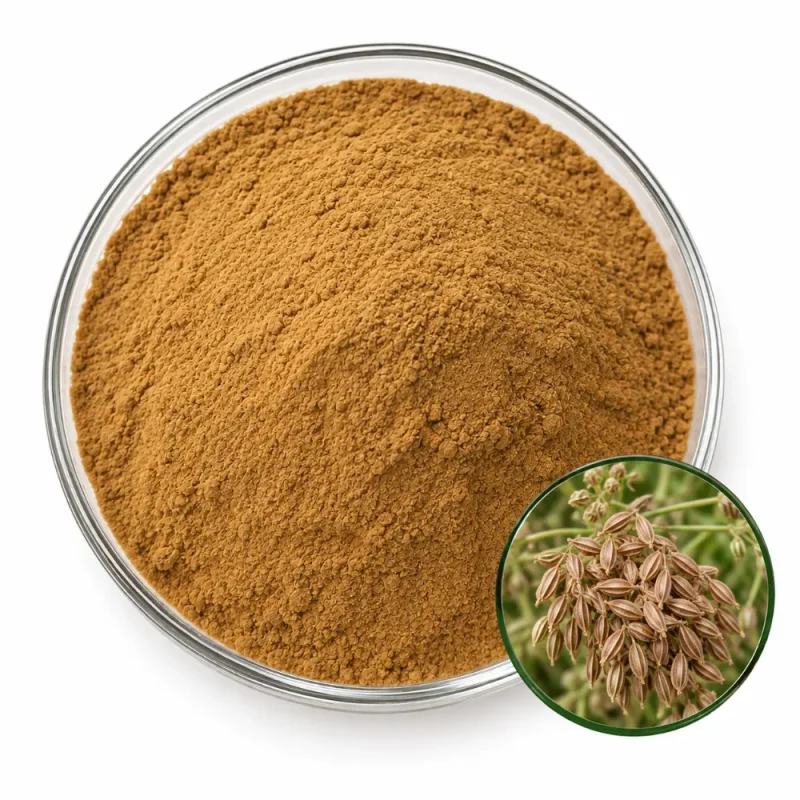
Cnidium monnieri Extract 5–30% Osthole

The dried fruit of Cnidium monnieri, known in the Chinese trade as she chuang zi, is the only part used in this extract, and the root, stem and leaf are excluded. Ethanol extraction takes up the lipophilic coumarins of the fruit, and the concentrate is dried to a light brown powder.

Osthole is measured by HPLC, with a primary grade of 30% and a lower grade of 5%. The powder is 80 mesh and insoluble in water. The 30% grade fits capsules and tablets that need a small fill, while the 5% grade fits blends and oil-based fills in which the fruit matrix is wanted at higher inclusion.

Osthole Standardization & Grades

Osthole is a prenylated coumarin, 7-methoxy-8-isopentenylcoumarin, and it is the main coumarin of the Cnidium fruit. Imperatorin, bergapten, xanthotoxin and isopimpinellin accompany it as furanocoumarins. The botanical entity is Cnidium monnieri (L.) Cusson, and the extract is standardized to osthole because it is the defining compound of the fruit. It is the compound used to separate true she chuang zi from look-alike Apiaceae fruits, and HPLC resolves it cleanly from the furanocoumarins.

GradeAssay & MethodWhere It Fits
5% OstholeHPLCBlends and oil-based fills, higher inclusion
30% OstholeHPLCCapsules and tablets, small fill weight

Grade choice follows dose and fill weight. The 30% grade carries six times the osthole load of the 5% grade per gram, so a capsule reaches its target with far less powder. The 5% grade is bulkier, more waxy and easier to disperse in a lipid carrier, and it keeps more of the aromatic fruit matrix in the Cnidium monnieri extract. Cnidium is also supplied as a 10:1 ratio extract with no marker figure, the Cnidium Fruit Extract Powder, and as a single compound, Osthole 98%. The standardized extract is the row to use when an osthole figure has to appear in the specification of the Cnidium monnieri extract.

Osthole Analysis & Purity Risks

HPLC separates osthole from the other coumarins on a reversed-phase column and quantifies the peak against a reference standard, with UV detection at a wavelength where the coumarin chromophore absorbs strongly. The result is osthole specifically. A UV total or a gravimetric coumarin figure would count the furanocoumarins as well, and neither can be converted into the HPLC value.

For identity, the fingerprint of the fruit is read beside osthole. Imperatorin, bergapten, xanthotoxin and isopimpinellin form a recognizable furanocoumarin cluster, and the ratio between these peaks and the osthole peak is characteristic of Cnidium monnieri fruit. The pattern helps to separate the fruit from material of related Apiaceae species.

Purity risks follow from the botanical group. The fruit of Torilis japonica and other Apiaceae are known to be traded as substitutes for she chuang zi, and Cnidium officinale, a different plant used for its rhizome, is easily confused by name. A named species, a stated fruit part and a coumarin fingerprint protect identity better than one percentage does. The furanocoumarins are photoactive, so a high furanocoumarin share is a quality consideration for external and oral use alike.

Sample preparation uses a polar organic solvent that dissolves the lipophilic coumarins, followed by filtration through a fine membrane. The solution is protected from light, because osthole and the furanocoumarins degrade under strong light, and the sequence is injected promptly.

Raw material handling also matters. The dried fruit is a small, ridged schizocarp with a fragrant oil, and cleaning removes stalks and soil before milling. Overheated drying or long storage in warm air lowers the osthole content and darkens the fruit, which is why a fresh, well-dried lot gives a cleaner extract.

Typical Specifications

Specification ItemProduct Information
Latin NameCnidium monnieri
Plant PartFruit & Berry
ProcessingEthanol Extraction
Compound ClassCoumarins, Polyphenols
Common NameCnidium, She Chuang Zi
Ingredient TypeStandardized Extract
Marker Compound(s)Osthole
Primary Grade30% Osthole (HPLC)
Available Grades5% · 30% Osthole (HPLC)
AppearanceLight Brown powder
Solubility / DispersibilityInsoluble in Water
Quality Parameters
Moisture (LOD)≤5.0%
Total Ash≤5.0%
Particle Size80 mesh
Heavy MetalsLead ≤2 ppm · Arsenic ≤1 ppm · Cadmium ≤1 ppm · Mercury ≤0.1 ppm
MicrobiologyTPC ≤1,000 cfu/g · Yeast & Mold ≤100 cfu/g · E. coli Negative · Salmonella Negative/25 g
Shelf Life24 months in unopened original packaging, cool and dry storage

Applications by Grade

30% Grade for Compact Capsules

The 30% grade of Cnidium monnieri extract reaches an osthole target in a small fill, which suits compact capsules. The lipophilic powder is waxy and clings to hopper walls, so a flow agent and a dry room keep fill weights steady.

5% Grade in Oil-Based Fills

The 5% grade disperses readily in an oil carrier, which suits softgel-style or liquid-fill capsules. Mill the powder fine before dispersion, because coarse coumarin particles settle in the oil and lead to uneven dosing. Keep the fill under gentle agitation while it is dispensed, and check capsule weight at intervals during the run.

30% Grade in Tablet Blends

Tablets of the 30% grade need a dry binder and a glidant, because the waxy extract can stick to punches in humid rooms. A film coat limits dust and covers the faintly aromatic, bitter taste of the fruit.

5% Grade in Sachet Blends

Sachets of the 5% grade dilute the extract with a bulking carrier so the filler can weigh an accurate dose. The extract is insoluble, so the label should call for stirring and the powder should be milled fine to avoid specks.

5% Grade in Bar Blends

In cold-pressed bars the 5% grade is blended into the dry fraction ahead of the syrup. The aromatic, slightly spicy taste of the fruit sits under cocoa, ginger or citrus-peel flavors, and the tan color blends into dark bases.

30% Grade for Contract Blending

Contract blenders place the 30% grade as a concentrated component in multi-ingredient powders. The aroma travels across adjacent runs, so dedicated scoops and a purge of the line protect milder products that follow. Record the clean-down so a later audit can trace the sequence of products.

Technical & Quality Considerations

Cnidium monnieri extract is a light brown powder with a distinctive aromatic, slightly resinous odor. It is insoluble in water, so any liquid format needs an oil carrier or a suspension system. Osthole dissolves in ethanol and in lipid phases, which is why oily or alcoholic phases give a more uniform dispersion than an aqueous mix.

Coumarins are stable to moderate heat, but osthole and the furanocoumarins absorb UV light and degrade on prolonged exposure, so finished goods should be protected from direct light in opaque or amber packs. The lipophilic powder oxidizes slowly in humid air, and the aromatic oil fraction can soften the powder during warm storage, causing clumping.

For scale-up, sieve the powder through a fine screen and premix it with part of the carrier. Weigh the first fills against the target, because density shifts between lots. Run encapsulation in a controlled-humidity room, and keep drums sealed and flushed.

Taste and odor are the limiting sensory features. The fruit has a pungent, bitter, aromatic taste that carries into any beverage, and flavor systems with ginger, citrus or warm spice mask it better than sweeteners alone. In dry formats the odor is of little concern, but opening a drum fills a packing room with the scent, so ventilation at the charging point is advisable. Sealed liners and a cool store keep the aroma in the drum and out of the packing room.

Packaging & Commercial Supply

Essencefield supports product evaluation, formulation trials, commercial orders, and ongoing ingredient supply. Packaging, storage, and shipping arrangements are determined by product characteristics, order quantity, stability requirements, and destination-market needs.

Supply ItemGeneral Information
SampleAvailable upon request for formulation, testing, and supplier evaluation
Order Quantities100 g · 1 kg · 5 kg · 25 kg · 100 kg · 500 kg · Bulk
Sample Lead TimeTypically 5–7 days after sample confirmation
Production Lead TimeTypically 15–30 days after order and specification confirmation
PackagingSuitable protective inner packaging with bags, cartons, drums, or other appropriate outer packaging
StorageStore in tightly sealed, suitable protective packaging in a cool, dry environment. Protect from moisture, heat, and direct sunlight. Specific storage conditions follow the approved product specification.
DocumentationCOA · Product Specification · TDS · SDS · Applicable declarations (as applicable)

Final order quantities, lead times, packaging, documentation, and shipping arrangements are confirmed according to the selected product and commercial requirements.

Request Ingredient Specifications & Quote

Share your target specification, application, quantity, and documentation needs. We’ll help confirm suitable options, samples, and commercial supply details.