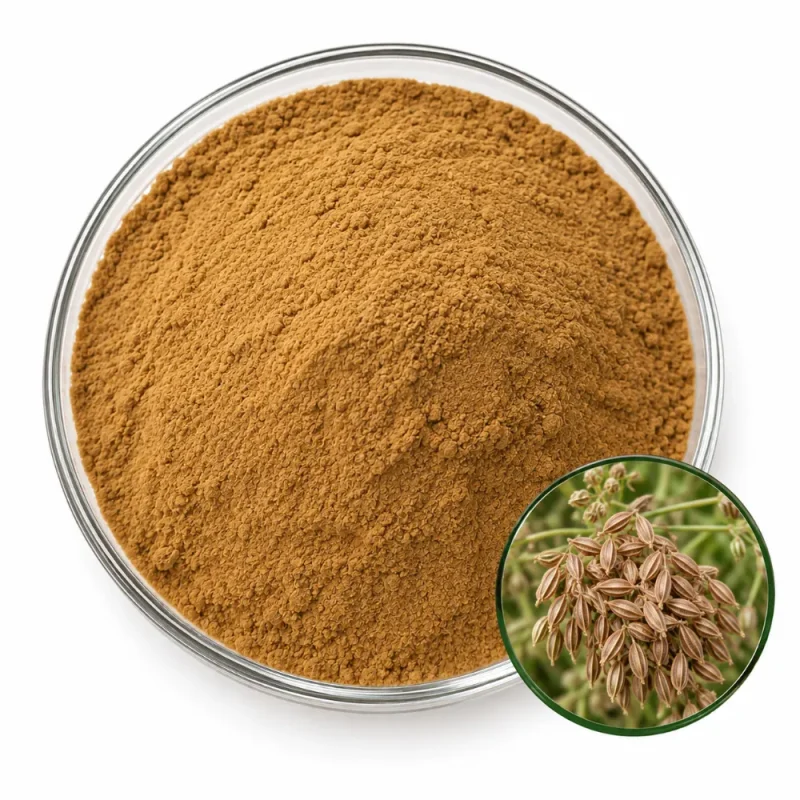
Cumin Seed Extract 2.5% Bitters

Cumin seed extract starts from the dried seed of Cuminum cyminum, the true cumin of the parsley family. The leaf, stem and the unrelated black cumin (Nigella sativa) are not part of the starting material. Ethanol extraction takes up the phenolic and bitter-tasting compounds of the seed, and the concentrate is dried to a light brown powder.

The single grade is 2.5% bitters, and no named assay method is attached to it. The powder is 80 mesh and slightly soluble in water. It fits capsules, tablets and spiced powder blends in which the seed’s bitter, warm character is part of the design.

Bitters Standardization & Grades

Bitters is a taste-defined class and not a single compound. In cumin seed it covers the bitter-tasting phenolic and terpenoid compounds that remain in the extract after the bulk of the volatile oil, whose main components are cuminaldehyde, p-cymene and the terpinene isomers, has been separated or lost in drying. The botanical entity is Cuminum cyminum L., and the extract is standardized to bitters because the bitter principle is the quality that buyers of a seed extract look for and the one that distinguishes a seed extract from a plain seed powder.

The grade is a single point at 2.5%, so there is no grade table. A bitters figure depends on how bitterness is measured, whether by a sensory dilution method or by a chemical proxy. A number from one procedure is not comparable with a number from another. A 10:1 ratio extract of cumin with no marker figure is available too, the Cumin Seed Extract Powder. The data also records a defined polyphenol option, which is not published here. The standardized extract is the row to use when a bitters figure has to appear in the specification of the cumin seed extract.

Bitters Analysis & Purity Risks

Bitterness is a sensory property, so the usual pharmacopoeial approach is a bitterness value, the highest dilution at which a panel still detects a bitter taste, compared with a quinine reference. A chemical proxy such as a summed HPLC peak group or a total phenolic reading can also be used. The grade carries no named method, so the figure is read as the bitters level determined by the procedure that accompanies the lot, and it cannot be converted into an HPLC value or a phenolic total.

For identity, a GC or HPLC fingerprint of the seed is read beside the bitters figure. Cuminaldehyde, cuminic alcohol and p-cymene mark the volatile fraction, and the flavonoid glycosides of apigenin and luteolin together with phenolic acids mark the non-volatile fraction. The pattern shows whether the material is cumin seed and not another aromatic seed.

Purity risks follow from the botanical group. Cumin is confused by name with black cumin, caraway and fennel, which belong to different genera and give different extracts. Ground spice has a documented history of dilution with cheaper plant material and of addition of dyes. The stated species, the stated seed part and a fingerprint protect identity better than one bitters figure does.

Sample preparation for sensory work requires a controlled dilution series and a trained panel, while chemical proxies require extraction into a suitable solvent and filtration. Either way the sample must be fresh, since volatile and bitter components change with storage.

Raw material handling also matters. Seed is cleaned of stalks, stones and dust, then milled, and heat during milling drives off part of the volatile oil. A seed lot stored in warm air loses aroma and darkens, which lowers the quality of the starting material before extraction begins.

Typical Specifications

Specification ItemProduct Information
Latin NameCuminum cyminum
Plant PartSeed & Grain
ProcessingEthanol Extraction
Compound ClassPolyphenols
Common NameCumin Seed, Cumin
Ingredient TypeStandardized Extract
Marker Compound(s)Bitters (bitter-tasting principles of the seed)
Primary Grade2.5% Bitters
AppearanceLight Brown powder
Solubility / DispersibilitySlightly Soluble in Water
Quality Parameters
Moisture (LOD)≤5.0%
Total Ash≤5.0%
Particle Size80 mesh
Heavy MetalsLead ≤2 ppm · Arsenic ≤1 ppm · Cadmium ≤1 ppm · Mercury ≤0.1 ppm
MicrobiologyTPC ≤1,000 cfu/g · Yeast & Mold ≤100 cfu/g · E. coli Negative · Salmonella Negative/25 g
Shelf Life24 months in unopened original packaging, cool and dry storage

Applications by Grade

2.5% Grade for Capsule Fills

Cumin seed extract at 2.5% bitters suits two-piece capsules, where the shell hides the taste. The powder carries a warm, spiced aroma, so fill in a closed system and use a flow agent to keep the slightly oily powder moving.

2.5% Grade in Tablet Blends

Tablets need a dry binder and a lubricant, because the seed’s oily fraction can stick to punches. A film coat contains the aroma and covers the bitterness, and the tablets should be packed in foil to hold the scent.

2.5% Grade in Spiced Powder Blends

Savory and spiced powder blends carry the extract naturally, since cumin character is expected in them. Add it with other ground spices in a dry blend, and check that the blend keeps its flow properties in humid storage.

2.5% Grade in Sachet Premixes

Sachets dilute the extract with a bulking carrier so that the filler can weigh an accurate dose. The extract is only slightly soluble, so the label should call for stirring, and a foil laminate holds the aroma.

2.5% Grade in Stick-Pack Drink Powders

Stick-pack drink powders pair the extract with ginger, lemon or mint flavors that carry its warm, bitter character. The cup is hazy and tan, and a fine grind improves dispersion in cold water. Keep the serving small, because cumin character builds quickly in a drink.

2.5% Grade for Contract Blending

Contract blenders use the extract as a flavor-forward component in multi-ingredient powders. Spice aroma persists on equipment surfaces, so a dry purge of the line protects milder products that follow, and the order of products belongs in the batch record.

Technical & Quality Considerations

Cumin seed extract is a light brown powder with a warm, spicy, slightly earthy odor and a bitter, persistent taste. It is slightly soluble in water, so a solution turns hazy brown, with part of the polar fraction dissolved and the lipophilic fraction in suspension. Heating helps dissolution but drives off aroma, so cool dispersion keeps the character cleaner.

The volatile aldehyde cuminaldehyde oxidizes to cuminic acid in air and light, which changes the aroma from fresh and spicy toward stale and sour over a long shelf life. Light-protective packaging and sealed liners slow this change. The phenolic fraction darkens slowly in the presence of iron, so stainless contact surfaces and low-iron fillers keep the color stable.

Scale-up of cumin seed extract starts with sieving and a premix with part of the carrier, followed by a weight check on the first fills. A drum that will sit for months is better flushed with nitrogen and stored cool, because the aldehyde fraction oxidizes in air. Local extraction at the charging point and separate scoops keep the spicy aroma away from milder products.

Taste is the limiting factor in beverages. A cup with more than a small serving of the extract tastes strongly spiced and bitter, and sweet, citrus or mint flavors soften the effect. In dry formats the taste is irrelevant to the buyer, and the aroma of a freshly opened drum is the main quality cue.

Packaging & Commercial Supply

Essencefield supports product evaluation, formulation trials, commercial orders, and ongoing ingredient supply. Packaging, storage, and shipping arrangements are determined by product characteristics, order quantity, stability requirements, and destination-market needs.

Supply ItemGeneral Information
SampleAvailable upon request for formulation, testing, and supplier evaluation
Order Quantities100 g · 1 kg · 5 kg · 25 kg · 100 kg · 500 kg · Bulk
Sample Lead TimeTypically 5–7 days after sample confirmation
Production Lead TimeTypically 15–30 days after order and specification confirmation
PackagingSuitable protective inner packaging with bags, cartons, drums, or other appropriate outer packaging
StorageStore in tightly sealed, suitable protective packaging in a cool, dry environment. Protect from moisture, heat, and direct sunlight. Specific storage conditions follow the approved product specification.
DocumentationCOA · Product Specification · TDS · SDS · Applicable declarations (as applicable)

Final order quantities, lead times, packaging, documentation, and shipping arrangements are confirmed according to the selected product and commercial requirements.

Request Ingredient Specifications & Quote

Share your target specification, application, quantity, and documentation needs. We’ll help confirm suitable options, samples, and commercial supply details.