
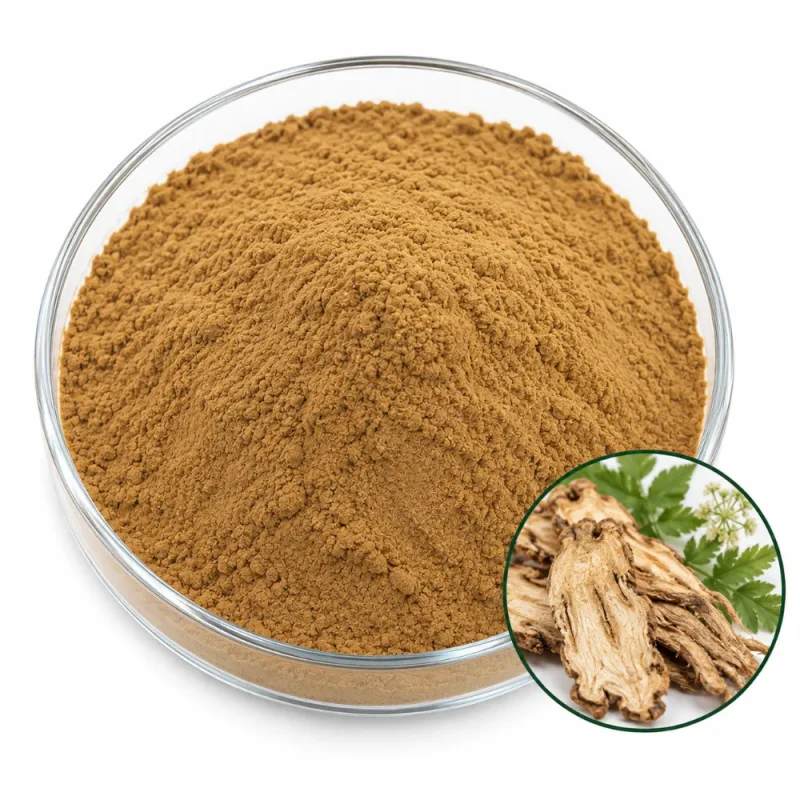
Ligustilide Standardization & Grades
Ligustilide is a phthalide, a lipophilic lactone that is the main volatile compound of the dong quai root and the one that gives the root its characteristic celery-like aroma. Butylidenephthalide, senkyunolide and ferulic acid accompany it in the extract. The botanical entity is Angelica sinensis (Oliv.) Diels, and the extract is standardized to ligustilide because it is the defining compound of the species and because HPLC resolves it from the other phthalides of the root.
| Grade | Assay & Method | Where It Fits |
|---|---|---|
| 1% Ligustilide | HPLC | Blends and oil-based fills, higher inclusion |
| 5% Ligustilide | HPLC | Capsules and softgel-style fills, small dose |
Grade choice follows dose and fill weight. The 5% grade carries five times the ligustilide of the 1% grade per gram, so a capsule reaches its target with less powder, while the 1% grade is bulkier, more fibrous and easier to blend dry. Dong quai is also supplied as a 10:1 ratio extract with no marker figure, the Dong Quai Extract Powder, and as milled root, the Angelica sinensis Root Powder, while the same root is also listed as the Angelica Root Extract Powder. When the dong quai extract specification has to state a ligustilide figure, the standardized extract is the one to use.


