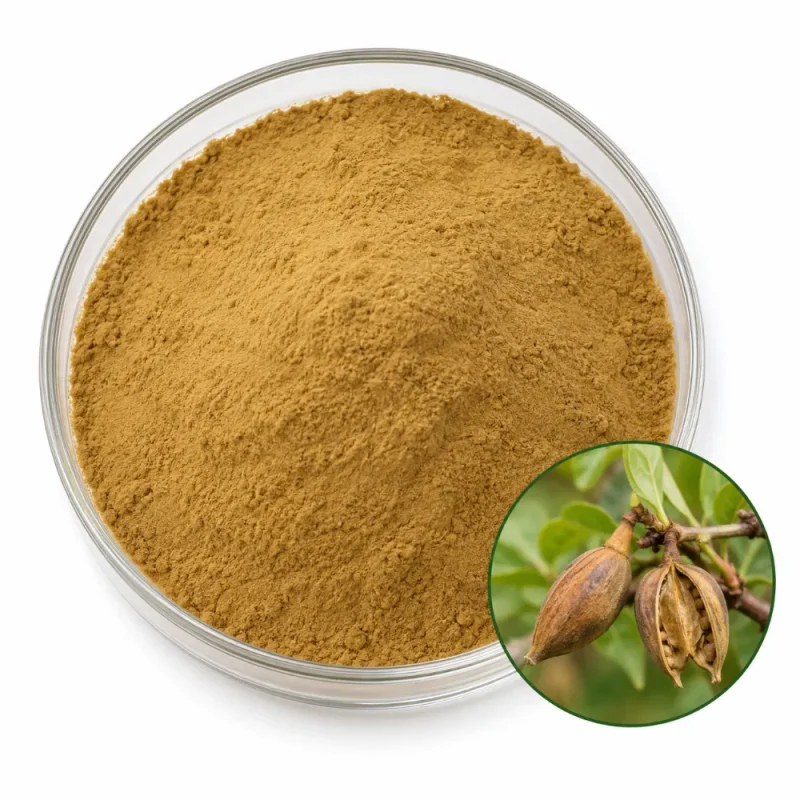
Forsythia Suspensa Extract 1–20% Phillyrin / Forsythiaside A

The dried fruit of Forsythia suspensa, the weeping forsythia sold in the Chinese trade as lian qiao, is the only part used in this extract, and the leaf, stem and flower are excluded. Ethanol extraction takes up the lignan and phenylethanoid glycosides of the fruit, and the concentrate is dried to a light brown powder.

Phillyrin and forsythiaside A are measured by HPLC, with a primary grade of 20% and a lower grade of 1%. The powder is 80 mesh and slightly soluble in water. The 20% grade fits capsules and tablets that need a small fill, while the 1% grade fits blends and drink powders in which the fruit matrix is wanted.

Phillyrin and Forsythiaside Standardization & Grades

Phillyrin, also called forsythin, is a lignan glycoside, while forsythiaside A is a caffeoyl phenylethanoid glycoside. The two compounds have different chemistry and polarity, and they are the two identity compounds of the forsythia fruit. The botanical entity is Forsythia suspensa (Thunb.) Vahl, and the extract is standardized to the pair because both are characteristic of the fruit and both are measured by the same HPLC run.

GradeAssay & MethodWhere It Fits
1% Phillyrin / Forsythiaside AHPLCBlends and drink powders, higher inclusion
20% Phillyrin / Forsythiaside AHPLCCapsules and tablets, small fill weight

Grade choice follows dose and fill weight. The 20% grade carries twenty times the marker load of the 1% grade per gram, so a capsule reaches its target with a fraction of the powder, while the 1% grade is bulkier and keeps more of the fruit’s sugars and phenolics. Forsythia is also supplied as a 10:1 ratio extract with no marker figure, the Forsythia Suspensa Extract Powder, as milled fruit, the Forsythia Fruit Powder, and as a single compound, Forsythoside A 98%. The standardized extract is the row to use when a marker figure has to appear in the specification of the Forsythia suspensa extract.

Phillyrin and Forsythiaside Analysis & Purity Risks

HPLC separates phillyrin and forsythiaside A on a reversed-phase column and quantifies the peaks against reference standards, with UV detection at a wavelength where both chromophores absorb. The grade refers to the pair, so the figure depends on whether the two are summed or one is stated, and on the reference chosen. A UV total would count other phenolics, and neither a UV nor a gravimetric figure can be converted into the HPLC value.

For identity, the fingerprint of the fruit is read beside the markers. Phillyrin is the less polar peak and forsythiaside A the more polar one, with rutin, pinoresinol glucoside and caffeic acid derivatives as neighbors. The ratio between phillyrin and forsythiaside A is characteristic of the maturity of the fruit, because green fruit and ripe fruit differ in their balance.

Purity risks follow from the botanical group. Forsythia fruit is traded in two forms, the green, immature fruit and the ripe, yellow-brown fruit, and the forsythiaside A level is higher in the green fruit. The stated fruit stage is therefore part of the identity. Other Forsythia species and the unrelated Hypericum and Lonicera fruits are sometimes mixed in, and a named species protects identity better than one percentage.

Sample preparation uses a polar solvent at moderate temperature, because forsythiaside A carries a caffeoyl ester that hydrolyzes in strong base and degrades in prolonged heat. Samples are kept neutral or mildly acidic and injected promptly.

Raw material handling also matters. Green fruit is harvested early and steamed or briefly boiled to stop enzymes before drying, while ripe fruit is harvested later and sun-dried. Enzymes that survive in poorly stabilized fruit degrade forsythiaside A during storage.

Typical Specifications

Specification ItemProduct Information
Latin NameForsythia suspensa
Plant PartFruit & Berry
ProcessingEthanol Extraction
Compound ClassPolyphenols
Common NameForsythia, Weeping Forsythia, Lian Qiao
Ingredient TypeStandardized Extract
Marker Compound(s)Phillyrin (forsythin) and forsythiaside A
Primary Grade20% Phillyrin / Forsythiaside A (HPLC)
Available Grades1% · 20% Phillyrin / Forsythiaside A (HPLC)
AppearanceLight Brown powder
Solubility / DispersibilitySlightly Soluble in Water
Quality Parameters
Moisture (LOD)≤5.0%
Total Ash≤5.0%
Particle Size80 mesh
Heavy MetalsLead ≤2 ppm · Arsenic ≤1 ppm · Cadmium ≤1 ppm · Mercury ≤0.1 ppm
MicrobiologyTPC ≤1,000 cfu/g · Yeast & Mold ≤100 cfu/g · E. coli Negative · Salmonella Negative/25 g
Shelf Life24 months in unopened original packaging, cool and dry storage

Applications by Grade

20% Grade for Compact Capsules

The 20% grade of Forsythia suspensa extract reaches a marker target in a small fill, which suits compact capsules. The powder is slightly hygroscopic, so fill in a dry room and seal the capsules in a desiccated bottle.

1% Grade in Drink Powders

The 1% grade of Forsythia suspensa extract is bulky enough to carry in stick-pack drink powders. It gives a pale brown, slightly hazy cup with a mild, bitter-sweet fruit taste that suits honey, citrus and herbal tea bases, and cool water gives the cleanest dispersion.

20% Grade in Tablet Blends

Tablets of the 20% grade need a dry binder and a glidant, because phenylethanoid-rich powders compact into hard, slow-dissolving tablets. Film coating slows moisture uptake, and tablets are tested for hardness after storage. A polished punch face reduces sticking when the compression room is humid.

1% Grade in Instant Tea-Style Blends

Instant blends in stick format use the 1% grade with chrysanthemum, honeysuckle or mint bases that match the cool, bitter-sweet character. A short stir is enough to produce an even cup without clumping, and a fine grind keeps the particles from settling too quickly.

1% Grade in Sachet Premixes

Sachets of the 1% grade call for a bulking carrier to dilute the extract, which lets the filler weigh an accurate dose. A foil laminate with low moisture transmission keeps the powder free-flowing through shelf life, and a quick check of sachet weights confirms the dilution holds across the run.

20% Grade in Stepwise Dilutions

Where a dose is small, the 20% grade is diluted in stages with a bulking carrier before it reaches the filler. Check blend uniformity on a trial batch, because small amounts of a strong powder stratify.

Technical & Quality Considerations

Forsythia suspensa extract is a light brown powder with a faint, woody-fruity odor and a bitter-sweet, slightly astringent taste. It is slightly soluble in water, so a solution turns hazy yellow-brown, with forsythiaside A largely dissolved and phillyrin, a less polar lignan, largely in suspension. Heating helps dissolution but deepens the color.

Forsythiaside A is the sensitive marker. The caffeoyl ester oxidizes in air and light, hydrolyzes at high pH and chelates iron to give dark complexes, so alkaline buffers, iron-fortified premixes and clear bottles lower the figure and darken the product. Acidic to neutral bases, antioxidants and light-protective packaging keep it steadier. Phillyrin is more stable and survives heat better.

At scale, start with a sieve and a premix with part of the carrier, then weigh the first fills. Drums are stored sealed and cool, with a desiccant liner in humid regions, and a closed charging system limits the brown dust that otherwise spreads across the packing room.

Before scale-up, the extract should be trialed with its intended co-ingredients. Protein-containing drinks may haze because the phenolics bind protein, and mineral premixes can discolor, so a pilot batch at the target pH shows early whether a combination is sound.

Taste and color deserve a short trial in liquid formats. Forsythia suspensa extract tastes bitter-sweet with a cool, resinous finish, and the cup is a pale to mid brown that deepens with heat. Honey, pear and chrysanthemum notes suit the character, and a squeeze of lemon lowers the pH enough to keep forsythiaside A steadier over the shelf life. A taste panel on the final recipe is worth more than a calculation.

Packaging & Commercial Supply

Essencefield supports product evaluation, formulation trials, commercial orders, and ongoing ingredient supply. Packaging, storage, and shipping arrangements are determined by product characteristics, order quantity, stability requirements, and destination-market needs.

Supply ItemGeneral Information
SampleAvailable upon request for formulation, testing, and supplier evaluation
Order Quantities100 g · 1 kg · 5 kg · 25 kg · 100 kg · 500 kg · Bulk
Sample Lead TimeTypically 5–7 days after sample confirmation
Production Lead TimeTypically 15–30 days after order and specification confirmation
PackagingSuitable protective inner packaging with bags, cartons, drums, or other appropriate outer packaging
StorageStore in tightly sealed, suitable protective packaging in a cool, dry environment. Protect from moisture, heat, and direct sunlight. Specific storage conditions follow the approved product specification.
DocumentationCOA · Product Specification · TDS · SDS · Applicable declarations (as applicable)

Final order quantities, lead times, packaging, documentation, and shipping arrangements are confirmed according to the selected product and commercial requirements.

Request Ingredient Specifications & Quote

Share your target specification, application, quantity, and documentation needs. We’ll help confirm suitable options, samples, and commercial supply details.