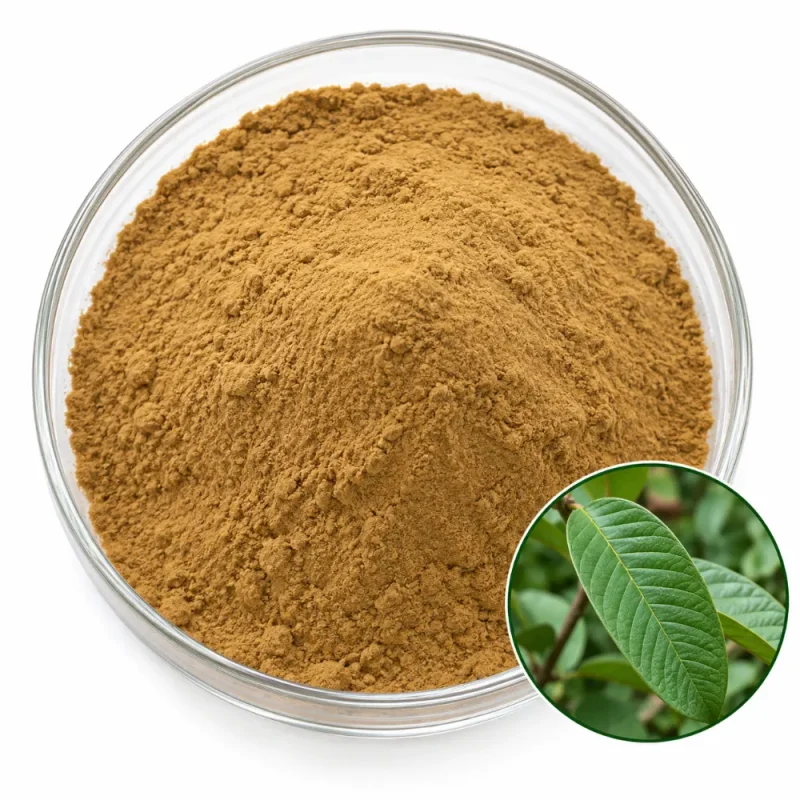
Guava Leaf Extract 20% Polyphenols

Guava leaf extract is prepared from the dried leaf of Psidium guajava, the common guava tree, and the fruit, bark and root are not part of the starting material. Ethanol extraction takes up the flavonoid glycosides and tannins of the leaf, and the concentrate is dried to a green powder.

The single grade is 20% polyphenols by UV with the Folin-Ciocalteu method. The powder is 80 mesh and water soluble. It fits capsules, tablets and drink powders in which a leaf-derived polyphenol fraction is the design target.

Polyphenol Standardization & Grades

Polyphenols here is a class figure, not a single compound. In guava leaf it covers quercetin glycosides such as guaijaverin, avicularin and hyperin, together with catechins and the ellagitannins and gallotannins that give the leaf its astringency, and phenolic acids such as gallic and ellagic acid. The botanical entity is Psidium guajava L., and the extract is standardized to polyphenols because no single compound dominates enough to serve as a marker. The class figure is the steadier release parameter for a leaf of this kind.

The grade is a single point at 20%, so there is no grade table. A figure of 20% leaves most of the powder as leaf sugars, organic acids and other soluble matter. Guava leaf is also supplied as a 10:1 ratio extract with no marker figure, the Guava Leaf Extract Powder, and the fruit is available as Guava Powder and Freeze-Dried Guava Powder, which are fruit products with a different composition. The standardized extract is the row to use when a polyphenol figure has to appear in the specification of the guava leaf extract.

Polyphenol Analysis & Purity Risks

In the Folin-Ciocalteu method, phenolic hydroxyl groups reduce the reagent, and the resulting blue product is read by UV-visible spectrophotometry against a reference phenol, most often gallic acid. The result is therefore an equivalent of that reference. The method is non-specific: ascorbic acid, some sugars and amino acids also reduce the reagent. A figure is comparable only with another figure on the same basis and cannot be converted into an HPLC result for a named flavonoid.

For identity, an HPLC fingerprint of the leaf is read beside the polyphenol figure. Guaijaverin, avicularin, hyperin and quercetin glycosides form the flavonol cluster, and gallic and ellagic acid with the tannin humps form a second group. The pattern separates guava leaf from the leaves of related Myrtaceae such as eucalyptus and clove.

Purity risks follow from the botanical group. Several guava species, among them the strawberry guava Psidium cattleianum, are grown and sold, and their leaf chemistry differs in proportion. Identity is protected better by the stated species and the stated leaf part than by one percentage. A Folin-Ciocalteu figure cannot show whether the phenolics are flavonoids or tannins, so the fingerprint matters as much as the percentage.

Samples are diluted into the working range of the calibration curve and run with a reagent blank. The reaction is sensitive to time and temperature, so each sample is read within a fixed window after the alkali goes in.

Raw material handling also matters. Mature leaves are picked, shade-dried and milled, because sun-drying degrades chlorophyll and some flavonoids. A well-dried leaf is green-gray and aromatic, whereas a damp lot browns and loses color in the extract.

Typical Specifications

Specification ItemProduct Information
Latin NamePsidium guajava
Plant PartLeaf & Herb
ProcessingEthanol Extraction
Compound ClassPolyphenols
Common NameGuava Leaf
Ingredient TypeStandardized Extract
Marker Compound(s)Total polyphenols
Primary Grade20% Polyphenols (UV, Folin-Ciocalteu)
AppearanceGreen powder
Solubility / DispersibilityWater Soluble
Quality Parameters
Moisture (LOD)≤5.0%
Total Ash≤5.0%
Particle Size80 mesh
Heavy MetalsLead ≤2 ppm · Arsenic ≤1 ppm · Cadmium ≤1 ppm · Mercury ≤0.1 ppm
MicrobiologyTPC ≤1,000 cfu/g · Yeast & Mold ≤100 cfu/g · E. coli Negative · Salmonella Negative/25 g
Shelf Life24 months in unopened original packaging, cool and dry storage

Applications by Grade

20% Grade for Standard Capsules

Guava leaf extract at 20% polyphenols fills two-piece capsules at a moderate weight. The green powder is hygroscopic and tannic, so fill in a dry room, use a flow agent and seal the capsules in a desiccated bottle.

20% Grade in Tablet Blends

Tablets need a dry binder and a glidant, and a film coat covers the astringent taste of the leaf. Tannin-bearing powders compact into hard tablets that dissolve slowly, so check hardness and disintegration after storage.

20% Grade in Tea-Style Drink Powders

Stick-pack drink powders pair the 20% grade with tea-like, citrus or mint flavors that suit the green, astringent character. The extract dissolves into a clear to slightly hazy green-brown cup, and cool water gives the cleanest result.

20% Grade in Fruit-Flavored Blends

Fruit-flavored powders use the extract as a polyphenol anchor in guava, tropical or berry bases. Because the green color fades in acidic fruit systems, test the shade at the intended pH before finalizing the recipe.

20% Grade in Sachet Premixes

For sachets, the 20% grade is diluted with a bulking carrier so that the filler can weigh an accurate dose. Foil laminate with low moisture transmission keeps the powder free-flowing, and light-protective film holds the green tone during storage.

20% Grade in Gummy Bases

Gummies take the extract in muted green or brown shades. Tannins can shorten the gel set of a pectin or gelatin base, so add the powder late in the cook and trial a small cast before scaling.

Technical & Quality Considerations

Guava leaf extract is a green to olive-green powder with a faint, tea-like and slightly resinous odor and an astringent, bitter taste. It is water soluble, giving a clear to slightly hazy green-brown solution. The solution darkens on standing as the polyphenols oxidize, and heating speeds the change.

Chlorophyll is the unstable pigment: in acidic media it loses its central magnesium and turns olive-brown, and light accelerates the change, so an acidic fruit beverage fades from green to brown within weeks. The tannins bind proteins, forming haze in dairy-based and plant-protein drinks, and they give blue-black complexes with iron. Stainless contact surfaces, low-iron fillers and opaque packaging help.

Scale-up of guava leaf extract starts with a sieve and a premix with part of the carrier, then a weight check on the first fills. The tannic powder takes up water quickly and cakes in humid air, so use a dry room, sealed drums and desiccant liners, and store cool and out of direct light.

A pilot batch with the full ingredient list answers compatibility questions quickly. Minerals, proteins and acidic fruit flavors all change the shade or clarity, so a pilot batch at the target pH shows early whether a combination is sound.

Taste is the final constraint for Guava leaf extract in a drink. The leaf tastes green, tea-like and astringent, and the dryness builds with serving size, so recipes keep the extract at a modest level and add sweetness or a creamy base. Citrus and mint blend with the character, while strongly acidic fruit systems fade the green color. A short trial at the intended pH, with a retained sample for comparison, shows how color and astringency change over the shelf life.

Packaging & Commercial Supply

Essencefield supports product evaluation, formulation trials, commercial orders, and ongoing ingredient supply. Packaging, storage, and shipping arrangements are determined by product characteristics, order quantity, stability requirements, and destination-market needs.

Supply ItemGeneral Information
SampleAvailable upon request for formulation, testing, and supplier evaluation
Order Quantities100 g · 1 kg · 5 kg · 25 kg · 100 kg · 500 kg · Bulk
Sample Lead TimeTypically 5–7 days after sample confirmation
Production Lead TimeTypically 15–30 days after order and specification confirmation
PackagingSuitable protective inner packaging with bags, cartons, drums, or other appropriate outer packaging
StorageStore in tightly sealed, suitable protective packaging in a cool, dry environment. Protect from moisture, heat, and direct sunlight. Specific storage conditions follow the approved product specification.
DocumentationCOA · Product Specification · TDS · SDS · Applicable declarations (as applicable)

Final order quantities, lead times, packaging, documentation, and shipping arrangements are confirmed according to the selected product and commercial requirements.

Request Ingredient Specifications & Quote

Share your target specification, application, quantity, and documentation needs. We’ll help confirm suitable options, samples, and commercial supply details.