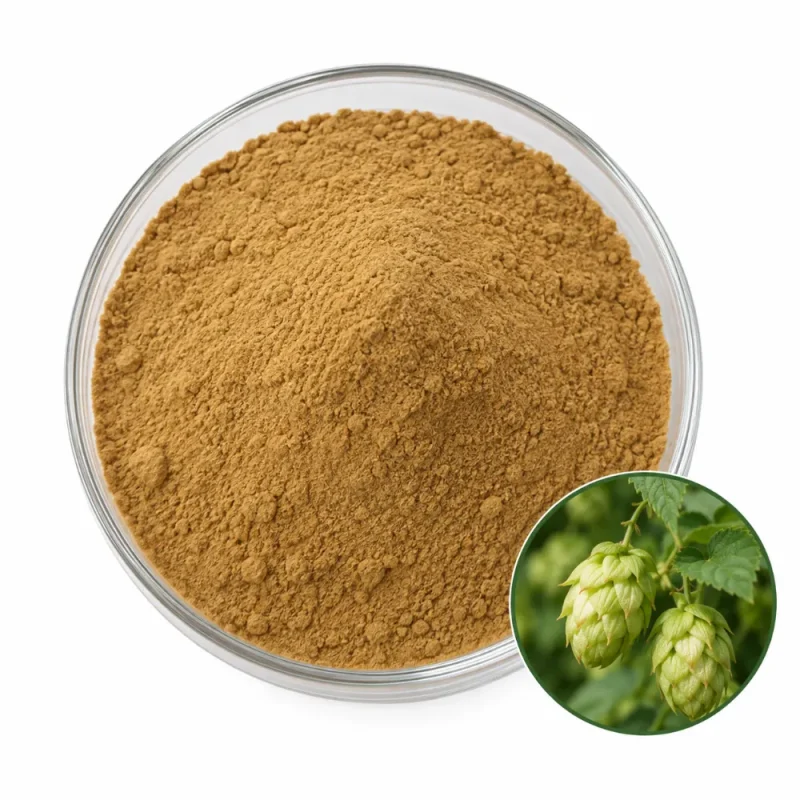
Hops Extract 2.5–10% Flavonoids

The female cones of Humulus lupulus, the climbing hemp-family vine grown for brewing, are extracted with ethanol to give this hops extract, which is standardized for its prenylated flavonoid fraction. The concentrate is dried to a light brown powder, milled to 80 mesh, that is only slightly soluble in water.

Total flavonoids are measured by UV and offered as a 2.5–10% range, with 10% as the primary grade and 2.5% as the lower grade. A separate low-dose 8-prenylnaringenin grade is listed as a different standardization. The higher grade fits small-fill capsules and tablets, and the lower grade fits blends.

Flavonoid Standardization & Grades

The flavonoids of hop cones are dominated by prenylated types, including the chalcone xanthohumol and its cyclized isomer isoxanthohumol, together with 8-prenylnaringenin at much lower levels. They sit in the lupulin glands of Humulus lupulus L. beside the bitter alpha and beta acids that brewers prize. Standardizing to total flavonoids gives buyers a figure for the phenolic fraction and keeps this extract distinct from resin-based hop extracts sold for their bitter acids.

GradeAssay & MethodWhere It Fits
2.5% FlavonoidsUVBlends, larger-fill capsules
10% FlavonoidsUVCapsules and tablets, small fill weight

Grade choice follows dose and fill weight. The 10% grade carries four times the flavonoids of the 2.5% grade per gram, so a capsule reaches its target with less powder, while the 2.5% grade is bulkier and easier to blend at gram-level inclusion. Hops are also supplied as a 10:1 ratio extract without a marker figure, the Hops Extract Powder, as a milled cone, Hops Flower Powder, and as a single compound, Xanthohumol 98%.

Flavonoid Analysis & Purity Risks

The UV figure is a group total read from absorbance. Prenylated chalcones and flavanones absorb strongly in the UV, and after a complexing reagent shifts the absorbance the total is calculated against a reference flavonoid. It is not a list of single compounds, and an HPLC figure for xanthohumol alone will be lower and cannot be converted into the UV number.

Because the assay responds to any phenolic with the right ring pattern, the chromatographic fingerprint is used for identity. Hop extract shows a characteristic cluster of prenylated chalcones and flavanones that is hard to imitate with other plant material, and this cluster also separates a flavonoid-standardized hops extract from a bitter acid extract, whose peaks are the alpha and beta acids.

Purity risks are tied to the species and to the type of hop extract. Japanese hop (Humulus scandens) is a different plant with a different profile, and the stated species is part of the identity. Resin-type hop extracts made with CO2 or other non-polar solvents contain few flavonoids, so they cannot stand in for this product. The 8-prenylnaringenin level is trace in normal cones and is tracked separately from the total.

Hops are also a crop with agricultural variability. Cultivar, harvest date and drying all affect the prenylflavonoid content, which is one reason the total is checked on each lot. Over-dried or stored cones oxidize the resins quickly, and the extract then carries a darker shade and a stale aroma.

Sample preparation affects the number. Prenylated flavonoids dissolve in ethanol or methanol, and resin acids from the cone dissolve with them and add turbidity, so extracts are filtered or cleaned before the color reaction. Incomplete removal of the resin leaves a cloudy blank and raises the apparent total, which is why the blank and the reference solution are prepared in the same solvent as the sample.

Typical Specifications

Specification ItemProduct Information
Latin NameHumulus lupulus
Plant PartFlower
ProcessingEthanol Extraction
Compound ClassFlavonoids, Polyphenols
Common NameHops, Common Hop
Ingredient TypeStandardized Extract
Marker Compound(s)Total Flavonoids
Primary Grade10% Flavonoids (UV)
Available Grades2.5% · 10% Flavonoids (UV)
AppearanceLight Brown powder
Solubility / DispersibilitySlightly Soluble in Water
Quality Parameters
Moisture (LOD)≤5.0%
Total Ash≤5.0%
Particle Size80 mesh
Heavy MetalsLead ≤2 ppm · Arsenic ≤1 ppm · Cadmium ≤1 ppm · Mercury ≤0.1 ppm
MicrobiologyTPC ≤1,000 cfu/g · Yeast & Mold ≤100 cfu/g · E. coli Negative · Salmonella Negative/25 g
Shelf Life24 months in unopened original packaging, cool and dry storage

Applications by Grade

10% Grade in Resinous Capsule Fills

The 10% grade of hops extract delivers a flavonoid target in a small fill, which suits two-piece capsules. The resinous powder is tacky and clings to hopper walls, so a flow agent and a dry room keep fill weights steady across the run.

10% Grade in Aromatic Tablets

Tablets of the 10% hops grade need a binder and a lubricant system that copes with the sticky resin traces in the powder. A film coat limits dust and covers the strong, hay-like hop aroma and bitter taste, which otherwise come through at higher loads.

2.5% Grade in Oil-Phase Softgels

The 2.5% grade disperses in an oil carrier better than in water, which suits softgel-style fills and liquid-filled capsules. Mill the powder fine before dispersion, because coarse particles settle, and keep the fill under gentle agitation while it is dispensed.

2.5% Grade in Hydroalcoholic Concentrates

Beverage concentrates can carry the 2.5% grade in a hydroalcoholic or emulsified base, because the flavonoids dissolve poorly in plain water. A stabilizer and a haze-tolerant label avoid complaints about settling, and the bitter hop note should be balanced with sweeteners.

10% Grade in Malt-Style Powder Mixes

Malt-style and brewed-flavor powder mixes use the 10% grade for a small gram weight in a bitter, grain-forward base. The hop aroma blends with roasted malt and cocoa, which masks the green note that appears when the powder is dissolved alone.

Technical & Quality Considerations

Hops extract is a light brown powder with the aroma of dried hop cones and a persistent bitterness. It is only slightly soluble in water, and the flavonoids dissolve better in ethanol and in lipid phases, so suspension systems or hydroalcoholic bases give a more uniform liquid than a plain aqueous mix.

Prenylated chalcones such as xanthohumol are thermally and chemically labile. Heat and alkaline conditions cyclize xanthohumol to isoxanthohumol, which changes the flavonoid pattern without necessarily changing the UV total, and light and oxygen darken the powder. Acidic to neutral bases, short heat treatment and opaque packaging hold the profile of the lot. This is also why hot, long-boiled brewing steps are not a model for finished product storage.

In production, sieve the powder and premix it with part of the carrier, since the resinous particles lump on first contact with a wet mass. Local extraction at the charging point limits the sticky, aromatic dust that settles on equipment and clothing.

Sealed drums flushed with nitrogen slow oxidation when a lot will be stored for months. Compatibility trials of hops extract with strong flavors such as mint, citrus oil or hop-forward beverage flavors help to set the final aroma balance. An accelerated stability run with the intended pack shows whether the flavonoid figure, color and flow hold across the shelf life.

Color is a quick check on every lot. A light brown to yellow-brown shade is expected, while a dark brown shade with a rancid note points to oxidized resin. Smell the lot at receipt, since a hop aroma that is faint or sour can signal storage damage before an assay confirms it.

Packaging & Commercial Supply

Essencefield supports product evaluation, formulation trials, commercial orders, and ongoing ingredient supply. Packaging, storage, and shipping arrangements are determined by product characteristics, order quantity, stability requirements, and destination-market needs.

Supply ItemGeneral Information
SampleAvailable upon request for formulation, testing, and supplier evaluation
Order Quantities100 g · 1 kg · 5 kg · 25 kg · 100 kg · 500 kg · Bulk
Sample Lead TimeTypically 5–7 days after sample confirmation
Production Lead TimeTypically 15–30 days after order and specification confirmation
PackagingSuitable protective inner packaging with bags, cartons, drums, or other appropriate outer packaging
StorageStore in tightly sealed, suitable protective packaging in a cool, dry environment. Protect from moisture, heat, and direct sunlight. Specific storage conditions follow the approved product specification.
DocumentationCOA · Product Specification · TDS · SDS · Applicable declarations (as applicable)

Final order quantities, lead times, packaging, documentation, and shipping arrangements are confirmed according to the selected product and commercial requirements.

Request Ingredient Specifications & Quote

Share your target specification, application, quantity, and documentation needs. We’ll help confirm suitable options, samples, and commercial supply details.