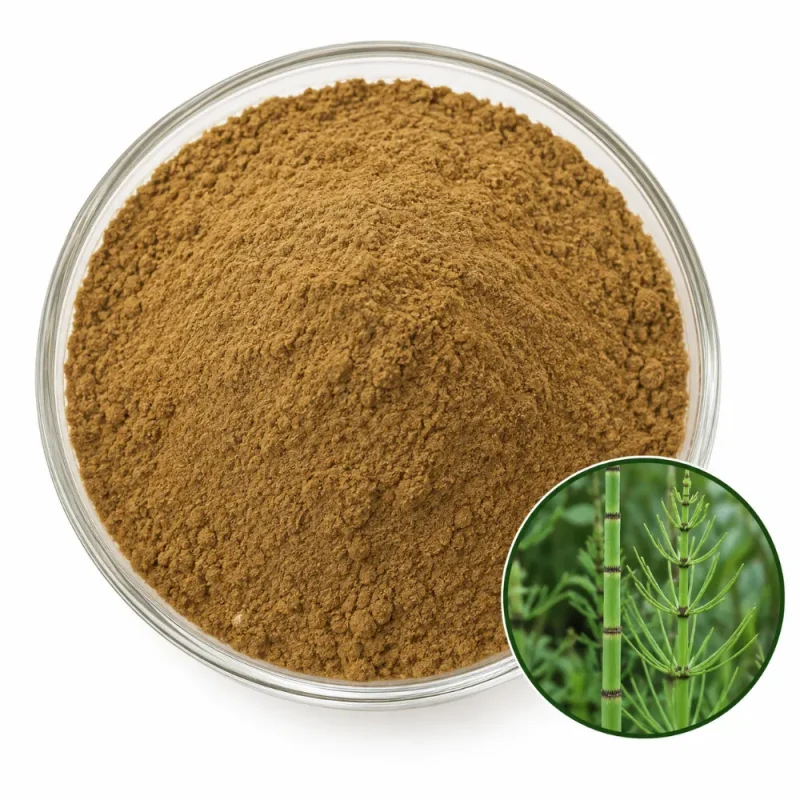
Horsetail Extract 7–20% Soluble Silica

The green, sterile stems of Equisetum arvense, the field horsetail, are extracted with ethanol to give this horsetail extract, which is standardized for its silica fraction. The concentrate is dried to a light brown powder, milled to 80 mesh, that does not dissolve in water and is best handled as a suspension.

Silica is offered as a 7–20% range, with 20% as the primary grade and 7% as the lower grade. The higher grade fits small-fill capsules and tablets, and the lower grade fits blends and powders that can carry more plant matrix.

Silica Standardization & Grades

Horsetail is the best-known plant accumulator of silicon, and Equisetum arvense L. deposits it in the cell walls of its stems as hydrated silica along with soluble silicic acid forms. Standardizing to soluble silica gives buyers one figure for the mineral fraction of the herb, which is the reason this horsetail extract exists. Other horsetail constituents such as flavonoids and the saponin equisetonin accompany the silica but are not the basis for the grade.

GradeAssay & MethodWhere It Fits
7% SilicaSoluble silicaBlends, higher-inclusion powders
20% SilicaSoluble silicaCapsules and tablets, small fill weight

Grade choice follows dose and fill weight. The 20% grade carries almost three times the silica of the 7% grade per gram, so a capsule reaches its target with a much smaller fill. The 7% grade is bulkier and easier to blend at gram-level inclusion. Horsetail is also supplied as a 10:1 ratio extract without a marker figure, the Horsetail Extract Powder. The standardized grade is the one to specify when a silica figure has to appear on the specification of the horsetail extract.

Silica Analysis & Purity Risks

Silica figures are only comparable when the fraction counted is stated. Total silicon by ashing and gravimetry counts every form, including the coarse structural silica of the stem. A soluble silica figure counts only the fraction that dissolves under defined conditions, usually read as a molybdate-reactive silicic acid. The two are not interchangeable, and a high total silicon figure can sit beside a low soluble fraction, which is why the grade name carries the word soluble.

For identity, the fingerprint of the polar fraction shows the flavonoid glycosides typical of Equisetum arvense, with luteolin and apigenin-type glycosides among the main peaks. This pattern helps to confirm that the silica came from the stated herb and not from added mineral material.

The major purity risk is species substitution. Marsh horsetail (Equisetum palustre) is a close look-alike that contains toxic alkaloids, and other horsetails such as Equisetum telmateia or the scouring rush Equisetum hyemale differ in silica and flavonoid content. The identity therefore names the species and the sterile green stem. Added silica from sand or diatomaceous earth is a second risk, because it raises the silica figure without any plant origin.

Sample preparation matters for the soluble fraction. The extract is dissolved or digested under controlled pH, time and temperature, because silicic acid polymerizes on standing and a sample left overnight reads low. Raw-material harvest also affects the result, since stems cut in summer and cleaned of soil carry the expected silica pattern.

Moisture and ash readings for this extract need careful interpretation, because the silica that defines the grade stays behind when the sample is ashed. Buyers who read ash as a measure of foreign matter should therefore compare it with the silica figure of the same lot, not with limits written for low-mineral extracts.

Typical Specifications

Specification ItemProduct Information
Latin NameEquisetum arvense
Plant PartLeaf & Herb
ProcessingEthanol Extraction
Compound ClassPolyphenols
Common NameHorsetail, Field Horsetail
Ingredient TypeStandardized Extract
Marker Compound(s)Soluble Silica
Primary Grade20% Soluble Silica
Available Grades7% · 20% Soluble Silica
AppearanceLight Brown powder
Solubility / DispersibilityInsoluble in Water
Quality Parameters
Moisture (LOD)≤5.0%
Total Ash≤5.0%
Particle Size80 mesh
Heavy MetalsLead ≤2 ppm · Arsenic ≤1 ppm · Cadmium ≤1 ppm · Mercury ≤0.1 ppm
MicrobiologyTPC ≤1,000 cfu/g · Yeast & Mold ≤100 cfu/g · E. coli Negative · Salmonella Negative/25 g
Shelf Life24 months in unopened original packaging, cool and dry storage

Applications by Grade

20% Grade in Abrasive Capsule Fills

The 20% grade of horsetail extract reaches a silica target in a small fill, which suits two-piece capsules. The powder is gritty and abrasive, so a flow agent helps, and the filling equipment should be checked for wear on contact surfaces during long runs.

20% Grade in Mineral-Rich Tablets

Tablets of the 20% grade need a strong binder because the mineral particles reduce compactability. Higher loads call for wet or dry granulation, and a hardness check after a month of storage shows whether the tablet has softened or capped.

7% Grade in Suspension Stick Packs

In stick packs, the 7% grade is blended with a bulking carrier so the filler can meter a dose of this water-insoluble powder. Label directions should call for stirring or shaking, because the extract disperses but does not dissolve, and a fine grind avoids visible grit.

7% Grade in Mineral Powder Blends

Mineral and plant powder blends can carry the 7% grade beside calcium or magnesium salts. The earthy, grassy flavor sits under fruit and vanilla notes, and the suspension should be sampled after stirring to confirm that the silica is evenly spread.

20% Grade in Dense Premix Systems

Premixes that combine the 20% grade with lighter botanical powders must allow for density differences, because the mineral-bearing particles settle first. Staged blending and a check of uniformity from several depths of the finished mix prevent a top layer that is poor in silica.

Technical & Quality Considerations

Horsetail extract is a light brown powder with a grassy, mildly mineral character. It does not dissolve in water, and the silica fraction is dispersed rather than dissolved, so liquid formats need a suspension system. Silicic acid is stable at slightly acidic to neutral pH but polymerizes and gels at higher concentration, which is a factor in any ready-to-drink design.

Alkaline conditions dissolve silica, and acidic conditions slow polymerization, so pH management affects both stability and the soluble fraction. The flavonoid glycosides in the extract behave as typical polyphenols: they darken slowly with light, oxygen and metal ions, so opaque packs and chelating agents help hold the color of a finished product.

The dry powder is abrasive and fairly dense. In production, sieve before use and check the wear of feeder screws and mixer blades, because mineral particles scour soft metal surfaces. Closed charging and local extraction limit the fine dust at the filling station.

Mineral premixes need compatibility trials because calcium or magnesium salts can shift the dispersion behavior of the silica over several days. An accelerated stability run with the intended pack shows early whether flow, color and suspension quality hold.

Color and texture give a quick receipt check. A light brown, slightly gritty powder is expected for horsetail extract, while a pale gray cast or sandy feel can mean that mineral matter other than plant silica is present. Both are visible before any assay result arrives, and they can be checked by rubbing a small amount between the fingers.

Packaging & Commercial Supply

Essencefield supports product evaluation, formulation trials, commercial orders, and ongoing ingredient supply. Packaging, storage, and shipping arrangements are determined by product characteristics, order quantity, stability requirements, and destination-market needs.

Supply ItemGeneral Information
SampleAvailable upon request for formulation, testing, and supplier evaluation
Order Quantities100 g · 1 kg · 5 kg · 25 kg · 100 kg · 500 kg · Bulk
Sample Lead TimeTypically 5–7 days after sample confirmation
Production Lead TimeTypically 15–30 days after order and specification confirmation
PackagingSuitable protective inner packaging with bags, cartons, drums, or other appropriate outer packaging
StorageStore in tightly sealed, suitable protective packaging in a cool, dry environment. Protect from moisture, heat, and direct sunlight. Specific storage conditions follow the approved product specification.
DocumentationCOA · Product Specification · TDS · SDS · Applicable declarations (as applicable)

Final order quantities, lead times, packaging, documentation, and shipping arrangements are confirmed according to the selected product and commercial requirements.

Request Ingredient Specifications & Quote

Share your target specification, application, quantity, and documentation needs. We’ll help confirm suitable options, samples, and commercial supply details.