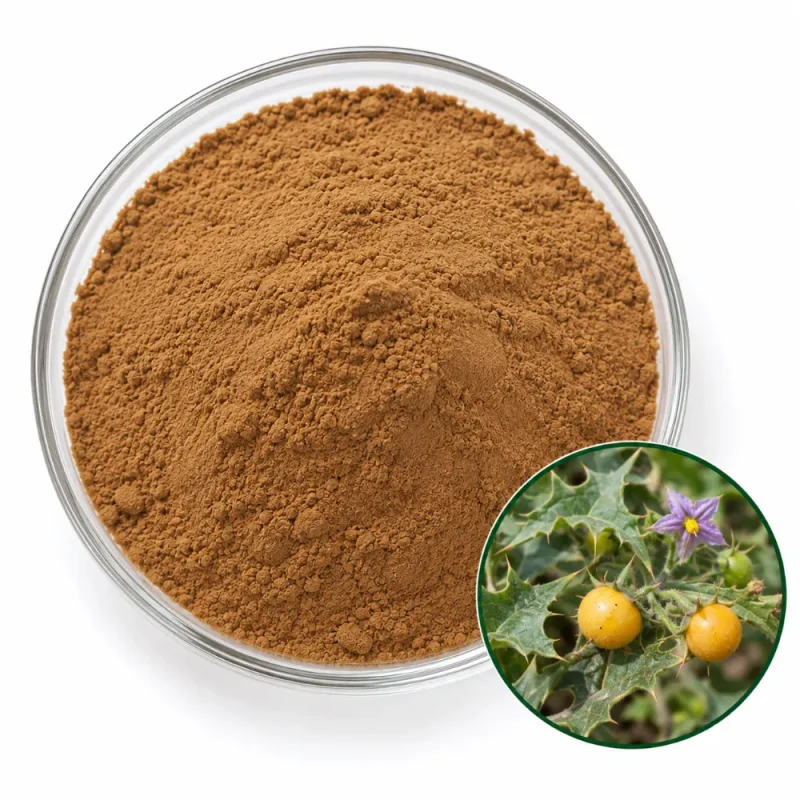
Kantkari Extract 1–2.5% Alkaloids

Kantkari, the spiny yellow-berried nightshade of Indian roadsides, is extracted with ethanol from the whole plant to give this kantkari extract. The concentrate is dried and milled to a light brown, 80 mesh powder that is only slightly soluble in water and has an earthy, bitter character.

Alkaloids are offered as a 1–2.5% range, with 2.5% as the primary grade and 1% as the lower grade. The plant is Solanum xanthocarpum in trade papers, a name that databases treat as a synonym of Solanum virginianum. The identity statement names the whole plant as the material.

Alkaloid Standardization & Grades

The alkaloids of Solanum xanthocarpum Schrad. & H.Wendl. are mainly steroidal glycoalkaloids built on the aglycone solasodine, with sugar chains that give solamargine and solasonine. They are the characteristic nitrogen-containing constituents of the spiny nightshade, and a kantkari extract is standardized to the alkaloid fraction as a group because the individual glycoalkaloids vary with plant part, season and extraction. The same plant also carries steroidal sapogenins, flavonoids and phenolic acids as a background.

GradeAssay & MethodWhere It Fits
1% AlkaloidsTotal alkaloids (group figure)Blends, larger-fill capsules
2.5% AlkaloidsTotal alkaloids (group figure)Capsules and tablets

The 2.5% grade carries two and a half times the alkaloid of the 1% grade per gram, so a capsule reaches its target with a smaller fill, while the 1% grade is bulkier and easier to blend. No sibling extract or powder of this species is currently listed in the catalog, and the grade figure applies only to the group of alkaloids and not to any single glycoalkaloid.

Glycoalkaloids of the nightshade family are a class that regulators and buyers read carefully, so the specification states the species, the part and the group figure and does not go further than the data supports.

The whole plant is the stated material, and it includes the spiny stems, the leaves and the small yellow berries of the herb. Because glycoalkaloids concentrate in some of these tissues more than in others, the proportion of each part in the dried herb shapes the profile of the extract. A consistent supplier of raw herb matters for repeat orders.

Alkaloid Analysis & Purity Risks

An alkaloid group figure counts nitrogen-containing basic compounds together, usually after they are extracted into acid and recovered. It does not separate solamargine from solasonine or from solasodine, and it cannot be converted into a figure for any single compound. For the same reason, a lot with the stated total can differ in its profile, and the fingerprint is used to describe what stands behind the number.

Identity is read from the fingerprint. The glycoalkaloids of Solanum xanthocarpum form a recognizable cluster in a reversed-phase chromatogram, and the pattern helps to separate kantkari from other nightshades sold under similar common names. The yellow berries and the prickly stems also have a typical look in the dried herb, but chemical identity decides.

The main purity risk is species confusion. Solanum xanthocarpum, Solanum virginianum and Solanum surattense are used for the same herb and are treated as one species by current databases, while black nightshade (Solanum nigrum), turkey berry (Solanum torvum) and the eggplant (Solanum melongena) are different species with different glycoalkaloid profiles. The stated species and the whole plant are part of the identity.

A second risk is plant maturity. Glycoalkaloid levels rise in the green and unripe berries and in sprouting tissue, and they fall as fruit ripens, so the harvest stage matters. Material that was harvested at a different stage or dried slowly in humid air shows a different alkaloid share and a darker extract.

Sample preparation uses acidic extraction, because glycoalkaloids are basic and dissolve best in dilute acid, and the result is read against a consistent procedure for all lots.

A group figure for alkaloids is read together with a profile. The reversed-phase chromatogram of the kantkari extract shows the main glycoalkaloid peaks and a series of smaller ones. A lot whose profile departs from the pattern of earlier lots is examined even if the group total is within range. This is a more useful quality control than the total alone.

Typical Specifications

Specification ItemProduct Information
Latin NameSolanum xanthocarpum
Plant PartWhole Plant
ProcessingEthanol Extraction
Compound ClassAlkaloids
Common NameKantkari, Yellow-Berried Nightshade
Ingredient TypeStandardized Extract
Marker Compound(s)Alkaloids
Primary Grade2.5% Alkaloids
Available Grades1% · 2.5% Alkaloids
AppearanceLight Brown powder
Solubility / DispersibilitySlightly Soluble in Water
Quality Parameters
Moisture (LOD)≤5.0%
Total Ash≤5.0%
Particle Size80 mesh
Heavy MetalsLead ≤2 ppm · Arsenic ≤1 ppm · Cadmium ≤1 ppm · Mercury ≤0.1 ppm
MicrobiologyTPC ≤1,000 cfu/g · Yeast & Mold ≤100 cfu/g · E. coli Negative · Salmonella Negative/25 g
Shelf Life24 months in unopened original packaging, cool and dry storage

Applications by Grade

2.5% Grade in Bitter Capsule Fills

The 2.5% grade of kantkari extract fits two-piece capsules at a modest fill weight. The powder is bitter and slightly hygroscopic, so an opaque shell, a dry filling room and a flow agent keep capsule weights steady and prevent bitter dust at the filler.

2.5% Grade in Coated Tablet Blends

Tablets of the 2.5% kantkari grade need a dry binder and a film coat, since a bitter, slightly sticky powder otherwise shows at the tablet edge. A coat also keeps moisture out, and a hardness check after a month of storage confirms that the tablet has not softened.

1% Grade in Herbal Powder Sachets

Herbal sachets use the 1% kantkari grade at gram-level inclusion beside other ground herbs. The extract is finer than the cut herbs, so premixing in stages avoids layering, and a sweet spice or ginger flavor balances its bitter, slightly peppery note.

1% Grade in Granulated Herbal Blends

Granulated blends for decoction-style preparations carry the 1% kantkari grade beside coarse herbs. The extract dissolves faster than the cut material, so it is sprayed or dosed as a fine powder into the blend, and sampling from several depths confirms uniformity.

2.5% Grade in Syrup and Paste Bases

Thick herbal paste and syrup bases can carry the 2.5% grade, because the sugar and fat in the base mask the bitterness. Add the extract after the cooling step, since long heat exposure in a sugar mass darkens glycoalkaloids and shifts the flavor.

Technical & Quality Considerations

Kantkari extract is a light brown powder with an earthy, bitter and mildly peppery character. It is only slightly soluble in water. The glycoalkaloids dissolve better in dilute acid, where they are protonated, and in aqueous alcohol, so mildly acidic liquid bases give a more uniform product than neutral water.

Steroidal glycoalkaloids are stable in the dry state, but strong acid and heat cleave their sugar chains to give the aglycone solasodine, which is far less soluble and may appear as a fine sediment. Neutral to mildly acidic bases and short heat treatment keep the profile stable. Light and oxygen darken the powder slowly, and opaque packaging limits color drift.

The dry powder takes up moisture, which causes caking. Store the lot in a closed drum with desiccant so the powder stays loose and pourable. Bitter, fine dust irritates the nose and eyes, so closed charging and local extraction are advised.

On the production line, sieve the kantkari powder and premix it with part of the carrier. An accelerated stability run in the intended pack shows early whether color, flow and taste remain acceptable. Brand owners read glycoalkaloid-containing botanicals carefully for each target market, so the species, the part and the group figure should match the labeling.

Packaging & Commercial Supply

Essencefield supports product evaluation, formulation trials, commercial orders, and ongoing ingredient supply. Packaging, storage, and shipping arrangements are determined by product characteristics, order quantity, stability requirements, and destination-market needs.

Supply ItemGeneral Information
SampleAvailable upon request for formulation, testing, and supplier evaluation
Order Quantities100 g · 1 kg · 5 kg · 25 kg · 100 kg · 500 kg · Bulk
Sample Lead TimeTypically 5–7 days after sample confirmation
Production Lead TimeTypically 15–30 days after order and specification confirmation
PackagingSuitable protective inner packaging with bags, cartons, drums, or other appropriate outer packaging
StorageStore in tightly sealed, suitable protective packaging in a cool, dry environment. Protect from moisture, heat, and direct sunlight. Specific storage conditions follow the approved product specification.
DocumentationCOA · Product Specification · TDS · SDS · Applicable declarations (as applicable)

Final order quantities, lead times, packaging, documentation, and shipping arrangements are confirmed according to the selected product and commercial requirements.

Request Ingredient Specifications & Quote

Share your target specification, application, quantity, and documentation needs. We’ll help confirm suitable options, samples, and commercial supply details.