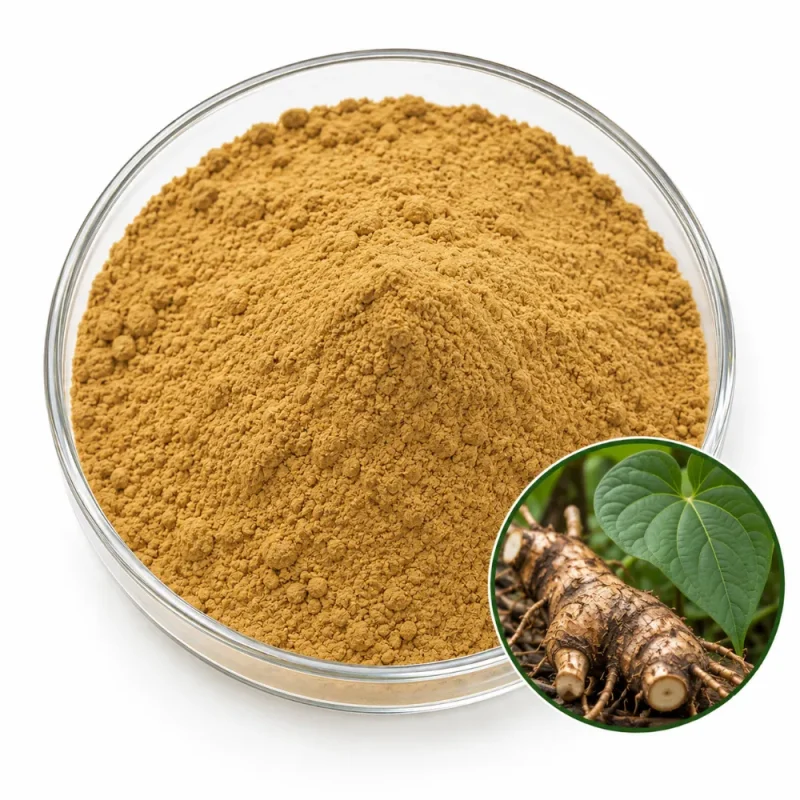
Kava Extract 30–70% Kavalactones

The root of Piper methysticum, the Pacific pepper-family shrub whose rootstock is the base of the ceremonial kava drink, is extracted with ethanol to give this kava extract. The concentrate is dried to a light brown powder, milled to 80 mesh, that does not dissolve in water and carries the resinous root matrix.

Kavalactones are measured by HPLC and offered as a 30–70% range, with 70% as the primary grade and 30% as the lower grade. The higher grade fits small-fill capsules and tablets, and the lower grade suits oil-based fills and blends that can carry more of the root.

Kavalactone Standardization & Grades

Kavalactones are a family of lipophilic lactones derived from styrylpyrones, and six of them make up most of the content of kava root: kavain, dihydrokavain, methysticin, dihydromethysticin, yangonin and desmethoxyyangonin. They are the characteristic compounds of Piper methysticum G.Forst., and a kava extract is standardized to their sum because the six occur in different proportions in different cultivars. A total figure gives buyers one number, and the fingerprint shows how the six are balanced.

GradeAssay & MethodWhere It Fits
30% KavalactonesHPLCOil-based fills, higher-inclusion blends
70% KavalactonesHPLCCapsules and tablets, small fill weight

The spread between the two grades is wide, so grade choice follows dose and carrier. At 70% the extract carries more than twice the kavalactones of the 30% grade per gram, which allows a compact capsule. At 30% the powder holds more of the root resin and starch, flows better and blends more easily. The same root is also supplied as a 10:1 ratio extract without a marker figure, the Kava Extract Powder.

Kava is a regulated botanical in several markets, with rules that differ by country on the plant part, the extraction solvent and the labeling. Brands review these rules for each destination before launch. Only the root is used in this extract, and the stem peelings and leaves are not part of the identity.

Cultivar and age shape the root. Kava roots are harvested after several years of growth, because older plants carry more lactones in the lateral roots than in the main stump, and the root is washed, dried and ground before extraction. A lot made from young roots or from heavily trimmed material has a lower kavalactone share and a larger proportion of starch, which is why the grade is measured on the finished powder.

Kavalactone Analysis & Purity Risks

HPLC separates the six major kavalactones on a reversed-phase column and detects them in the UV, where the styrylpyrone chromophore absorbs strongly. Each of the six is quantified against its own reference standard, and the total is their sum. The six absorb at somewhat different wavelengths, so a method that reads one wavelength for all of them is a compromise, and results from different laboratories agree best when the same wavelength program is used.

The ratio of the six is part of identity. Noble cultivars of kava are rich in kavain and dihydrokavain, while the so-called two-day cultivars carry more dihydromethysticin and are processed differently. A fingerprint that shows the expected balance, together with the total, tells more about the material than the total alone.

Purity risks are tied to the plant part and the cultivar. The aerial parts of the plant carry a different set of compounds and are not interchangeable with the root. Chalcone-type flavokavains, which are minor constituents of the root, are tracked in some quality systems because they are higher in particular cultivars. Wild or mixed-origin roots of uncertain cultivar are a further risk, which the fingerprint helps to show.

Sample preparation needs thorough dissolution. The resinous powder is dissolved in methanol or acetonitrile with sonication, and incomplete dissolution gives a low result that can be mistaken for a weak lot. Light degrades some kavalactones, notably yangonin, so prepared solutions are kept in amber vials and analyzed promptly.

Typical Specifications

Specification ItemProduct Information
Latin NamePiper methysticum
Plant PartRoot & Rhizome
ProcessingEthanol Extraction
Common NameKava, Kava Kava
Ingredient TypeStandardized Extract
Marker Compound(s)Kavalactones
Primary Grade70% Kavalactones (HPLC)
Available Grades30% · 70% Kavalactones (HPLC)
AppearanceLight Brown powder
Solubility / DispersibilityInsoluble in Water
Quality Parameters
Moisture (LOD)≤5.0%
Total Ash≤5.0%
Particle Size80 mesh
Heavy MetalsLead ≤2 ppm · Arsenic ≤1 ppm · Cadmium ≤1 ppm · Mercury ≤0.1 ppm
MicrobiologyTPC ≤1,000 cfu/g · Yeast & Mold ≤100 cfu/g · E. coli Negative · Salmonella Negative/25 g
Shelf Life24 months in unopened original packaging, cool and dry storage

Applications by Grade

70% Grade in Resin-Rich Capsule Fills

The 70% grade of kava extract reaches a kavalactone target in a very small fill, which suits two-piece capsules. The resinous powder is sticky and clings to tamping pins, so a flow agent, a dry room and clean equipment keep fill weights steady across the run.

70% Grade in Tablet Blends

Tablets of the 70% grade need a lubricant system that copes with the waxy resin and a binder that holds the dense lactone particles together. A film coat covers the numbing, peppery taste of the root and limits dust on the press and in the bottle.

30% Grade in Oil-Based Softgel Fills

The 30% grade disperses in an oil carrier, which suits softgel-style fills and liquid-filled capsules. The lactones are lipophilic and dissolve in the oil phase partly, so fine milling and gentle agitation give a uniform fill and avoid a resinous sediment.

30% Grade in Emulsified Drink Concentrates

Beverage concentrates can carry the 30% grade in an emulsified base, because the extract does not dissolve in water. A food-grade emulsifier and homogenization keep the resin dispersed, and the characteristic earthy and mildly numbing taste needs masking with fruit or coconut flavors.

70% Grade in Powder Stick Premixes

Stick-pack premixes use the 70% grade in a bulking carrier so the filler can meter an accurate dose of this strong powder. Label directions should call for shaking or stirring, since the powder floats and clumps on water, and a fine grind avoids visible specks.

Technical & Quality Considerations

Kava extract is a light brown powder with an earthy, peppery and slightly numbing character. It does not dissolve in water, and the lactones dissolve well in ethanol, in lipids and in some surfactant systems, so oil, alcohol and emulsion bases give a more uniform product than an aqueous mix.

Kavalactones are sensitive to light and, in some cases, to heat. Yangonin and desmethoxyyangonin isomerize under strong light, and several of the six degrade slowly in solution, so opaque packaging and amber containers protect the profile. Strong alkali opens the lactone ring and should be avoided, and neutral to mildly acidic bases keep the lactones intact.

The dry powder is resinous and tends to cake in a warm warehouse. Humidity is the main storage risk, and a desiccant sachet in a sealed bag controls it. Closed charging and local extraction are advised, since kava dust is irritating to the nose and mouth and leaves a numbing sensation on contact.

In production, sieve the powder before use and premix it with part of the carrier, because a resinous powder forms lumps on first contact with a wet mass. Weigh the first capsules or tablets and check the dispersion in the oil base under a microscope. An accelerated stability run in the intended pack shows early whether color, flow and kavalactone figure hold across the shelf life.

Color and smell give a quick check at receipt. A light brown to beige-brown powder with an earthy, slightly peppery note is expected for kava extract. A dark, burnt shade points to heat damage in concentration, and a sour smell suggests that the root was dried slowly in damp air. Both are visible before any assay result arrives.

Packaging & Commercial Supply

Essencefield supports product evaluation, formulation trials, commercial orders, and ongoing ingredient supply. Packaging, storage, and shipping arrangements are determined by product characteristics, order quantity, stability requirements, and destination-market needs.

Supply ItemGeneral Information
SampleAvailable upon request for formulation, testing, and supplier evaluation
Order Quantities100 g · 1 kg · 5 kg · 25 kg · 100 kg · 500 kg · Bulk
Sample Lead TimeTypically 5–7 days after sample confirmation
Production Lead TimeTypically 15–30 days after order and specification confirmation
PackagingSuitable protective inner packaging with bags, cartons, drums, or other appropriate outer packaging
StorageStore in tightly sealed, suitable protective packaging in a cool, dry environment. Protect from moisture, heat, and direct sunlight. Specific storage conditions follow the approved product specification.
DocumentationCOA · Product Specification · TDS · SDS · Applicable declarations (as applicable)

Final order quantities, lead times, packaging, documentation, and shipping arrangements are confirmed according to the selected product and commercial requirements.

Request Ingredient Specifications & Quote

Share your target specification, application, quantity, and documentation needs. We’ll help confirm suitable options, samples, and commercial supply details.