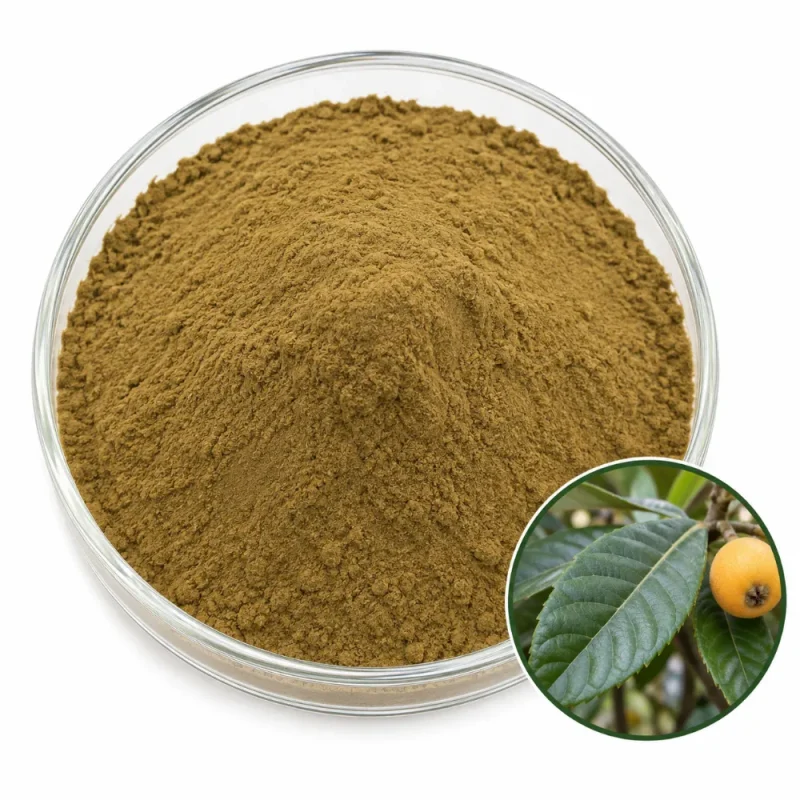
Loquat Leaf Extract 1–20% Corosolic Acid

Leaves of Eriobotrya japonica, the evergreen loquat tree of southern China now grown across warm regions, are extracted with ethanol to give this loquat leaf extract, which is standardized for one pentacyclic triterpenoid acid. The concentrate is dried to a green powder, milled to 80 mesh, that does not dissolve in water.

Corosolic acid is measured by HPLC and offered as a 1–20% range, with 20% as the primary grade and 1% as the lower grade. The higher grade fits small-fill capsules and tablets, and the lower grade suits blends and oil-based fills that can carry more of the leaf matrix.

Corosolic Acid Standardization & Grades

Corosolic acid is 2α-hydroxyursolic acid, a pentacyclic triterpenoid carboxylic acid of the ursane type. In loquat leaf it accompanies ursolic acid, oleanolic acid, maslinic acid and tormentic acid, which together form the triterpenoid acid fraction of Eriobotrya japonica (Thunb.) Lindl. A loquat leaf extract is standardized to corosolic acid because it is a defined, measurable member of that fraction, and the grade figure tells buyers how concentrated the extract is in this one acid.

GradeAssay & MethodWhere It Fits
1% Corosolic AcidHPLCBlends, oil-based fills
20% Corosolic AcidHPLCCapsules and tablets, small fill weight

The span is wide, so grade choice follows dose and carrier. At 20% the extract carries twenty times the corosolic acid of the 1% grade per gram, which permits a compact capsule. At 1% the powder keeps more of the leaf matrix, including phenolic compounds and fiber, and behaves like a leaf extract in blends. The same leaf is also supplied as a 10:1 ratio extract without a marker figure, the Loquat Leaf Extract Powder, and as a milled leaf, Loquat Leaf Powder. The fruit, Loquat Fruit Powder, is a separate material.

The leaf is the part used. Loquat leaves are thick, leathery and evergreen, and they are harvested from mature trees, brushed free of the rusty hairs on the underside and dried before extraction. Younger leaves and older leaves differ in their triterpenoid acid content, so the harvest age is part of the raw-material control for a loquat leaf extract.

Corosolic Acid Analysis & Purity Risks

HPLC separates corosolic acid from ursolic acid, oleanolic acid, maslinic acid and the other triterpenoid acids on a reversed-phase column. These compounds are close structural relatives and elute near each other, so the separation depends on a column and gradient chosen for isomeric triterpenoids. Detection is at a low UV wavelength, since the molecule has only a weak chromophore, and the result is corosolic acid itself, quantified against a reference standard.

The identity of the leaf is read from the companion acids. A genuine loquat leaf extract shows ursolic acid, oleanolic acid and maslinic acid in a recognizable pattern beside corosolic acid, and this pattern differs from that of banaba (Lagerstroemia speciosa), the better-known commercial source of corosolic acid. A lot with a corosolic acid figure and none of the usual companions is not a loquat leaf extract.

Purity risks are botanical. The common name loquat is used for the fruit as well as the leaf, and the fruit and seed contain different compounds, including cyanogenic glycosides in the seed. Leaf from other members of the rose family can resemble loquat leaf when dried and cut, and the leaf underside of loquat is covered in dense rusty hairs that are removed before extraction. The stated species and the leaf part are part of the identity.

Triterpenoid acids dissolve poorly, so sample preparation requires thorough dissolution in methanol or a methanol-chloroform mixture with sonication. Incomplete dissolution gives a low reading that is easily mistaken for a weak lot, and spiked recoveries are used to prove complete extraction.

Raw leaf is harvested from mature trees, brushed free of hairs, washed and dried at moderate temperature before extraction.

A second analytical point concerns the isomers. Corosolic acid and its neighbor maslinic acid differ only by the position of a hydroxyl group, and ursolic acid and oleanolic acid differ only by the position of a methyl group. These small differences are the reason the chromatographic separation needs tuning, and a method that merges the peaks reports a total of several acids as corosolic acid.

Typical Specifications

Specification ItemProduct Information
Latin NameEriobotrya japonica
Plant PartLeaf & Herb
ProcessingEthanol Extraction
Compound ClassTriterpenoids, Terpenoids
Common NameLoquat, Japanese Plum
Ingredient TypeStandardized Extract
Marker Compound(s)Corosolic Acid
Primary Grade20% Corosolic Acid (HPLC)
Available Grades1% · 20% Corosolic Acid (HPLC)
AppearanceGreen powder
Solubility / DispersibilityInsoluble in Water
Quality Parameters
Moisture (LOD)≤5.0%
Total Ash≤5.0%
Particle Size80 mesh
Heavy MetalsLead ≤2 ppm · Arsenic ≤1 ppm · Cadmium ≤1 ppm · Mercury ≤0.1 ppm
MicrobiologyTPC ≤1,000 cfu/g · Yeast & Mold ≤100 cfu/g · E. coli Negative · Salmonella Negative/25 g
Shelf Life24 months in unopened original packaging, cool and dry storage

Applications by Grade

20% Grade in Waxy Capsule Fills

Capsules of the 20% loquat grade need only a small fill to reach a corosolic acid target, which suits two-piece shells. The waxy, water-repellent powder clings to hopper walls and tamping pins, so a flow agent and a dry filling room keep fill weights steady across the run.

20% Grade in Direct-Compression Tablets

Tablets of the 20% grade need a dry binder and a lubricant system that copes with the waxy leaf matrix. A film coat limits dust, hides the faint green tint, and keeps the triterpenoid powder from sticking to punches in humid rooms.

1% Grade in Oil-Based Softgels

The 1% grade disperses in an oil carrier, which suits softgel-style fills and liquid-filled capsules of loquat leaf extract. Mill the powder fine before dispersion, because coarse triterpenoid acid particles settle in the oil, and hold the fill under gentle agitation while it is dispensed.

1% Grade in Shake-Before-Use Sticks

In stick packs, the 1% grade is blended with a bulking carrier so the filler can meter a dose of this water-repellent powder. Because the extract floats on water, label directions should call for shaking, and a fine grind avoids visible green specks.

1% Grade in Herbal Tea Blends

Granulated blends for infusion can carry the 1% grade beside cut loquat leaf, which gives a visible leaf and a mild, slightly sweet infusion. The triterpenoid acids dissolve poorly in hot water, so the extract adds green color more than dissolved marker.

Technical & Quality Considerations

Loquat leaf extract is a green to yellow-green powder with a mild, leafy, faintly bitter character. It does not dissolve in water, and corosolic acid dissolves in ethanol and in lipid phases, so oil bases, alcohol-containing bases or suspension systems give a more uniform product than a plain aqueous mix.

Corosolic acid is a stable, saturated-skeleton triterpenoid with one free carboxylic acid and a hydroxyl group at the second carbon. It tolerates heat and moderate acidity and resists oxidation in the dry state. The chlorophyll-related pigments in the leaf matrix are less stable: they fade to olive and brown with light, heat and acid, so opaque packaging and low warehouse light hold the green shade.

The dry powder takes up little moisture but can cake in a warm warehouse. The powder stays pourable when the drum is closed with a desiccant between charges. Closed charging and local extraction limit the airborne green dust, which clings to equipment and clothing.

Wet granulation needs a wetting agent because the powder repels water. An accelerated stability run in the intended pack shows early whether color, flow and the corosolic acid figure hold across the shelf life.

Packaging & Commercial Supply

Essencefield supports product evaluation, formulation trials, commercial orders, and ongoing ingredient supply. Packaging, storage, and shipping arrangements are determined by product characteristics, order quantity, stability requirements, and destination-market needs.

Supply ItemGeneral Information
SampleAvailable upon request for formulation, testing, and supplier evaluation
Order Quantities100 g · 1 kg · 5 kg · 25 kg · 100 kg · 500 kg · Bulk
Sample Lead TimeTypically 5–7 days after sample confirmation
Production Lead TimeTypically 15–30 days after order and specification confirmation
PackagingSuitable protective inner packaging with bags, cartons, drums, or other appropriate outer packaging
StorageStore in tightly sealed, suitable protective packaging in a cool, dry environment. Protect from moisture, heat, and direct sunlight. Specific storage conditions follow the approved product specification.
DocumentationCOA · Product Specification · TDS · SDS · Applicable declarations (as applicable)

Final order quantities, lead times, packaging, documentation, and shipping arrangements are confirmed according to the selected product and commercial requirements.

Request Ingredient Specifications & Quote

Share your target specification, application, quantity, and documentation needs. We’ll help confirm suitable options, samples, and commercial supply details.