
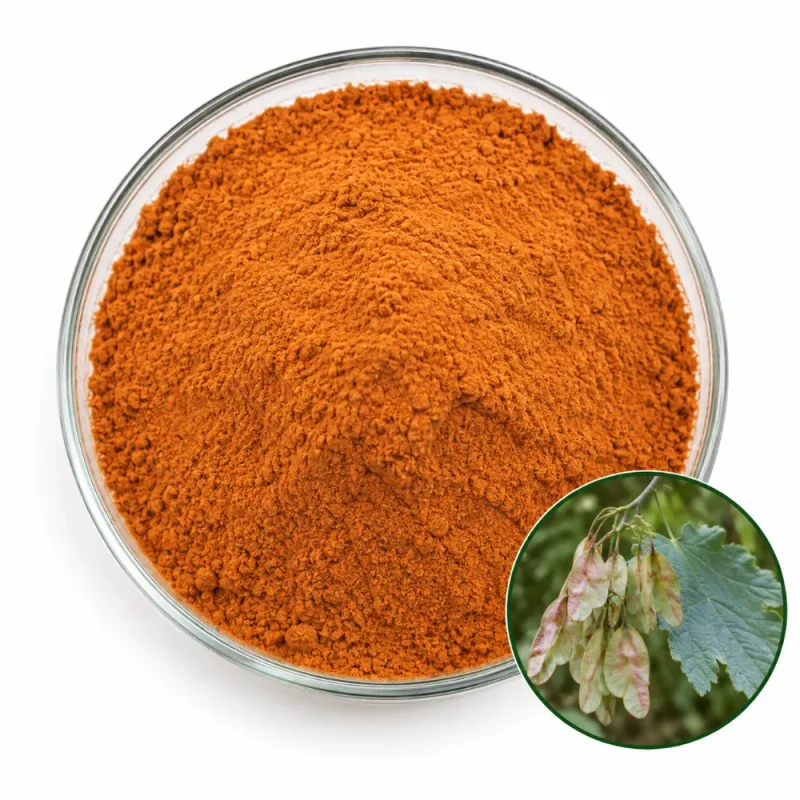
Sanguinarine Standardization & Grades
Sanguinarine is a quaternary benzophenanthridine alkaloid, a flat, four-ring cation with a methylenedioxy group at each end. It is the principal alkaloid of the plume poppy, and it accompanies chelerythrine, which is its close analog, together with protopine and allocryptopine. In acidic solution sanguinarine is an orange-red iminium cation, and in neutral to alkaline solution it adds hydroxide to form a colorless pseudo-base. Macleaya cordata extract is standardized to sanguinarine because the compound is the dominant and characteristic alkaloid of the plant.
The botanical entity is Macleaya cordata (Willd.) R.Br., and the part is the whole plant, including the latex-bearing aerial portions and the root. The sap of the plume poppy is orange, and it is the source of the alkaloid color. The milled plant is supplied as Macleaya Powder, a different material that carries the alkaloids at a far lower level. The related species Macleaya microcarpa is a separate plant with a different alkaloid ratio.
| Grade | Assay & Method | Where It Fits |
|---|---|---|
| 40% Sanguinarine | HPLC | Premixes, controlled blending |
| 60% Sanguinarine | HPLC | High-strength premix, small charge |
The 60% grade of Macleaya cordata extract carries half as much again as the 40% grade per gram. Both are high-strength alkaloid extracts, so the handling is controlled, the weighing is done in a contained area, and the inclusion rate is set from the stated sanguinarine content of the lot. Neither is meant for use as a bulk ingredient.
The extract is made from dried, milled plant that is extracted under acidic conditions, because the alkaloid is a salt in acid and dissolves well. The concentrate is purified by partition and precipitation, which removes the fiber and sugars of the plant and leaves a powder rich in alkaloid salts.


