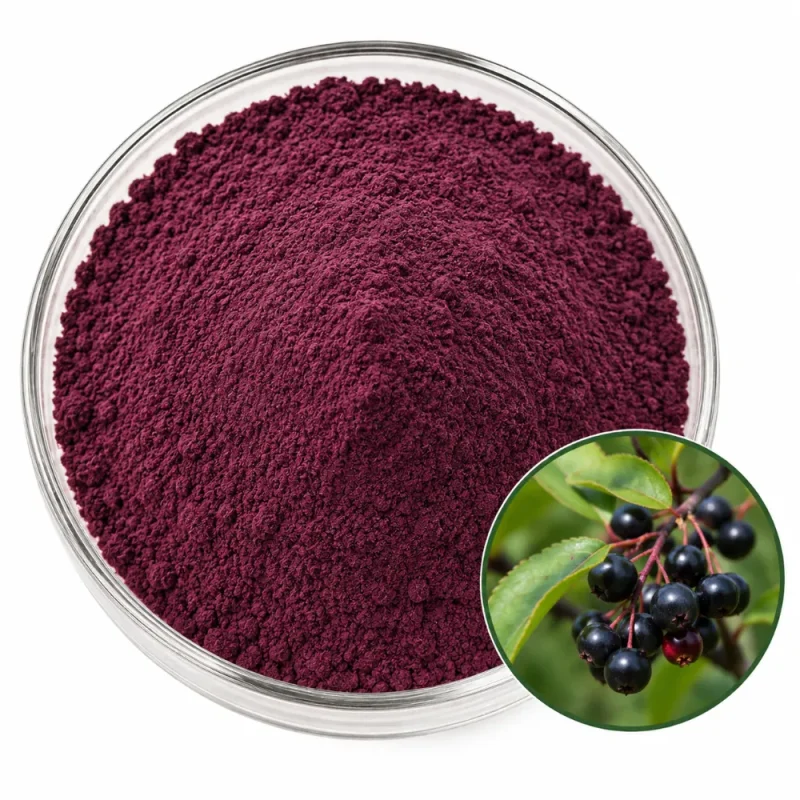
Maqui Berry Extract 20–35% Total Anthocyanins

The dark berries of Aristotelia chilensis, the maqui tree of the Chilean temperate forests, are extracted to give this maqui berry extract, which is standardized for its purple-red pigment fraction. The concentrate is dried to a purple-red powder that dissolves in water and is milled to 80 mesh.

Total anthocyanins are measured by UV with the pH differential method and offered as a 20–35% range, with 35% as the primary grade and 20% as the lower grade. A delphinidin-based standardization is a separate specification. The higher grade fits capsules and tablets, and the lower grade fits drink powders.

Anthocyanin Standardization & Grades

The berries of Aristotelia chilensis (Molina) Stuntz are among the anthocyanin-richest fruits known, and their pigments are dominated by delphinidin glycosides, with cyanidin glycosides in smaller amounts. Delphinidin carries three hydroxyl groups on its B ring, which makes its pigments deeply colored and more reactive than those of fruits where cyanidin or malvidin dominate. Standardizing to total anthocyanins gives buyers one figure for the pigment fraction as a group.

GradeAssay & MethodWhere It Fits
20% Total AnthocyaninsUV (pH differential)Drink powders, higher-inclusion blends
35% Total AnthocyaninsUV (pH differential)Capsules and tablets, small fill weight

The 35% grade carries about three-quarters more pigment than the 20% grade per gram, which permits a smaller fill and a deeper color at lower use rates. The 20% grade is bulkier and blends easily at gram-level inclusion. Maqui is also supplied as whole berry powders, the Maqui Berry Powder and the Freeze-Dried Maqui Berry Powder, which are fruit products without a pigment figure. The standardized extract is the one to specify when an anthocyanin figure has to appear on the specification.

The berry is the part used. Maqui berries are picked ripe, when the skin is nearly black, and they are frozen or dried promptly, since the pigment is concentrated in the skin and is lost when the fruit softens. The leaves and stems of the tree carry different compounds and are not part of this identity. The extract is therefore defined by the berry and by the anthocyanin fraction.

Anthocyanin Analysis & Purity Risks

The pH differential method exploits the structural change of anthocyanins with pH. At pH 1.0 the pigment is a colored flavylium cation, and at pH 4.5 it is converted to a colorless form, so the difference in absorbance at the visible maximum between the two buffers measures monomeric anthocyanin only. Polymerized or degraded pigment, which stays colored at both pH values, is ignored. The result is expressed against a reference anthocyanin, most often cyanidin-3-glucoside, and is a group total.

Because the method reads monomeric pigment, it is stricter than a simple color reading. A heat-damaged extract can look dark but show a low pH differential value, which is a useful sign of quality. An HPLC figure for single glycosides will be lower, and it cannot be converted into the UV number.

Identity is read from the fingerprint. The pattern of delphinidin-3,5-diglucoside and the related delphinidin and cyanidin glycosides separates maqui from other dark berries, such as bilberry, blackcurrant and elderberry, in which the same pigments are present in different proportions. A lot that shows a normal total and a foreign pigment pattern is not a genuine maqui extract.

Purity risks come from added color and from the fruit part. Anthocyanin-rich colorants from black carrot, purple sweet potato or grape skin can be added to raise the color, and the fingerprint shows foreign acylated pigments. The stated species and the berry part are part of the identity.

Raw material handling is critical. Berries are picked ripe, frozen or dried promptly and extracted under mild conditions, because delphinidin pigments degrade quickly with heat, light and oxygen, and the loss shows as a brown shift in the extract.

Sample preparation affects the result. Anthocyanins are extracted into acidified solvent, because the colored cation is stable only at low pH, and the sample is read quickly at both buffer pH values to avoid drift. A sample left in neutral solution fades during the measurement and gives a lower reading, which is why analysts control time and pH.

Typical Specifications

Specification ItemProduct Information
Latin NameAristotelia chilensis
Plant PartFruit & Berry
ProcessingEthanol Extraction
Compound ClassAnthocyanins, Flavonoids, Polyphenols
Common NameMaqui, Chilean Wineberry
Ingredient TypeStandardized Extract
Marker Compound(s)Total Anthocyanins
Primary Grade35% Total Anthocyanins (UV, pH differential)
Available Grades20% · 35% Total Anthocyanins (UV, pH differential)
AppearancePurple Red powder
Solubility / DispersibilityWater Soluble
Quality Parameters
Moisture (LOD)≤5.0%
Total Ash≤5.0%
Particle Size80 mesh
Heavy MetalsLead ≤2 ppm · Arsenic ≤1 ppm · Cadmium ≤1 ppm · Mercury ≤0.1 ppm
MicrobiologyTPC ≤1,000 cfu/g · Yeast & Mold ≤100 cfu/g · E. coli Negative · Salmonella Negative/25 g
Shelf Life24 months in unopened original packaging, cool and dry storage

Applications by Grade

35% Grade in Pigmented Capsule Fills

The 35% grade of maqui berry extract reaches an anthocyanin target in a small fill, which suits two-piece capsules. The powder is strongly hygroscopic and stains equipment, so a dry filling room, a flow agent and quick cleaning between lots keep the run clean.

35% Grade in Coated Tablets

Tablets of the 35% grade need a dry binder and a moisture-barrier coat, since anthocyanins fade when the tablet takes up water. A deep purple-red tablet core shows through light coats, so an opaque coat of a matching shade gives an even appearance.

20% Grade in Acidic Drink Powders

The 20% grade dissolves to a bright purple-red in acidic drinks, where anthocyanins are most stable and most colorful. Mixed with citric acid, it suits berry-flavored sticks and fruit-style drinks, and the drink turns bluer as the pH rises toward neutral.

20% Grade in Gummy Bases

In gummies, the 20% grade is dissolved into the syrup late in the cook. High heat and long holds degrade delphinidin pigments, and a pH around 3 keeps the color red-purple, so acid is added with the extract and the mass is deposited promptly.

20% Grade in Yogurt and Cereal Coatings

Dry coatings and inclusions for dairy-style or cereal products use the 20% grade for color and fruit character. The pigment turns blue-gray in neutral dairy, so test the finished food and add acid or choose a coating base that keeps the pH low.

Technical & Quality Considerations

Maqui berry extract is a deep purple-red powder with a fruity, tart and mildly astringent character. It dissolves in water to a clear purple-red solution at low pH, and the color shifts to violet, blue and finally a gray-green or yellowish tone as the pH rises, which is the best-known behavior of anthocyanins.

Delphinidin pigments are among the least stable anthocyanins. They degrade with heat, light, oxygen and ascorbic acid, and they bind metal ions to form blue-violet complexes. Mildly acidic bases, short heat treatment, light-protective packaging and chelating agents hold the color. Sulfites bleach the pigment reversibly and should be avoided in the same product.

The dry powder is very hygroscopic and cakes quickly in humid air. A desiccant in a well-sealed pack is the simplest way to keep the powder from setting. Fine pigment dust stains clothing and surfaces, so closed charging and local extraction are advised.

On the line, weigh the first capsules or tablets and compare the color with a retained sample. An accelerated stability run in the intended pack shows early whether color, flow and the anthocyanin figure hold across the shelf life.

A quick check at receipt is useful. A deep purple-red, fine powder with a fruity, tart note is expected for maqui berry extract, while a brown or dull cast points to heat damage and a fermented smell suggests wet storage of the berries. Both are visible before any assay result arrives.

Packaging & Commercial Supply

Essencefield supports product evaluation, formulation trials, commercial orders, and ongoing ingredient supply. Packaging, storage, and shipping arrangements are determined by product characteristics, order quantity, stability requirements, and destination-market needs.

Supply ItemGeneral Information
SampleAvailable upon request for formulation, testing, and supplier evaluation
Order Quantities100 g · 1 kg · 5 kg · 25 kg · 100 kg · 500 kg · Bulk
Sample Lead TimeTypically 5–7 days after sample confirmation
Production Lead TimeTypically 15–30 days after order and specification confirmation
PackagingSuitable protective inner packaging with bags, cartons, drums, or other appropriate outer packaging
StorageStore in tightly sealed, suitable protective packaging in a cool, dry environment. Protect from moisture, heat, and direct sunlight. Specific storage conditions follow the approved product specification.
DocumentationCOA · Product Specification · TDS · SDS · Applicable declarations (as applicable)

Final order quantities, lead times, packaging, documentation, and shipping arrangements are confirmed according to the selected product and commercial requirements.

Request Ingredient Specifications & Quote

Share your target specification, application, quantity, and documentation needs. We’ll help confirm suitable options, samples, and commercial supply details.