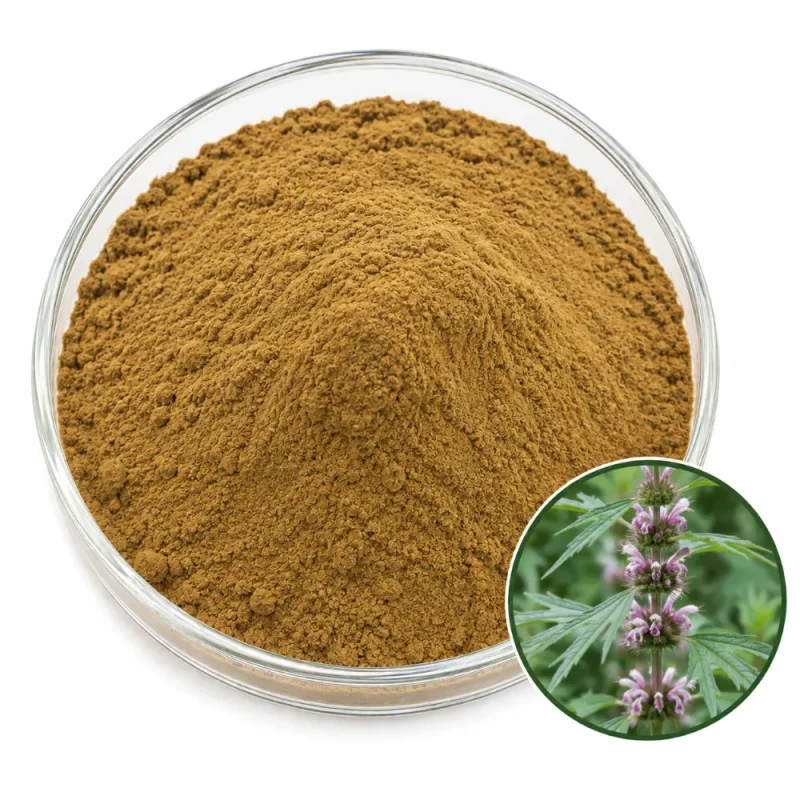
Motherwort Extract 1–5% Stachydrine

The aerial parts of Leonurus japonicus, the Chinese motherwort of East Asian roadsides and herbal trade, are extracted with ethanol to give this motherwort extract, which is standardized for one small, highly polar alkaloid. The concentrate is dried and milled to a light brown, 80 mesh powder that dissolves in water to a clear amber solution.

Stachydrine is measured by HPLC and offered as a 1–5% range, with 5% as the primary grade and 1% as the lower grade. The European motherwort is a different species. The higher grade fits small-fill capsules and tablets, and the lower grade suits drink powders and blends.

Stachydrine Standardization & Grades

Stachydrine is N,N-dimethylproline, a quaternary ammonium amino acid also known as proline betaine. It is a permanent zwitterion, which means it is highly water soluble, insoluble in most organic solvents and chemically very stable. It occurs in Leonurus japonicus Houtt. together with the guanidine ester leonurine, diterpenoids and flavonoid glycosides, and it is the marker chosen for this extract because it can be measured reliably and its level changes with the harvest and the extraction.

GradeAssay & MethodWhere It Fits
1% StachydrineHPLCDrink powders, higher-inclusion blends
5% StachydrineHPLCCapsules and tablets, small fill weight

The 5% grade carries five times the stachydrine of the 1% grade per gram, so a capsule reaches its target with a much smaller fill, while the 1% grade is bulkier and blends easily at gram-level inclusion. The same plant is also supplied as a 10:1 ratio extract without a marker figure, the Motherwort Extract Powder, as a milled herb, Motherwort Powder, and as a single compound, Leonurine 98%. Leonurine is a different molecule from stachydrine and is not part of the grade.

The aerial herb is the part used. The fruit of the same plant is a separate herbal drug with other constituents, and it is not part of this identity.

Harvest and part also matter. Motherwort is cut at the start of flowering, when the leaves are full and the stems still tender, and the whole aerial herb, including the soft upper stem, goes into extraction. Thick, woody lower stems add fiber and dilute the alkaloid share, so a lot with a high proportion of old stem shows a lower stachydrine figure and a paler extract.

Stachydrine Analysis & Purity Risks

Stachydrine is difficult to analyze by ordinary reversed-phase HPLC. The molecule has no chromophore beyond a carboxylate, and it is so polar that it is not retained on a C18 column. Methods therefore use hydrophilic interaction chromatography or ion-pairing, with detection at a very low UV wavelength or with an evaporative light scattering or mass detector. The result is stachydrine itself, quantified against a reference standard.

Because the signal sits at the edge of UV detection, the baseline matters and so do the sample salts. The extract is dissolved in a defined solvent and filtered, and a spiked sample shows that the method sees the whole compound. A lot analyzed by a different method can give a different number, so results should be compared only between laboratories that use the same procedure.

Stachydrine is not unique to motherwort. It occurs in alfalfa, in citrus fruit and peel, in members of the mint family and in many other plants, so the figure alone does not prove the botanical. Identity is read from the fingerprint, where leonurine and the characteristic flavonoid glycosides appear beside stachydrine, and the pattern is distinctive for Leonurus japonicus.

The botanical risk is the genus. European motherwort (Leonurus cardiaca) and Siberian motherwort (Leonurus sibiricus) are traded under similar names, and their chemistry differs, with leonurine very low or absent in the European species. The stated species and the aerial part are part of the identity.

Harvest timing matters. The herb is cut in the flowering stage and dried promptly; material cut late or stored damp loses stachydrine to leaching and microbial breakdown, and the extract made from it is darker and weaker.

Typical Specifications

Specification ItemProduct Information
Latin NameLeonurus japonicus
Plant PartLeaf & Herb
ProcessingEthanol Extraction
Compound ClassAlkaloids
Common NameMotherwort, Chinese Motherwort
Ingredient TypeStandardized Extract
Marker Compound(s)Stachydrine
Primary Grade5% Stachydrine (HPLC)
Available Grades1% · 5% Stachydrine (HPLC)
AppearanceLight Brown powder
Solubility / DispersibilityWater Soluble
Quality Parameters
Moisture (LOD)≤5.0%
Total Ash≤5.0%
Particle Size80 mesh
Heavy MetalsLead ≤2 ppm · Arsenic ≤1 ppm · Cadmium ≤1 ppm · Mercury ≤0.1 ppm
MicrobiologyTPC ≤1,000 cfu/g · Yeast & Mold ≤100 cfu/g · E. coli Negative · Salmonella Negative/25 g
Shelf Life24 months in unopened original packaging, cool and dry storage

Applications by Grade

5% Grade in Hygroscopic Capsule Fills

The 5% grade of motherwort extract reaches a stachydrine target in a small fill, which suits two-piece capsules. Stachydrine is strongly hygroscopic, so the powder grabs moisture quickly, and a dry filling room, a flow agent and sealed hoppers keep capsule weights steady.

5% Grade in Moisture-Sealed Tablets

Tablets of the 5% grade need a dry binder and a moisture-barrier film coat, because the betaine fraction draws water into the tablet. A hardness check after a month of storage and a desiccant in the bottle show whether the tablet has softened.

1% Grade in Clear Drink Powders

The 1% grade dissolves completely in cold water to a clear amber solution, which suits instant drink powders and stick packs. Its mild herbal bitterness pairs with citrus, honey or ginger flavors, and a fine grind dissolves in seconds.

1% Grade in Herbal Granule Blends

Granulated herbal blends carry the 1% grade beside cut herbs. The extract is hygroscopic and can bind moisture from the blend, so it is dosed late and kept apart from damp ingredients, with sampling from several depths to confirm that it is spread evenly.

5% Grade in Liquid Concentrates

Aqueous liquid concentrates dissolve the 5% grade easily, since stachydrine is highly soluble. The solution is stable over a wide pH range, so the main work is preservation and flavor, and a check of clarity after a week at the storage temperature confirms stability.

Technical & Quality Considerations

Motherwort extract is a light brown powder with a mild, herbal and slightly bitter character. It dissolves in water to a clear amber solution. Stachydrine itself is colorless, odorless and almost tasteless, and it is not responsible for the bitterness, which comes from the diterpenoid and phenolic fractions of the herb.

Stachydrine is chemically very stable. It resists heat, a wide range of pH values and oxidation, and it does not react with sugars or amino acids, which makes the marker robust in baked, pasteurized and acidic products. The rest of the extract is less stable: the flavonoid and phenolic fractions darken slowly with light, oxygen and metal ions, so opaque packaging and chelating agents hold the shade.

The dry powder is strongly hygroscopic and cakes when damp. A resealable liner with a desiccant sachet protects the powder from room humidity. Fine dust irritates the nose and eyes, so closed charging and local extraction are advised.

At the filler, sieve the powder, premix it with part of the carrier and weigh the first units. A humidity log for the room is useful because the extract moves with it. A short accelerated stability run in the intended pack shows early whether flow, color and clarity hold across the shelf life.

A quick check at receipt is useful. A light brown, fine powder with a mild herbal note is expected for motherwort extract, while a very dark shade or a caramel smell points to heat damage in concentration. A powder that arrives in hard lumps has already taken up moisture and should be sieved and dried before use.

Packaging & Commercial Supply

Essencefield supports product evaluation, formulation trials, commercial orders, and ongoing ingredient supply. Packaging, storage, and shipping arrangements are determined by product characteristics, order quantity, stability requirements, and destination-market needs.

Supply ItemGeneral Information
SampleAvailable upon request for formulation, testing, and supplier evaluation
Order Quantities100 g · 1 kg · 5 kg · 25 kg · 100 kg · 500 kg · Bulk
Sample Lead TimeTypically 5–7 days after sample confirmation
Production Lead TimeTypically 15–30 days after order and specification confirmation
PackagingSuitable protective inner packaging with bags, cartons, drums, or other appropriate outer packaging
StorageStore in tightly sealed, suitable protective packaging in a cool, dry environment. Protect from moisture, heat, and direct sunlight. Specific storage conditions follow the approved product specification.
DocumentationCOA · Product Specification · TDS · SDS · Applicable declarations (as applicable)

Final order quantities, lead times, packaging, documentation, and shipping arrangements are confirmed according to the selected product and commercial requirements.

Request Ingredient Specifications & Quote

Share your target specification, application, quantity, and documentation needs. We’ll help confirm suitable options, samples, and commercial supply details.