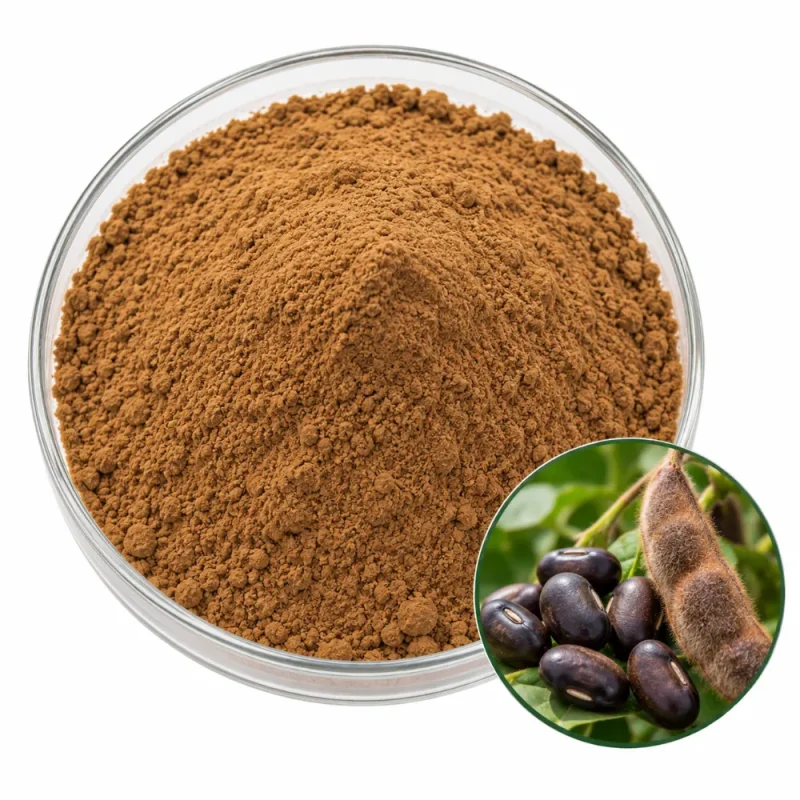
Mucuna pruriens Extract 10–20% L-DOPA

Mucuna pruriens, the velvet bean, a climbing tropical legume with long seed pods and stinging hairs, is the source plant of this Mucuna pruriens extract, which is standardized for one aromatic amino acid. The material is extracted with ethanol, and the concentrate is dried to a light brown powder, milled to 80 mesh, that is only slightly soluble in water.

L-DOPA is measured by HPLC and offered as a 10–20% range, with 20% as the primary grade and 10% as the lower grade. The higher grade fits small-fill capsules, and the lower grade fits blends and tablets that can carry more of the plant matrix.

L-DOPA Standardization & Grades

L-DOPA, or levodopa, is 3,4-dihydroxy-L-phenylalanine, a non-protein amino acid with a catechol ring. It is the characteristic compound of Mucuna pruriens (L.) DC., accumulating in the plant as a chemical defense, and it is the marker chosen for this extract because it can be measured reliably and varies strongly with the plant material. The same plant also carries tryptamines, tannins and saponins as a background profile.

GradeAssay & MethodWhere It Fits
10% L-DOPAHPLCBlends, tablets
20% L-DOPAHPLCCapsules, small fill weight

The 20% grade carries twice the L-DOPA of the 10% grade per gram, so a capsule reaches its target with half the fill. The 10% grade is bulkier and blends easily at gram-level inclusion. The same plant is also supplied as a 10:1 ratio extract without a marker figure, the Mucuna Pruriens Extract Powder, and as a milled seed, Mucuna pruriens Seed Powder. Buyers who need L-DOPA stated on the specification use this standardized grade.

L-DOPA is also a pharmaceutical substance, and its regulatory status differs between markets and product categories. Brands review it for each destination before launch.

The botanical identity is simple to state and easy to confuse in trade. Mucuna pruriens has several varieties and many look-alike species, and the words velvet bean, cowhage and kapikacchu all refer to it in different regions. A Mucuna pruriens extract is therefore defined by the species name and by the L-DOPA figure, and not by a common name.

L-DOPA Analysis & Purity Risks

HPLC separates L-DOPA from tyrosine, dopamine and the other amines of the plant on a reversed-phase or mixed-mode column. L-DOPA is polar and zwitterionic, so the mobile phase is acidified to suppress ionization of the carboxyl group and give a sharp peak, and detection uses the UV absorbance of the catechol ring. The result is L-DOPA itself, quantified against a reference standard.

Sample preparation is critical because the catechol group oxidizes in minutes at neutral pH and in the presence of oxygen. Extracts are dissolved in dilute acid, often with an antioxidant such as ascorbic acid or sodium metabisulfite, and are analyzed immediately. A sample left in neutral solution turns pink and then dark brown as melanin-like products form, and the L-DOPA peak falls, so results from slow or careless preparation are low.

Identity is read from the fingerprint. L-DOPA appears beside the minor amines of the plant, such as tryptamine-type compounds, and this pattern separates the extract from material that has been spiked with synthetic L-DOPA, which is chemically identical and cheap. A lot with a high figure and no companion peaks deserves a second look.

The botanical risk is the genus. Many Mucuna species are traded as velvet bean, and several carry little L-DOPA. L-DOPA is not evenly distributed in the plant, so the part used is stated on the specification and the content of a lot depends on it. The stinging hairs of the pod are a handling issue for the raw material only.

Raw material that was harvested wet or stored damp loses L-DOPA to enzymatic oxidation, and the extract made from it is darker and weaker.

Method detail matters for the number. Mucuna pruriens extract contains compounds that absorb in the same region as L-DOPA, so the chromatographic resolution and the peak purity check are what separate the L-DOPA result from the neighboring peaks, and a method with poor resolution can overstate the figure of a lot.

Typical Specifications

Specification ItemProduct Information
Latin NameMucuna pruriens
Plant PartWhole Plant
ProcessingEthanol Extraction
Compound ClassAlkaloids
Common NameMucuna, Velvet Bean
Ingredient TypeStandardized Extract
Marker Compound(s)L-DOPA
Primary Grade20% L-DOPA (HPLC)
Available Grades10% · 20% L-DOPA (HPLC)
AppearanceLight Brown powder
Solubility / DispersibilitySlightly Soluble in Water
Quality Parameters
Moisture (LOD)≤5.0%
Total Ash≤5.0%
Particle Size80 mesh
Heavy MetalsLead ≤2 ppm · Arsenic ≤1 ppm · Cadmium ≤1 ppm · Mercury ≤0.1 ppm
MicrobiologyTPC ≤1,000 cfu/g · Yeast & Mold ≤100 cfu/g · E. coli Negative · Salmonella Negative/25 g
Shelf Life24 months in unopened original packaging, cool and dry storage

Applications by Grade

20% Grade in Oxidation-Sensitive Capsule Fills

The 20% grade of Mucuna pruriens extract reaches an L-DOPA target in a small fill, which suits two-piece capsules. The catechol darkens when it is exposed to moist air, so a dry filling room, quick handling and sealed hoppers protect the color of the powder.

20% Grade in Coated Tablets

Tablets of the 20% grade need a dry binder and a moisture-barrier film coat, because the amino acid oxidizes at the surface of the tablet. An opaque coat protects from light, and an oxygen absorber in the bottle slows the browning of the core.

10% Grade in Acidified Powder Blends

Dry blends carry the 10% grade with an acidic carrier such as citric acid or ascorbic acid, which stabilizes the catechol. Such blends are dissolved immediately before use, since the solution oxidizes and browns within an hour at neutral pH.

10% Grade in Stick-Pack Premixes

Stick-pack premixes use the 10% grade in a bulking carrier so the filler can meter an accurate dose. The extract is only slightly soluble, so label directions should call for stirring, and a cocoa or coffee flavor masks the earthy bitterness.

20% Grade in Contract Blending

Contract blenders use the 20% grade as a concentrated component in multi-ingredient powders. Blend in stages, since a low inclusion of a fine powder segregates in transport, and keep the batch records of lot and moisture, because the marker degrades in damp storage.

Technical & Quality Considerations

Mucuna pruriens extract is a light brown powder with a mild, earthy and slightly bitter character. It is only slightly soluble in water. L-DOPA dissolves better in dilute acid, where the amine is protonated, and it is poorly soluble in neutral water and in organic solvents, so acidified liquid bases give a more uniform solution than neutral ones.

The catechol group is the stability-limiting feature. In neutral to alkaline solution, and in the presence of oxygen and trace metals, L-DOPA oxidizes to dopaquinone and then to dark melanin-like polymers. Acidic bases, antioxidants such as ascorbic acid, chelating agents and oxygen-free packaging slow the reaction. The dry powder is more stable, but it turns darker in humid air.

The dry powder takes up moisture and cakes. Sealed packaging and a desiccant sachet keep humidity from turning the powder into lumps.

During production, avoid contact of the powder with alkaline fillers and iron-bearing equipment, which accelerate browning. An accelerated stability run in the intended pack shows early whether color, flow and the L-DOPA figure hold across the shelf life.

A quick check at receipt is useful. A light brown to beige-brown, fine powder with a faint beany and earthy note is expected for Mucuna pruriens extract, while a dark gray or purplish cast points to oxidized catechol and a sour smell suggests damp storage. Both are visible before any assay result arrives.

Packaging & Commercial Supply

Essencefield supports product evaluation, formulation trials, commercial orders, and ongoing ingredient supply. Packaging, storage, and shipping arrangements are determined by product characteristics, order quantity, stability requirements, and destination-market needs.

Supply ItemGeneral Information
SampleAvailable upon request for formulation, testing, and supplier evaluation
Order Quantities100 g · 1 kg · 5 kg · 25 kg · 100 kg · 500 kg · Bulk
Sample Lead TimeTypically 5–7 days after sample confirmation
Production Lead TimeTypically 15–30 days after order and specification confirmation
PackagingSuitable protective inner packaging with bags, cartons, drums, or other appropriate outer packaging
StorageStore in tightly sealed, suitable protective packaging in a cool, dry environment. Protect from moisture, heat, and direct sunlight. Specific storage conditions follow the approved product specification.
DocumentationCOA · Product Specification · TDS · SDS · Applicable declarations (as applicable)

Final order quantities, lead times, packaging, documentation, and shipping arrangements are confirmed according to the selected product and commercial requirements.

Request Ingredient Specifications & Quote

Share your target specification, application, quantity, and documentation needs. We’ll help confirm suitable options, samples, and commercial supply details.