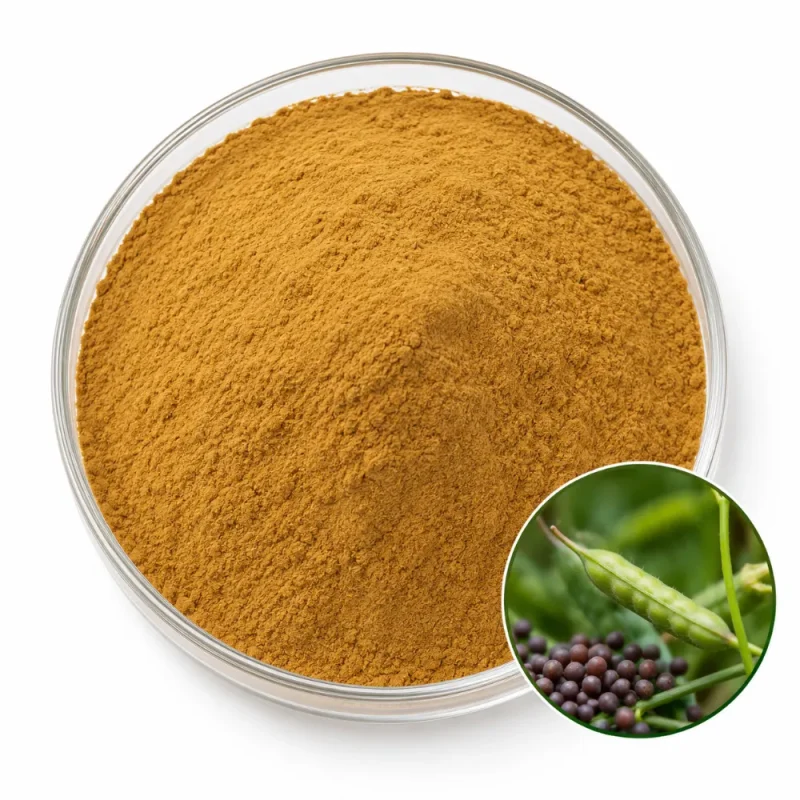
Mustard Seed Extract Powder

Mustard seed extract starts from the seed of Brassica juncea, the brown or Indian mustard, with the pod and green parts excluded. Water extraction concentrates the soluble seed fraction, and the liquor is dried into a light brown powder that disperses in water.

The extract is supplied at a 10:1 ratio with no marker percentage and is milled to 80 mesh. It is a ratio extract of the seed and not a mustard oil, an oleoresin or a ground mustard flour. Mustard greens are a separate leaf product.

Brassica juncea Identity & Plant Part

The botanical entity is Brassica juncea (L.) Czern., brown mustard of the Brassicaceae, an annual with yellow four-petaled flowers and slender pods packed with small reddish-brown seeds. The part used is the seed. The leaf, stem and root are not part of this mustard seed extract.

Three mustard species are traded as seed. Black mustard is Brassica nigra and white or yellow mustard is Sinapis alba, so a specification should quote the Latin binomial. The seed holds glucosinolates such as sinigrin together with the enzyme myrosinase, fixed oil, mucilage in the seed coat and phenolic acids, named here only as families.

What 10:1 Means for Mustard Seed

A 10:1 ratio on a mustard seed extract describes concentration against the starting seed and gives no glucosinolate figure. The pungency of mustard depends on myrosinase acting on sinigrin to release allyl isothiocyanate, and a hot water process can inactivate the enzyme, so aroma and heat in the powder differ from those of fresh ground seed. A buyer who needs a defined pungency or glucosinolate level has to look at a marker-based product. A buyer who names the species, the seed and the ratio can use this mustard seed extract as listed.

Typical Specifications

Specification ItemProduct Information
Latin NameBrassica juncea
Plant PartSeed & Grain
ProcessingWater Extraction
Common NameBrown Mustard Seed
Ingredient TypeRatio Extract
Extract Ratio10:1
AppearanceLight brown powder
Solubility / DispersibilityWater Dispersible
Quality Parameters
Moisture (LOD)≤5.0%
Total Ash≤5.0%
Particle Size80 mesh
Heavy MetalsLead ≤2 ppm · Arsenic ≤1 ppm · Cadmium ≤1 ppm · Mercury ≤0.1 ppm
MicrobiologyTPC ≤1,000 cfu/g · Yeast & Mold ≤100 cfu/g · E. coli Negative · Salmonella Negative/25 g
Shelf Life24 months in unopened original packaging, cool and dry storage

Application Areas

Capsules for Seed Extracts

Mustard seed extract fills into capsules as a light brown powder that disperses in water. Seed extracts that carry sugars and mucilage bridge in the hopper, so a flow aid and a dry room help. A disintegration test on the filled capsule shows that the shell opens as expected.

Tablet Blends

Compressed tablets bind mustard seed extract with microcrystalline cellulose and a disintegrant. The mild pungent note is covered by a film coat. Because mucilage slows disintegration, release is tested on the finished tablet rather than assumed from the blend.

Low-Dose Drink Powders

Drink powders carry the mustard seed extract at a low level, where it dissolves to a hazy tan liquid with a mild bean-like note. Ginger, lemon and honey flavors blend with that note. A carrier keeps the dose even in every sachet.

Powder Stick Premixes

Sticks combine mustard seed extract with a flavor and a sweetener in barrier laminate. A trace of pungency can build in a closed stick if moisture wakes residual enzyme activity, so the premix is dried and the seal is checked.

Gummy Premix Blends

Gummies take the extract late in the cooked base, and orange, ginger or caramel flavors hide the tint. Heat does not release pungency from a process-inactivated powder, but a flavor trial confirms the finished taste.

Formulation Notes

Mustard seed extract is a light brown powder with a faint, nutty, lightly pungent aroma and a mildly bitter taste. In water it forms a hazy tan liquid, and the mucilage gives a slight viscosity. Pungency appears only where residual enzyme activity meets glucosinolate in the presence of water.

Weigh the mustard seed extract in a dry area and keep the liner closed between draws, since the powder takes up moisture and clumps. Moisture also lets any remaining myrosinase act on glucosinolate, which can raise the pungent note over time. Keep the opened pack away from heat and light, and trial pungency after storage when the formula is sensitive.

Keep mustard seed extract away from wet processing steps until the end of the batch, since moisture can revive residual enzyme activity. Dry blends are screened once and filled promptly. In capsules a flow aid helps, and in drinks the powder is stirred into a dry base before water is added.

Packaging & Commercial Supply

Essencefield supports product evaluation, formulation trials, commercial orders, and ongoing ingredient supply. Packaging, storage, and shipping arrangements are determined by product characteristics, order quantity, stability requirements, and destination-market needs.

Supply ItemGeneral Information
SampleAvailable upon request for formulation, testing, and supplier evaluation
Order Quantities100 g · 1 kg · 5 kg · 25 kg · 100 kg · 500 kg · Bulk
Sample Lead TimeTypically 5–7 days after sample confirmation
Production Lead TimeTypically 15–30 days after order and specification confirmation
PackagingSuitable protective inner packaging with bags, cartons, drums, or other appropriate outer packaging
StorageStore in tightly sealed, suitable protective packaging in a cool, dry environment. Protect from moisture, heat, and direct sunlight. Specific storage conditions follow the approved product specification.
DocumentationCOA · Product Specification · TDS · SDS · Applicable declarations (as applicable)

Final order quantities, lead times, packaging, documentation, and shipping arrangements are confirmed according to the selected product and commercial requirements.

Request Ingredient Specifications & Quote

Share your target specification, application, quantity, and documentation needs. We’ll help confirm suitable options, samples, and commercial supply details.