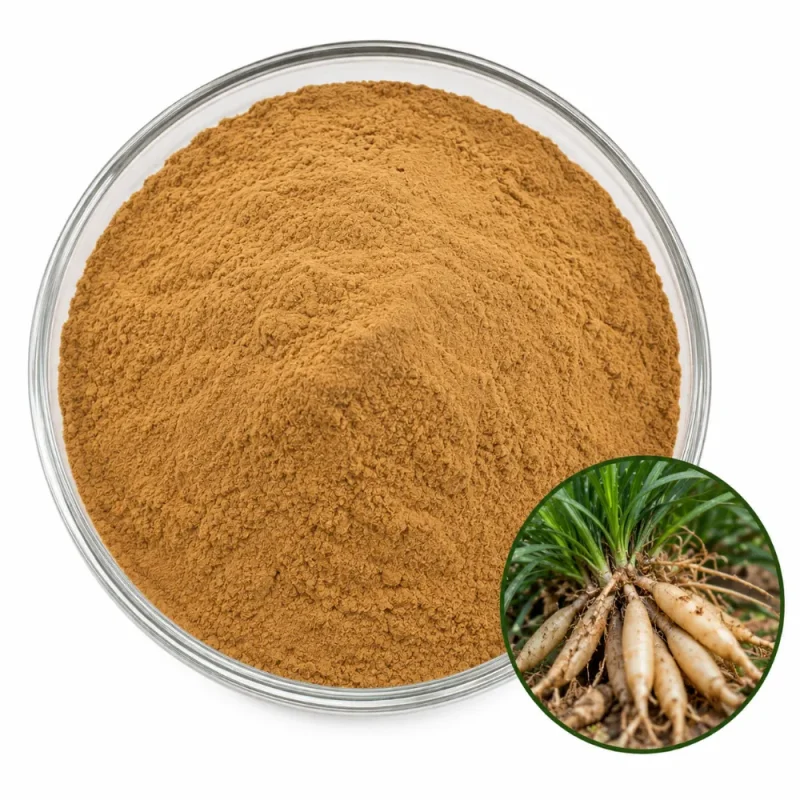
Ophiopogon Japonicus Extract 5–20% Saponins

The tuberous root of Ophiopogon japonicus, the mondo grass whose swollen root tips are used in East Asian herbal trade as maidong, is extracted with ethanol to give this Ophiopogon japonicus extract. The concentrate is dried and milled to a light brown, 80 mesh powder that dissolves in water, with a mildly sweet, earthy note.

Total saponins are measured by UV and offered as a 5–20% range, with 20% as the primary grade and 5% as the lower grade. Ophiopogonin D is tracked as a second marker. The higher grade suits compact capsules and tablets, while the lower grade suits drink powders that can carry more of the root.

Saponin Standardization & Grades

The root of Ophiopogon japonicus (Thunb.) Ker Gawl. carries steroidal saponins built on the sapogenin ruscogenin, among them ophiopogonin D and its relatives, together with homoisoflavonoids and a fructan-rich polysaccharide fraction. Standardizing an Ophiopogon japonicus extract to total saponins gives buyers a figure for the steroidal glycoside fraction as a group, while the homoisoflavonoids and the polysaccharides accompany it as background.

GradeAssay & MethodWhere It Fits
5% SaponinsUVDrink powders, higher-inclusion blends
20% SaponinsUVCapsules and tablets, small fill weight

The 20% grade carries four times the saponin of the 5% grade per gram, so a capsule reaches its target with a smaller fill, while the 5% grade is bulkier and dissolves quickly into beverages. The same root is also supplied as a 10:1 ratio extract without a marker figure, the Ophiopogon Japonicus Extract Powder, and as a milled root, Ophiopogon Root Powder. This standardized grade serves formulas that need a saponin figure on the specification.

The tuberous root is the part used. Leaves and the fibrous roots between the tubers carry little of the saponin fraction and are not part of this identity.

The tuberous root is the part used. Maidong tubers are lifted in early summer after two or more years, washed, trimmed and dried, with the woody core often removed, and the tubers are then sliced or milled before extraction. Fibrous roots, leaves and the grass-like crown are removed. A lot made from poorly cleaned material carries more fiber and a lower saponin share.

Saponin Analysis & Purity Risks

The UV method for total saponins is colorimetric. The saponins react with vanillin and strong acid, or with a similar acid reagent, and the color is read against a reference saponin, often ruscogenin or ophiopogonin D. The figure is a group total expressed as that reference, and it responds to any triterpenoid or steroidal glycoside, so it does not by itself show which saponins are present.

The second marker is read separately by chromatography. Ophiopogonin D is a defined steroidal saponin, and its share of the total shows how much of the saponin fraction is the characteristic compound. A lot with a high total and a low ophiopogonin D share has a different saponin balance from one where the two rise together.

Identity is read from the fingerprint. The steroidal saponin cluster with the homoisoflavonoid peaks forms a pattern typical of maidong, and the pattern separates an Ophiopogon japonicus extract from other tuber drugs sold in the same grade range.

The best-known botanical risk is a look-alike. The tuberous roots of Liriope spicata and Liriope muscari, called shan maidong, resemble maidong and are sold in the same markets, but they are a different genus with a different saponin profile. The stated species and the tuberous root are part of the identity, and the fingerprint is the practical check for the substitution.

Sugars are a second issue. The root is rich in fructans and sugars, and free sugars react in the acid color step and raise the apparent total, which is why a 20% extract depends on a purification step that removes them. Raw root is washed, steamed or boiled briefly, dried and cleaned before extraction.

Sample preparation affects the reading. The extract is dissolved in aqueous alcohol and cleared by filtration or centrifugation, and the solution is diluted into the working range before the color reaction. A fixed heating time and a fresh calibration curve are needed, because the color of the acid reaction drifts with time and reagent age.

Typical Specifications

Specification ItemProduct Information
Latin NameOphiopogon japonicus
Plant PartRoot & Rhizome
ProcessingEthanol Extraction
Compound ClassSaponins
Common NameOphiopogon, Mondo Grass, Maidong
Ingredient TypeStandardized Extract
Marker Compound(s)Saponins; Ophiopogonin D
Primary Grade20% Saponins (UV)
Available Grades5% · 20% Saponins (UV)
AppearanceLight Brown powder
Solubility / DispersibilityWater Soluble
Quality Parameters
Moisture (LOD)≤5.0%
Total Ash≤5.0%
Particle Size80 mesh
Heavy MetalsLead ≤2 ppm · Arsenic ≤1 ppm · Cadmium ≤1 ppm · Mercury ≤0.1 ppm
MicrobiologyTPC ≤1,000 cfu/g · Yeast & Mold ≤100 cfu/g · E. coli Negative · Salmonella Negative/25 g
Shelf Life24 months in unopened original packaging, cool and dry storage

Applications by Grade

20% Grade in Foam-Prone Capsule Fills

The 20% grade of Ophiopogon japonicus extract reaches a saponin target in a small fill, which suits two-piece capsules. The powder is hygroscopic and can trap air, so a dry filling room and a flow agent that does not whip up foam keep capsule weights steady.

20% Grade in Moisture-Barrier Tablets

Tablets of the 20% grade need a dry binder and a moisture-barrier film coat, because the steroidal saponin powder softens in humid air. Direct compression works at low inclusion, while heavier loads call for granulation and a hardness check after storage.

5% Grade in Sweet-Root Drink Powders

The 5% grade of Ophiopogon japonicus extract dissolves readily into instant drink powders and stick packs. The root’s mildly sweet, mucilaginous character suits warm herbal drinks, and a low-shear mix keeps the foam down when the powder is stirred into water.

5% Grade in Syrup and Gel Bases

Syrups and gels carry the 5% grade dissolved in the aqueous phase. The fructans and saponins thicken the base slightly, so viscosity should be checked after a week, and a sugar-rich syrup damps the foam during filling.

5% Grade in Granule Sachets

Granulated sachets carry the 5% grade with a malt or honey-type base. The extract is hygroscopic and can bind moisture from the base, so it is dosed late and kept apart from damp ingredients, with sampling from several depths to confirm that it is evenly spread.

Technical & Quality Considerations

Ophiopogon japonicus extract is a light brown powder with a mildly sweet, slightly bitter and earthy character.

Steroidal saponins are fairly stable to heat and mild acid. Strong acid and prolonged heat cleave the sugar chains to the aglycone ruscogenin, which is far less soluble and appears as a fine sediment. The homoisoflavonoids are lipophilic and light-sensitive, so opaque packaging protects the shade.

The dry powder is strongly hygroscopic and cakes when damp, partly because of residual sugars. Closed charging and local extraction keep fine saponin dust out of the air at the filler.

A quick check at receipt is useful. A light brown, fine powder with a mildly sweet and earthy note is expected for Ophiopogon japonicus extract, while a very dark or caramel-like shade points to heat damage and sugar browning during concentration. Both are visible before any assay result arrives.

Packaging & Commercial Supply

Essencefield supports product evaluation, formulation trials, commercial orders, and ongoing ingredient supply. Packaging, storage, and shipping arrangements are determined by product characteristics, order quantity, stability requirements, and destination-market needs.

Supply ItemGeneral Information
SampleAvailable upon request for formulation, testing, and supplier evaluation
Order Quantities100 g · 1 kg · 5 kg · 25 kg · 100 kg · 500 kg · Bulk
Sample Lead TimeTypically 5–7 days after sample confirmation
Production Lead TimeTypically 15–30 days after order and specification confirmation
PackagingSuitable protective inner packaging with bags, cartons, drums, or other appropriate outer packaging
StorageStore in tightly sealed, suitable protective packaging in a cool, dry environment. Protect from moisture, heat, and direct sunlight. Specific storage conditions follow the approved product specification.
DocumentationCOA · Product Specification · TDS · SDS · Applicable declarations (as applicable)

Final order quantities, lead times, packaging, documentation, and shipping arrangements are confirmed according to the selected product and commercial requirements.

Request Ingredient Specifications & Quote

Share your target specification, application, quantity, and documentation needs. We’ll help confirm suitable options, samples, and commercial supply details.