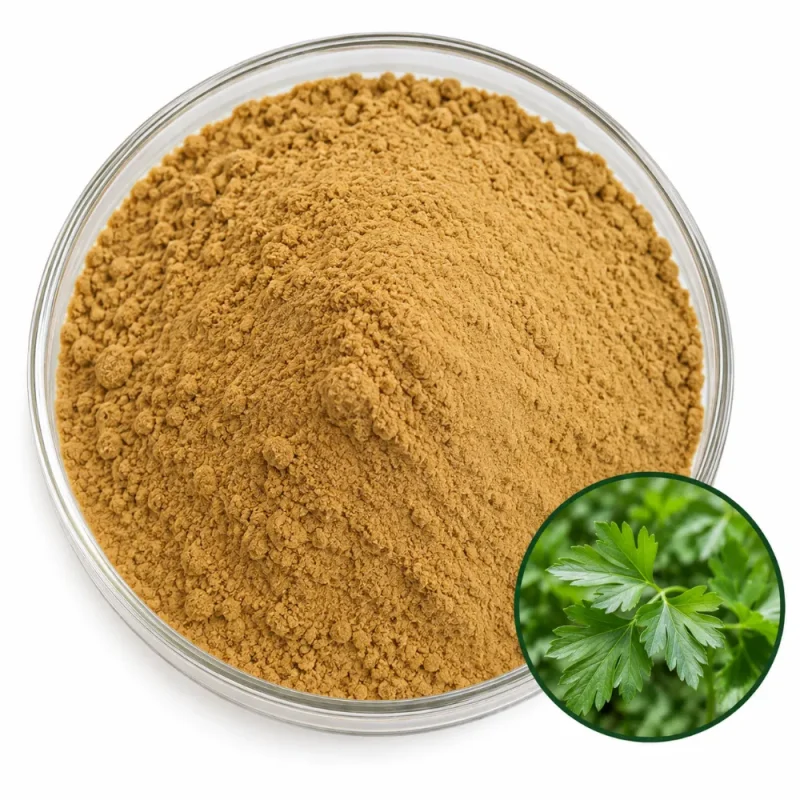
Parsley Extract 30% Flavonoids

The fresh herb of Petroselinum crispum, the curly or flat-leaf garden parsley of Mediterranean origin, is dried and extracted with ethanol to give this parsley extract, which is a flavonoid concentrate and not an essential oil. It is dried and milled to a green, 80 mesh powder with a mild, grassy character.

Total flavonoids are measured by UV at a single 30% grade. The powder fits capsules, tablets, drink powders and green blends that need a defined herb extract with a mild, grassy character and none of the sharp aroma of the oil.

Flavonoid Standardization & Grades

Parsley is unusually rich in apigenin glycosides. The main flavonoid of Petroselinum crispum (Mill.) Fuss is apiin, the 7-apiosylglucoside of apigenin, accompanied by luteolin and chrysoeriol glycosides, with smaller amounts of flavonols. The herb also carries a volatile oil with apiol and myristicin, but these are volatile and are largely absent from a dried ethanol-extracted powder. Standardizing to total flavonoids gives buyers a figure for the polar phenolic fraction as a group.

A single 30% level keeps every lot on one target and one method. A 30% flavonoid figure is a strong concentration for an herb extract and implies a purification step that removes sugars and chlorophyll-bound material. The same herb is also supplied as a 10:1 ratio extract without a marker figure, the Parsley Leaf Extract Powder, and as a milled leaf, Parsley Leaf Powder. A specification that needs a flavonoid figure is met by this standardized grade.

The herb is the part used. Root, seed and the oil distilled from them are separate materials with different chemistry, and they are not part of this identity.

Flavonoid Analysis & Purity Risks

Total flavonoids by UV are calculated from the absorbance of a colored complex formed between the flavonoid hydroxyl groups and a metal-ion reagent, and the result is expressed against a reference flavonoid such as rutin or apigenin. The figure is a group total. It responds mainly to flavonoids with free hydroxyl groups in particular positions, so it can under-count some glycosides and over-count others, and it cannot be converted into a figure for apiin or any single compound.

Because of that, identity is read from the fingerprint. A parsley extract shows apiin as the leading peak, with luteolin and chrysoeriol glycosides beside it, and this pattern separates it from extracts of other green herbs, such as celery leaf or lovage, whose main flavonoid glycosides are different. A lot with the correct total and a different pattern is examined.

The botanical risk is the family. Parsley belongs to the carrot family, and toxic look-alikes exist in the wild, including fool’s parsley (Aethusa cynapium) and poison hemlock (Conium maculatum), which resemble parsley leaf when dried and cut. Cultivated parsley supplied by farms is the practical safeguard, and the fingerprint is a second control. The stated species and the herb part are part of the identity.

A second risk is sugars. A color reaction for flavonoids is less affected by sugars than a Folin assay, but free sugars and chlorophyll can alter the apparent absorbance, so the extract is cleaned before the measurement and a blank is run alongside.

Raw herb is cut before flowering, washed and dried at moderate temperature, because heat degrades chlorophyll and some flavonoids, and slow drying in damp air gives a brown, musty extract.

Sample preparation affects the reading. The extract is dissolved in aqueous ethanol with sonication, cleared by centrifugation or filtration and diluted into the working range before the color reaction, and the reaction time and reagent concentration are held constant. A blank prepared from the same solvent corrects for the green background that chlorophyll adds to the absorbance.

Typical Specifications

Specification ItemProduct Information
Latin NamePetroselinum crispum
Plant PartWhole Plant
ProcessingEthanol Extraction
Compound ClassFlavonoids, Polyphenols
Common NameParsley, Garden Parsley
Ingredient TypeStandardized Extract
Marker Compound(s)Total Flavonoids
Primary Grade30% Flavonoids (UV)
AppearanceGreen powder
Solubility / DispersibilitySlightly Soluble in Water
Quality Parameters
Moisture (LOD)≤5.0%
Total Ash≤5.0%
Particle Size80 mesh
Heavy MetalsLead ≤2 ppm · Arsenic ≤1 ppm · Cadmium ≤1 ppm · Mercury ≤0.1 ppm
MicrobiologyTPC ≤1,000 cfu/g · Yeast & Mold ≤100 cfu/g · E. coli Negative · Salmonella Negative/25 g
Shelf Life24 months in unopened original packaging, cool and dry storage

Applications by Grade

30% Grade in Green Capsule Fills

The 30% grade of parsley extract fits two-piece capsules at a modest fill weight. The green powder is mildly hygroscopic and sticks to tamping pins when damp, so a flow agent and a dry filling room keep capsule weights steady across the run.

30% Grade in Pigment-Aware Tablets

Tablets of the 30% grade carry a green tint that fades to olive and brown as chlorophyll degrades. A dry binder and an opaque film coat protect the tablet color, and a desiccant in the bottle limits moisture-driven darkening through the shelf life.

30% Grade in Green Drink Powders

Instant green drink powders use the 30% grade at gram level beside spirulina-type or grass-type ingredients. The mild herbal flavor blends with lemon, apple or cucumber notes, and the powder disperses to a fine green haze because it is only slightly soluble.

30% Grade in Savory Seasoning Blends

Savory seasoning and soup-style blends carry the 30% grade for a green herbal background without the volatile top note of fresh parsley. The extract is much finer than rubbed parsley, so it is premixed with salt before the main charge to avoid specks.

30% Grade in Stick-Pack Premixes

Stick-pack premixes use the 30% grade in a bulking carrier so the filler can meter an accurate dose of this slightly soluble powder. Label directions should call for stirring or shaking, and a fine grind avoids visible green specks in the glass.

Technical & Quality Considerations

Parsley extract is a green to olive-green powder with a mild, grassy and faintly sweet herbal character. It is only slightly soluble in water. Apigenin glycosides dissolve better in warm water and aqueous alcohol, while the aglycones dissolve poorly, so the extract gives a hazy green dispersion that clears only partly on warming.

Apigenin glycosides are fairly stable to heat and light compared with other flavonoids, but chlorophyll and its derivatives fade with light, acid and heat, shifting the color from green through olive to brown. Opaque packaging, low warehouse light and mildly alkaline-free bases hold the shade. Strong acid and prolonged heat hydrolyze apiin to the aglycone apigenin, which is far less soluble and appears as a fine sediment.

The dry powder takes up moisture and cakes when damp. Closed charging and local extraction keep the fine green dust out of the air and off clothing.

A receiving check helps: a green, fine powder with a mild parsley note is expected, while a brown cast points to oxidized chlorophyll and a hay-like smell suggests storage damage. Then an accelerated stability run in the intended pack shows early whether color, flow and the flavonoid figure hold across the shelf life.

Packaging & Commercial Supply

Essencefield supports product evaluation, formulation trials, commercial orders, and ongoing ingredient supply. Packaging, storage, and shipping arrangements are determined by product characteristics, order quantity, stability requirements, and destination-market needs.

Supply ItemGeneral Information
SampleAvailable upon request for formulation, testing, and supplier evaluation
Order Quantities100 g · 1 kg · 5 kg · 25 kg · 100 kg · 500 kg · Bulk
Sample Lead TimeTypically 5–7 days after sample confirmation
Production Lead TimeTypically 15–30 days after order and specification confirmation
PackagingSuitable protective inner packaging with bags, cartons, drums, or other appropriate outer packaging
StorageStore in tightly sealed, suitable protective packaging in a cool, dry environment. Protect from moisture, heat, and direct sunlight. Specific storage conditions follow the approved product specification.
DocumentationCOA · Product Specification · TDS · SDS · Applicable declarations (as applicable)

Final order quantities, lead times, packaging, documentation, and shipping arrangements are confirmed according to the selected product and commercial requirements.

Request Ingredient Specifications & Quote

Share your target specification, application, quantity, and documentation needs. We’ll help confirm suitable options, samples, and commercial supply details.