
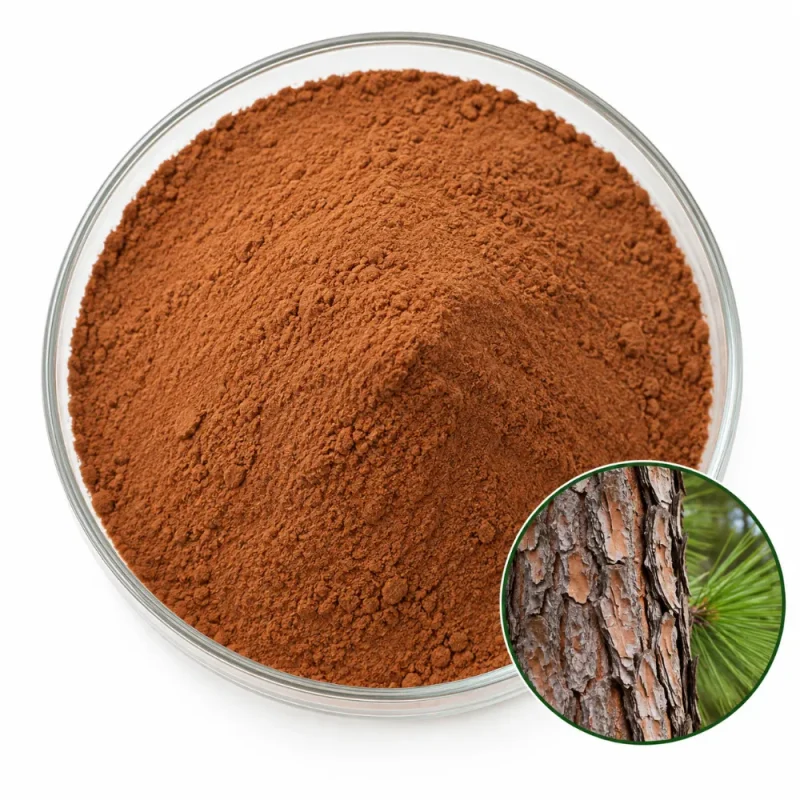
Proanthocyanidin Standardization & Grades
Proanthocyanidins are condensed tannins, polymers of flavan-3-ol units such as catechin and epicatechin joined by carbon bonds. In the bark of Pinus pinaster Aiton the units are mainly procyanidins, built from catechin and epicatechin, and they range from dimers and trimers, which are the oligomers called OPC, to long polymers. A pine bark extract is standardized to proanthocyanidins because they are the characteristic and dominant polyphenols of the bark. The 95% figure describes an extract in which nearly all of the phenolic material is of this type.
The grade is a single 95% level, so each lot is measured against the same target and the same method. A 95% proanthocyanidin figure is very high and implies an extract purified of sugars, phenolic acids and low-molecular-weight material. The same bark is also supplied as a French maritime pine bark extract with a range of 65 to 95% procyanidins, the French Maritime Pine Bark Extract ≥65–95% Procyanidins/OPC, and as a 10:1 ratio extract, the Pine Bark Extract Powder. That range product is the one to consider when the lower tiers are acceptable.
The bark is the only part used. Needles, cones and the resin of the same tree are different materials with other chemistry, and they are not part of this identity.


