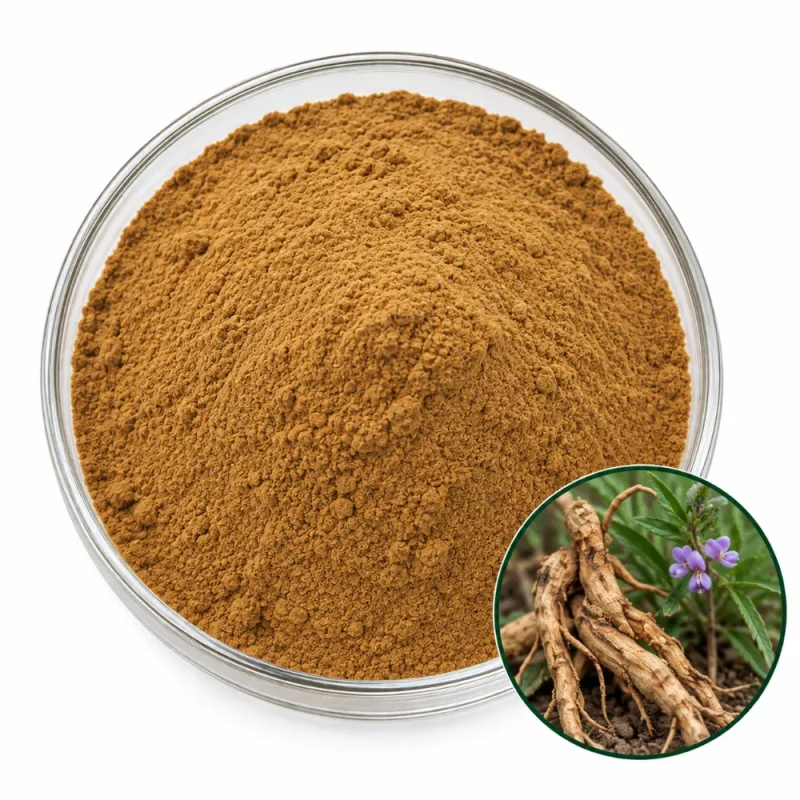
Polygala Tenuifolia Extract 5–20% Onjisaponins

The root of Polygala tenuifolia, the slender-leaved milkwort whose root is used in East Asian herbal trade as yuanzhi, is extracted with ethanol to give this Polygala tenuifolia extract. The concentrate is dried and milled to a light brown, 80 mesh powder that dissolves in water, with an acrid, bitter root note.

Onjisaponins are measured by UV and offered as a 5–20% range, with 20% as the primary grade and 5% as the lower grade. Tenuifolin is tracked as a second marker. The higher grade fits capsules and tablets, and the lower grade fits drink powders and blends.

Onjisaponin Standardization & Grades

Onjisaponins are the characteristic triterpenoid saponins of Polygala tenuifolia Willd. They are built on the aglycone presenegenin and carry sugar chains that are esterified with phenolic acids, and the group is named after onji, the Japanese name of the root. The root also holds oligosaccharide esters such as 3,6′-disinapoyl sucrose and a series of xanthones. Standardizing the extract to onjisaponins gives buyers one figure for the saponin fraction that defines the root.

GradeAssay & MethodWhere It Fits
5% OnjisaponinsUVDrink powders, higher-inclusion blends
20% OnjisaponinsUVCapsules and tablets, small fill weight

The 20% grade carries four times the onjisaponin of the 5% grade per gram, so a capsule reaches its target with a smaller fill, while the 5% grade is bulkier and dissolves quickly into beverages. The same root is also supplied as a 10:1 ratio extract without a marker figure, the Polygala Root Extract Powder, and as a milled root, Polygala Root Powder. For an onjisaponin figure on the specification, this standardized grade is the one to use.

The root is the only part used. The aerial parts of the plant are a separate material with other compounds, and they are not part of this identity.

The root part needs a precise statement. In the traditional drug the root bark is split from the woody core, and the core is discarded, because the core carries few saponins. The extract described here is a Polygala tenuifolia extract of the root, and the saponin share of a lot depends on how much core was removed before extraction, which is one reason the grade is measured on the finished powder.

Onjisaponin Analysis & Purity Risks

The UV method for saponins is colorimetric. The saponins react with an acid reagent such as vanillin and strong acid, and the color is read against a reference saponin. The figure is a group total expressed as that reference, and it responds to any triterpenoid saponin, so it does not by itself show which saponins are present or whether they are intact esters or breakdown products.

The second marker is read separately by chromatography. Tenuifolin is a smaller compound formed when onjisaponins are hydrolyzed and deesterified, so a high tenuifolin share points to a more degraded saponin fraction, while a low share points to intact saponins. This makes the pair a useful gauge of handling and processing, and it is why the two are read together.

Identity is read from the fingerprint. The onjisaponin cluster, with the sucrose esters and the xanthones, forms a pattern typical of yuanzhi and separates it from other saponin-rich roots sold in the same grade range. Saponins and sucrose esters have different chromophores, so detection uses more than one wavelength.

The botanical risk is the species and the part. The pharmacopeia accepts Polygala tenuifolia and Polygala sibirica, and both are traded as yuanzhi. Other Polygala species with different saponin patterns are also sold. The traditional drug is the root bark with the woody core removed, while whole root includes the core, which dilutes the saponin share. Both the species and the root are fixed in the identity statement.

Onjisaponin esters are sensitive to hydrolysis, so raw root is dried quickly, stored dry and extracted under mild conditions. Root dried slowly in damp air loses ester groups and gives a darker, weaker extract.

Sample preparation affects the reading. The extract is dissolved in aqueous alcohol and filtered, and the solution is read promptly because the ester bonds of onjisaponins hydrolyze on standing in neutral or alkaline solution. Standards are prepared fresh and the calibration is rerun when the reagent is renewed, so that results of different days stay comparable.

Typical Specifications

Specification ItemProduct Information
Latin NamePolygala tenuifolia
Plant PartRoot & Rhizome
ProcessingEthanol Extraction
Compound ClassSaponins
Common NamePolygala, Yuanzhi
Ingredient TypeStandardized Extract
Marker Compound(s)Onjisaponins; Tenuifolin
Primary Grade20% Onjisaponins (UV)
Available Grades5% · 20% Onjisaponins (UV)
AppearanceLight Brown powder
Solubility / DispersibilityWater Soluble
Quality Parameters
Moisture (LOD)≤5.0%
Total Ash≤5.0%
Particle Size80 mesh
Heavy MetalsLead ≤2 ppm · Arsenic ≤1 ppm · Cadmium ≤1 ppm · Mercury ≤0.1 ppm
MicrobiologyTPC ≤1,000 cfu/g · Yeast & Mold ≤100 cfu/g · E. coli Negative · Salmonella Negative/25 g
Shelf Life24 months in unopened original packaging, cool and dry storage

Applications by Grade

20% Grade in Foam-Prone Capsule Fills

Two-piece capsules suit the 20% Polygala tenuifolia grade, because a small fill reaches an onjisaponin target. The saponin powder picks up moisture quickly, so a dry filling room and sealed hoppers keep capsule weights consistent.

20% Grade in Throat-Aware Tablets

Tablets of the 20% grade need a dry binder and a film coat, because the saponins of this root are acrid and leave a scratchy taste on contact. A coat covers the taste and a hardness check after a month confirms that the tablet has not softened.

5% Grade in Sweetened Drink Powders

The 5% grade of Polygala tenuifolia extract dissolves into instant drink powders and stick packs without a residue. The root’s acrid, bitter taste calls for strong sweeteners and spice flavors, and a low-shear mix keeps the foam down when the powder is stirred into water.

5% Grade in Syrup Bases

Syrup bases carry the 5% grade dissolved in a sugar solution, which damps the foam and mellows the taste. The pH of the syrup should be mildly acidic to neutral, since the ester groups of the saponins hydrolyze in alkaline syrups, and clarity is checked after a week.

20% Grade in Granule Sachets

Granulated sachets carry the 20% grade with a honey or malt base. The extract is hygroscopic, so it is dosed late and kept apart from damp ingredients, and the blend is sampled from several depths to confirm that the onjisaponins are evenly spread.

Technical & Quality Considerations

Polygala tenuifolia extract is a light brown powder with an acrid, bitter and slightly sweet root character. It dissolves in water to a clear to slightly hazy brown solution, and the dissolved saponins are surface-active, so agitation produces a persistent foam that settles slowly.

Onjisaponins carry ester groups that are sensitive to alkali and to enzymes, and the sugar chains hydrolyze under strong acid and heat. High-pH premixes and enzyme-containing ingredients degrade the saponins to tenuifolin, so neutral to mildly acidic bases, short heat treatment and enzyme-free formulas keep the profile. The sucrose esters and xanthones darken slowly with light and oxygen.

The dry powder is hygroscopic and cakes when damp. Closed charging and local extraction keep the acrid, irritating dust out of the air at the filler, since saponin dust affects the nose and throat.

A receiving check helps: a light brown, fine powder with a mild root note is expected, while hard lumps point to moisture uptake and a caramel smell points to heat damage. Then an accelerated stability run in the intended pack shows early whether flow, color, taste and clarity hold across the shelf life.

Packaging & Commercial Supply

Essencefield supports product evaluation, formulation trials, commercial orders, and ongoing ingredient supply. Packaging, storage, and shipping arrangements are determined by product characteristics, order quantity, stability requirements, and destination-market needs.

Supply ItemGeneral Information
SampleAvailable upon request for formulation, testing, and supplier evaluation
Order Quantities100 g · 1 kg · 5 kg · 25 kg · 100 kg · 500 kg · Bulk
Sample Lead TimeTypically 5–7 days after sample confirmation
Production Lead TimeTypically 15–30 days after order and specification confirmation
PackagingSuitable protective inner packaging with bags, cartons, drums, or other appropriate outer packaging
StorageStore in tightly sealed, suitable protective packaging in a cool, dry environment. Protect from moisture, heat, and direct sunlight. Specific storage conditions follow the approved product specification.
DocumentationCOA · Product Specification · TDS · SDS · Applicable declarations (as applicable)

Final order quantities, lead times, packaging, documentation, and shipping arrangements are confirmed according to the selected product and commercial requirements.

Request Ingredient Specifications & Quote

Share your target specification, application, quantity, and documentation needs. We’ll help confirm suitable options, samples, and commercial supply details.