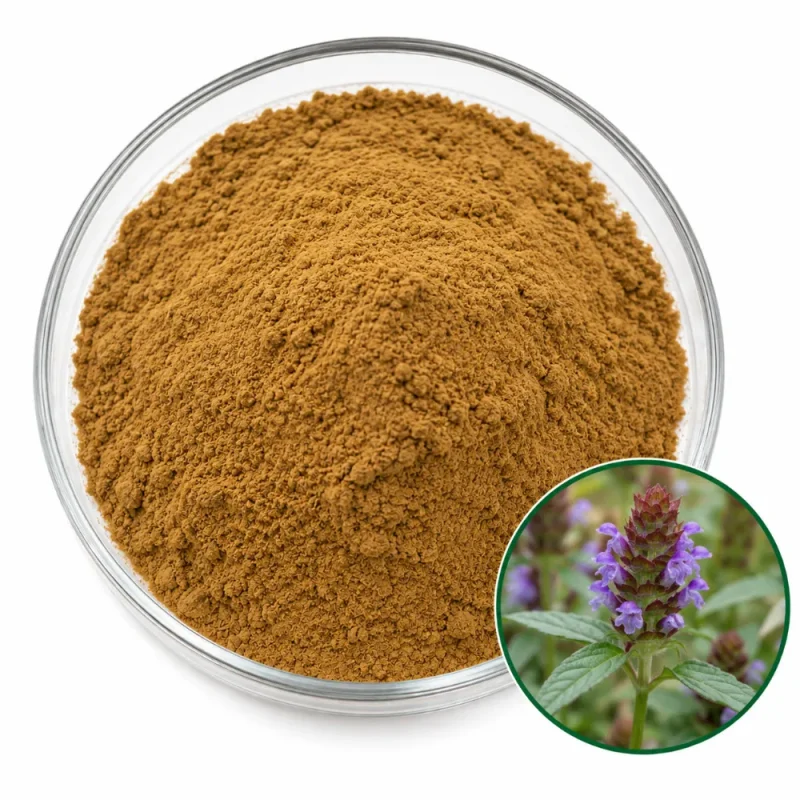
Prunella Vulgaris Extract 2–10% Rosmarinic Acid / 10–50% Triterpenes

The flowering spikes and aerial parts of Prunella vulgaris, the self-heal of temperate meadows and the xiakucao of East Asian herbal trade, are extracted with ethanol to give this Prunella vulgaris extract. The concentrate is dried and milled to a light brown, 80 mesh powder with a mild herbal note and a faintly bitter finish.

Rosmarinic acid is measured by HPLC and offered as a 2–10% range, with 10% as the primary grade and 2% as the lower grade. Total triterpenes of 10–50% are stated beside it. The higher grade suits compact capsules and tablets, while the lower grade suits tea blends and powders that can carry more of the herb.

Marker Compounds & Standardization

Prunella vulgaris L. carries two chemically different marker families. Rosmarinic acid is a polar caffeic acid ester that is the leading phenolic of the Lamiaceae herb, and the pentacyclic triterpenoid acids, mainly ursolic and oleanolic acid, are the lipophilic fraction. A grade that names both asks the extract to hold a polar phenolic and a group of lipophilic acids at once, which depends on the extraction solvent and the cleanup.

GradeAssay & MethodWhere It Fits
2% Rosmarinic AcidHPLCBlends, higher-inclusion powders
10% Rosmarinic AcidHPLCCapsules and tablets, small fill weight

The total triterpenes figure of 10–50% is a separate measure of the lipophilic fraction, and a lot is described by both numbers, not by one alone. At the higher rosmarinic acid grade, the extract carries five times the marker of the lower grade per gram, which allows a compact capsule, while the lower grade keeps more of the herb matrix. The same herb is also supplied as a 10:1 ratio extract without a marker figure, the Selfheal Extract Powder, and as a milled herb, Selfheal (Prunella) Powder.

The aerial herb is the part used. Prunella vulgaris is cut at flowering, when the purple flower spikes are fully formed, and the whole spike, leaf and soft upper stem are dried and extracted. Thick lower stems add fiber and little marker content, so a lot with a high proportion of old stem shows lower rosmarinic acid and triterpene figures.

Analytical Methods & Purity Risks

The total triterpenes figure counts the pentacyclic triterpenoid acids as a group, and these have little UV absorbance, so they are read by low-wavelength detection, by a detector that does not depend on a chromophore, or by a colorimetric procedure. The two figures come from different parts of the analytical program, and they are not interchangeable.

The balance of the two is informative. A water-rich extraction favors rosmarinic acid, while an ethanol-rich one favors the triterpenoid acids, and a product that is high in both has been made with a purposeful two-stage approach. A lot with a high rosmarinic acid figure and a low triterpene figure comes from a different process from one with the reverse.

Identity is read from the fingerprint. Rosmarinic acid with the ursolic and oleanolic acid peaks and the flavonoid glycosides, notably rutin and hyperoside, is typical of Prunella vulgaris. This pattern separates the herb from other mint-family herbs rich in rosmarinic acid, such as rosemary, sage and lemon balm, where the triterpenoid and flavonoid companions differ.

The botanical risk is the name. Self-heal is traded under several common names, including heal-all, and other Prunella species, such as Prunella asiatica, appear in markets. In the Chinese drug, the dried fruit spike is the stated part, while the extract described here covers the aerial parts. The stated species and the part are part of the identity.

Rosmarinic acid is an ester and is sensitive to heat and alkali, and the triterpenoid acids are stable. Herb that was dried slowly in damp air loses rosmarinic acid to enzymatic oxidation, so the harvest is dried promptly and extracted under mild conditions.

Sample preparation affects both readings. Rosmarinic acid dissolves in aqueous methanol, while the triterpenoid acids need pure methanol or a chloroform mixture, so a single solvent recovers one marker better than the other. The method fixes the solvent and the sonication time, and a spiked sample proves that both are extracted completely.

Typical Specifications

Specification ItemProduct Information
Latin NamePrunella vulgaris
Plant PartLeaf & Herb
ProcessingEthanol Extraction
Compound ClassTriterpenoids, Terpenoids, Polyphenols
Common NamePrunella, Selfheal, Heal-All
Ingredient TypeStandardized Extract
Marker Compound(s)Rosmarinic Acid; Total Triterpenes
Primary Grade10% Rosmarinic Acid (HPLC)
Available Grades2% · 10% Rosmarinic Acid (HPLC); Total Triterpenes 10–50%
AppearanceLight Brown powder
Solubility / DispersibilitySlightly Soluble in Water
Quality Parameters
Moisture (LOD)≤5.0%
Total Ash≤5.0%
Particle Size80 mesh
Heavy MetalsLead ≤2 ppm · Arsenic ≤1 ppm · Cadmium ≤1 ppm · Mercury ≤0.1 ppm
MicrobiologyTPC ≤1,000 cfu/g · Yeast & Mold ≤100 cfu/g · E. coli Negative · Salmonella Negative/25 g
Shelf Life24 months in unopened original packaging, cool and dry storage

Applications by Grade

10% Grade in Waxy Capsule Fills

The 10% grade of Prunella vulgaris extract reaches a rosmarinic acid target in a small fill, which suits two-piece capsules. The triterpenoid acids make the powder waxy and water-repellent, so a flow agent and a dry filling room keep capsule weights consistent.

10% Grade in Direct-Compression Tablets

Tablets of the 10% grade need a dry binder and a lubricant system that copes with the waxy triterpenoid fraction, which sticks to punches in humid rooms. A film coat limits dust and covers the bitter, herbal taste of the spike.

2% Grade in Herbal Tea Granules

Granulated blends for infusion pair the 2% grade with cut selfheal spikes, which gives a visible flower and a dissolved phenolic base. The triterpenoid acids dissolve poorly in hot water, so the extract adds body and color more than dissolved triterpenes.

2% Grade in Instant Drink Powders

Instant drink powders disperse the 2% grade at gram level, giving a pale brown haze because it is only slightly soluble. The mild herbal flavor suits lemon, mint or chamomile flavors, and the powder should be stirred in slowly to avoid floating lumps.

10% Grade in Oil-Phase Softgels

The 10% grade disperses in an oil carrier, in which the triterpenoid acids dissolve better than in water. Mill the powder fine before dispersion, because coarse particles settle in the oil, and keep the fill under gentle agitation while it is dispensed.

Technical & Quality Considerations

Prunella vulgaris extract is a light brown powder with a mild, herbal and faintly bitter character. It is only slightly soluble in water. Rosmarinic acid dissolves in warm water and aqueous alcohol, while the triterpenoid acids dissolve in ethanol and lipids and not in water, so the extract disperses in water without forming a true solution.

Rosmarinic acid is an ester and hydrolyzes under strong alkali and prolonged heat to caffeic acid and a danshensu-type acid. It also oxidizes in solution with iron and copper and darkens. The triterpenoid acids are stable to heat and oxidation.

The dry powder takes up moisture and cakes when damp. Closed charging and local extraction keep the fine herbal dust out of the air at the filler.

A receiving check helps: a light brown, fine powder with a mild herbal note is expected, while a very dark shade points to heat damage and a musty smell suggests damp herb. Then an accelerated stability run in the intended pack shows early whether color, flow and the rosmarinic acid figure hold across the shelf life.

A quick check at receipt is useful. A light brown, fine powder with a mild herbal note is expected for Prunella vulgaris extract, while a waxy, sticky texture points to a high triterpenoid share and a sour smell suggests damp herb. Both are visible before any assay result arrives.

Packaging & Commercial Supply

Essencefield supports product evaluation, formulation trials, commercial orders, and ongoing ingredient supply. Packaging, storage, and shipping arrangements are determined by product characteristics, order quantity, stability requirements, and destination-market needs.

Supply ItemGeneral Information
SampleAvailable upon request for formulation, testing, and supplier evaluation
Order Quantities100 g · 1 kg · 5 kg · 25 kg · 100 kg · 500 kg · Bulk
Sample Lead TimeTypically 5–7 days after sample confirmation
Production Lead TimeTypically 15–30 days after order and specification confirmation
PackagingSuitable protective inner packaging with bags, cartons, drums, or other appropriate outer packaging
StorageStore in tightly sealed, suitable protective packaging in a cool, dry environment. Protect from moisture, heat, and direct sunlight. Specific storage conditions follow the approved product specification.
DocumentationCOA · Product Specification · TDS · SDS · Applicable declarations (as applicable)

Final order quantities, lead times, packaging, documentation, and shipping arrangements are confirmed according to the selected product and commercial requirements.

Request Ingredient Specifications & Quote

Share your target specification, application, quantity, and documentation needs. We’ll help confirm suitable options, samples, and commercial supply details.