
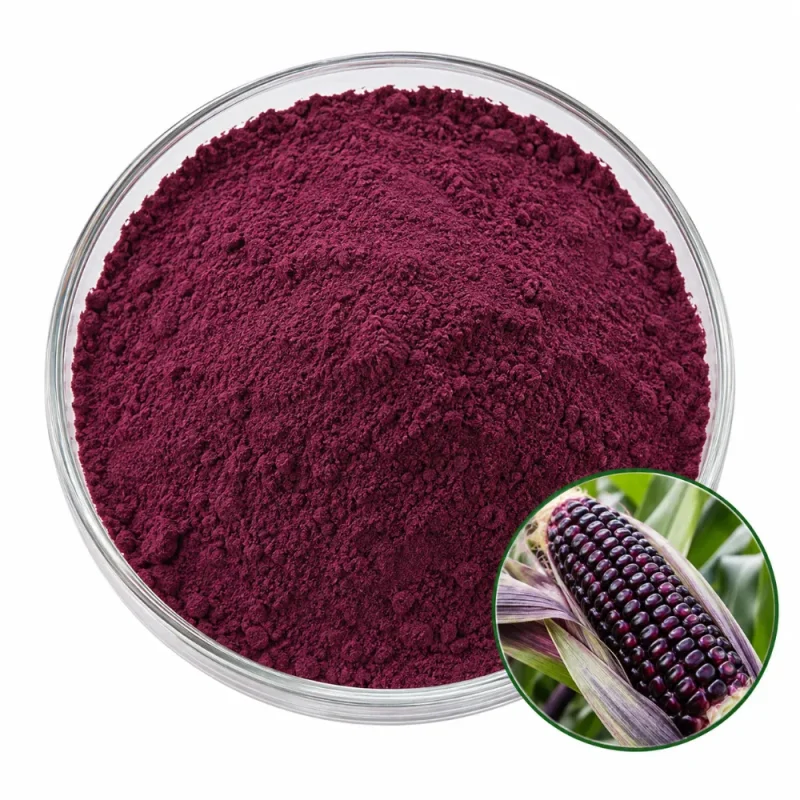
Anthocyanin Standardization & Grades
Anthocyanins are the water-soluble pigments behind red, purple and blue colors in plants. Purple corn is a rich and distinctive source: cyanidin-3-glucoside dominates, accompanied by pelargonidin and peonidin glucosides and, characteristically, by their malonylated forms, in which an acid group is attached to the sugar. The page standardizes to the summed anthocyanin class, because the kernel carries many related pigments. The botanical entity is Zea mays L., and the part used is the pigmented kernel.
| Grade | Assay & Method | Where It Fits |
|---|---|---|
| 10% Anthocyanins | UV (pH differential) | Beverage bases and gummy premixes |
| 25% Anthocyanins | UV (pH differential) | Capsules and drink sticks with small fill |
Choose the grade by dose, pigment strength and capsule fill. The 25% grade holds two and a half times the pigment load per gram of the 10% grade, so it reaches a target with a smaller fill and colors a base intensely at low inclusion. The 10% grade keeps more of the kernel sugars and phenolic acids and is slightly sweeter and less intense. Siblings of the same crop are the unstandardized Purple Corn Extract Powder, the milled Purple Corn Powder and the plain Corn Powder.
Buyers who compare purple corn extract quotes should check the type of corn before the percentage. Yellow and white maize contain no anthocyanins and carry carotenoids or none, so only pigmented varieties can meet an anthocyanin grade. A named variety, the kernel as the stated part and a clear method are the items that make an anthocyanin figure comparable.


