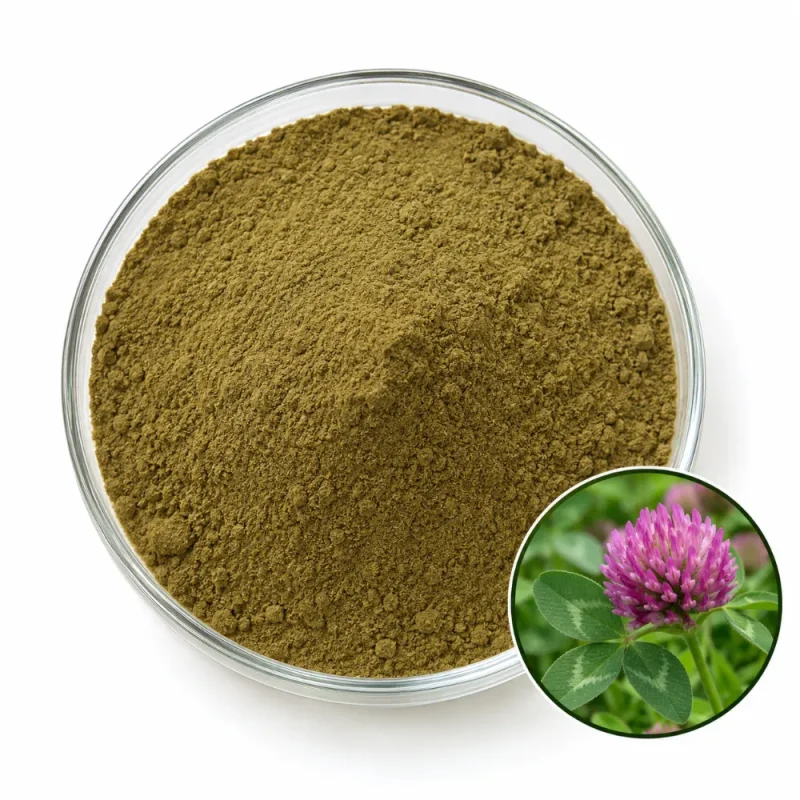
Red Clover Extract 8–40% Isoflavones

Red clover extract is prepared from the flower heads of Trifolium pratense L., a perennial legume of the family Fabaceae. Ethanol extraction concentrates the isoflavones of the blossom, and the concentrate is dried to a light brown powder.

Isoflavones are measured by HPLC, with a primary grade of 40% and a lower grade of 8%. The powder is 80 mesh and insoluble in water. The 40% grade suits capsules and tablets, while the 8% grade suits blends that need a plant-derived isoflavone profile at larger inclusion.

Red Clover Isoflavone Standardization & Grades

Isoflavones are phenolic compounds built on a 3-phenylchromone skeleton, and they occur in legumes. Red clover is distinctive because its main isoflavones are biochanin A and formononetin, the 4′-methyl ethers of genistein and daidzein, with genistein and daidzein themselves present in smaller amounts. In the plant most of them are bound to sugars, and they appear as glucosides and malonyl glucosides. Red clover extract is standardized to isoflavones because the class is stable, measurable and specific to the blossom profile.

The botanical entity is Trifolium pratense L., and the part is the flower head, which carries more isoflavone than the leaf or stem.

GradeAssay & MethodWhere It Fits
8% IsoflavonesHPLCBlends, larger inclusion
40% IsoflavonesHPLCCapsules and tablets, small fill

The 40% grade carries five times the isoflavone load per gram of the 8% grade, so a capsule reaches its target with a small fill. The 8% grade is bulkier and blends easily. The same blossom is also supplied as a 10:1 ratio extract with no marker figure, the Red Clover Extract Powder. For research and formulation work that needs a single compound, Biochanin A 98% is available as a separate phytochemical.

Red Clover Isoflavone Analysis & Purity Risks

An HPLC assay separates the individual isoflavones and reads each against a reference standard. The total is then calculated from the compounds counted, so the basis matters. A sum of the four aglycones, daidzein, genistein, formononetin and biochanin A, is the usual convention for red clover, and a figure that also counts the glucosides gives a different number from the same powder. Two certificates compare only when they state the same compounds and the same basis, and an HPLC isoflavone total cannot be swapped for a UV total flavonoid figure.

For identity, the chromatographic fingerprint is read beside the total. The relative height of the biochanin A and formononetin peaks is characteristic of red clover, and it separates the plant from soy, whose profile is dominated by daidzein and genistein. Coumarins and phenolic acids give additional peaks that complete the pattern.

Purity risks follow from the material class. White clover (Trifolium repens) and sweet clover (Melilotus) grow in the same fields and have a different chemistry. Harvest timing and drying change the isoflavone level in the blossom, and the glucoside to aglycone ratio changes during drying and storage. A lot made from leaf or stem dilutes the isoflavone fraction, so the flower head is the defined part.

Extraction conditions affect what is counted. A long, warm extraction in the presence of plant enzymes converts glucosides to aglycones, and the same powder can then read differently on a glucoside-inclusive basis, which is why the HPLC conditions are fixed and the basis is stated.

Typical Specifications

Specification ItemProduct Information
Latin NameTrifolium pratense
Plant PartFlower
ProcessingEthanol Extraction
Compound ClassIsoflavones, Flavonoids, Polyphenols
Common NameRed Clover
Ingredient TypeStandardized Extract
Marker Compound(s)Isoflavones (biochanin A, formononetin, genistein, daidzein)
Primary Grade40% Isoflavones (HPLC)
Available Grades8% · 40% Isoflavones (HPLC)
AppearanceLight Brown powder
Solubility / DispersibilityInsoluble in Water
Quality Parameters
Moisture (LOD)≤5.0%
Total Ash≤5.0%
Particle Size80 mesh
Heavy MetalsLead ≤2 ppm · Arsenic ≤1 ppm · Cadmium ≤1 ppm · Mercury ≤0.1 ppm
MicrobiologyTPC ≤1,000 cfu/g · Yeast & Mold ≤100 cfu/g · E. coli Negative · Salmonella Negative/25 g
Shelf Life24 months in unopened original packaging, cool and dry storage

Applications by Grade

40% Grade for Capsule Fills

The 40% grade reaches an isoflavone target in a small fill, which suits two-piece capsules. The powder is not freely flowing, so a flow agent and a dry filling room keep the hopper from bridging, and a tamping check at the start of each run confirms the fill weight.

8% Grade in Powder Blends

The 8% grade blends with other plant extracts in dry mixes where isoflavones are one component among several. Sieve it with the carrier first, because the light brown powder picks up moisture and clumps, and combine it with the other ingredients in two stages.

40% Grade in Tablet Blends

Tablets of the 40% grade need a dry binder and a glidant. The extract compacts well, but hardness and disintegration are checked after storage, since the phenolic solid takes up moisture and darkens slowly. A film coat also hides the brown core and reduces dusting.

8% Grade in Soft-Chew Bases

Soft chews take the 8% grade as a lower-strength ingredient in a larger base. Add it after the main cook, because long heating deepens the brown color, and keep the base pH in the range the gelling system needs.

40% Grade for Softgel Suspensions

The insoluble 40% grade is milled into an oil phase for softgels. Particle size and viscosity are checked, because settling inside the fill mass leads to uneven dosing across a batch. A suspending agent such as a wax or lecithin slows settling and keeps the red clover extract evenly spread.

8% Grade for Stick-Pack Mixes

Stick-pack mixes use the 8% grade at a higher gram weight with a bulking carrier. The powder does not dissolve, so the mix is sold for stirring into a thick base and not for clear drinks.

Technical & Quality Considerations

Red clover extract is a light brown powder with a mild, hay-like odor. It is insoluble in water, so a drink made from the extract appears as a fine suspension that settles on standing, and wetting agents, milling and a viscous carrier improve the dispersion. Isoflavones are stable to moderate heat, but they bind iron and the powder darkens on contact with carbon steel, so stainless surfaces and low-iron fillers are preferred.

The glucosides and the aglycones differ in dissolution and in bioavailability behavior on the formulation bench, which is why a dissolution check is run after changes in the capsule shell or the binder. The powder is hygroscopic, and moisture lowers flow and promotes caking in warm storage, so sealed liners and a cool, dry store are used.

Blossom material also carries a small amount of chlorophyll and wax that survive an ethanol extraction. They give some lots a greenish cast and a slightly sticky texture, and in warm storage they make the powder cake against the liner. Sieving in a cool room and keeping drums away from heat limits both effects.

For scale-up, premix the extract with a small share of the carrier and verify fill weight at each lot change, since the two grades differ widely in bulk. Compare each lot with a retained sample for hue, because a lot made from older blossom is browner than one made from fresh flower heads.

Packaging & Commercial Supply

Essencefield supports product evaluation, formulation trials, commercial orders, and ongoing ingredient supply. Packaging, storage, and shipping arrangements are determined by product characteristics, order quantity, stability requirements, and destination-market needs.

Supply ItemGeneral Information
SampleAvailable upon request for formulation, testing, and supplier evaluation
Order Quantities100 g · 1 kg · 5 kg · 25 kg · 100 kg · 500 kg · Bulk
Sample Lead TimeTypically 5–7 days after sample confirmation
Production Lead TimeTypically 15–30 days after order and specification confirmation
PackagingSuitable protective inner packaging with bags, cartons, drums, or other appropriate outer packaging
StorageStore in tightly sealed, suitable protective packaging in a cool, dry environment. Protect from moisture, heat, and direct sunlight. Specific storage conditions follow the approved product specification.
DocumentationCOA · Product Specification · TDS · SDS · Applicable declarations (as applicable)

Final order quantities, lead times, packaging, documentation, and shipping arrangements are confirmed according to the selected product and commercial requirements.

Request Ingredient Specifications & Quote

Share your target specification, application, quantity, and documentation needs. We’ll help confirm suitable options, samples, and commercial supply details.