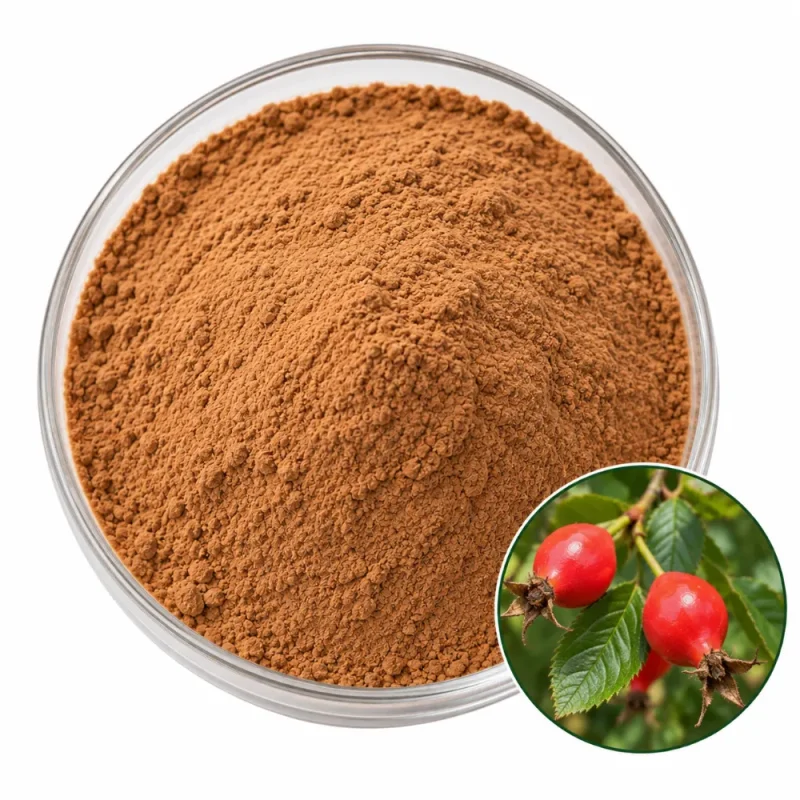
Rose Hip Extract 2–12% Polyphenols

Rose hip extract comes from the ripe fruit of the dog rose, Rosa canina L., of the family Rosaceae. The hip is the red, fleshy cup that encloses the seeds. Ethanol extraction concentrates its phenolic fraction, and the concentrate is dried to a light brown powder that dissolves in water.

Total polyphenols are measured by UV spectrophotometry with the Folin-Ciocalteu reagent, with a primary grade of 12% and a lower grade of 2%. The powder is 80 mesh. The 12% grade suits capsules and tablets, while the 2% grade suits drink powders and bulk blends.

Rose Hip Polyphenol Standardization & Grades

Polyphenols carry several phenolic hydroxyl groups on their ring systems. In rose hips they include flavonol glycosides, catechin-type flavan-3-ols, tannins and phenolic acids, alongside the carotenoids that give the fruit its orange-red color and the vitamin C, pectin and organic acids that make the pulp tart. Rose hip extract is standardized to total polyphenols because this is the one class that is measurable on a UV instrument across lots, while carotenoids and acids are separate fractions.

The botanical entity is Rosa canina L., and the part is the fruit. The seeds of the hip are oil-bearing, and the fine hairs on them are removed before processing. Rose hip is also supplied as a 10:1 ratio extract, the Rose Hip Extract Powder, and as the milled fruit, Rose Hip Powder and Freeze-Dried Rose Hip Powder.

GradeAssay & MethodWhere It Fits
2% PolyphenolsUV (Folin-Ciocalteu)Drink powders, bulk blends
12% PolyphenolsUV (Folin-Ciocalteu)Capsules and tablets, smaller fill

The 12% grade carries six times the polyphenol load of the 2% grade per gram, so a capsule reaches its target with a modest fill. The 2% grade is nearer to a concentrated fruit extract in its bulk and flavor, and it suits drink premixes and blends in which the tart, fruity note of the hip is welcome. Because the two grades share the same reagent basis, a formulator can scale between them by weight alone.

Rose Hip Polyphenol Analysis & Purity Risks

The Folin-Ciocalteu assay measures reducing capacity. A reagent containing molybdenum and tungsten is reduced by phenolic groups and turns blue, and the absorbance is read and calculated against a reference phenol, often gallic acid. The percentage is an equivalent, not a count of molecules. Ascorbic acid, which is abundant in rose hip, reduces the same reagent, so a hip extract rich in vitamin C can read higher than its polyphenol load alone would give.

For that reason the identity check and the figure are read together. An HPLC fingerprint of the flavonol glycosides and phenolic acids separates a hip extract from other red fruit extracts. A Folin-Ciocalteu total cannot be converted into an HPLC result for single compounds, and neither can be compared with a UV total of a different class such as flavonoids.

Purity risks follow from the material class. The genus Rosa is large, and several species yield hips that are traded under the same name, so botanical identity is confirmed before extraction. The ripe hip is the defined part. Seeds and hairs, if they are carried into the extract, add oil and fiber and lower the polyphenol share. The raw hips are also seasonal, and the phenolic content changes with ripeness, which is why ripe fruit is dried promptly.

Sample preparation takes account of the color of the powder. The sample is dissolved, a defined volume of reagent is added, and a sample blank is run so that the orange-red carotenoid tint is not read as a phenolic response.

Typical Specifications

Specification ItemProduct Information
Latin NameRosa canina
Plant PartFruit & Berry
ProcessingEthanol Extraction
Compound ClassPolyphenols
Common NameRose Hip, Dog Rose Hip
Ingredient TypeStandardized Extract
Marker Compound(s)Total polyphenols (flavonol glycosides, flavan-3-ols, phenolic acids)
Primary Grade12% Polyphenols (UV, Folin-Ciocalteu)
Available Grades2% · 12% Polyphenols (UV, Folin-Ciocalteu)
AppearanceLight Brown powder
Solubility / DispersibilityWater Soluble
Quality Parameters
Moisture (LOD)≤5.0%
Total Ash≤5.0%
Particle Size80 mesh
Heavy MetalsLead ≤2 ppm · Arsenic ≤1 ppm · Cadmium ≤1 ppm · Mercury ≤0.1 ppm
MicrobiologyTPC ≤1,000 cfu/g · Yeast & Mold ≤100 cfu/g · E. coli Negative · Salmonella Negative/25 g
Shelf Life24 months in unopened original packaging, cool and dry storage

Applications by Grade

12% Grade for Capsule Fills

The 12% grade reaches a polyphenol target in a modest fill, which suits two-piece capsules. The powder carries a slight fruity-tart scent and takes up moisture, so a dry filling room and a flow agent prevent bridging in the hopper.

2% Grade in Drink Powders

The 2% grade dissolves in cold water to a clear to slightly hazy orange-brown drink with a tart, fruity note. It works with berry, citrus and hibiscus flavors, where the acidity of the hip is part of the taste profile.

12% Grade in Tablet Blends

Tablets of the 12% grade need a dry binder and a lubricant. A film coat limits moisture pickup and color transfer onto the punch faces. Tablet hardness is checked after storage, since the acidic, hygroscopic solid softens in humidity and the tablet edges can chip.

2% Grade for Gummy Bases

Gummies take the 2% grade as a flavor- and color-contributing ingredient. Add it after the main cook and check the gel pH, because the tart extract lowers it and can weaken a pectin set, and a trial batch shows whether the gel holds.

12% Grade in Stick-Pack Premixes

Stick-pack premixes of the 12% grade are diluted in steps with a bulking carrier so that the filler can weigh an accurate dose. The powder is sticky when damp, so the packing room is kept dry.

2% Grade for Syrup and Concentrate Bases

Instant concentrates and syrup bases use the 2% grade as a dissolved ingredient. It blends with sugars and acids without dropping out, and the color stays stable while the base is cool and protected from light.

Technical & Quality Considerations

Rose hip extract is a light brown powder with a fruity, tart, slightly sweet note. It is water soluble, and the solution is orange-brown. Carotenoids and phenolics darken under light and oxygen, so clear packs are kept out of direct light and drums are sealed and flushed. The polyphenols chelate iron, and the powder darkens on contact with carbon steel, so stainless surfaces and low-iron fillers are preferred.

Acids and sugars from the pulp make the solid hygroscopic. In warm, humid storage the powder cakes and darkens, and the surface becomes sticky. Closed liners and a desiccant sachet hold the powder loose through shelf life. In protein drinks, tannins from the hip bind protein, which can cause haze, and this is checked in trial batches.

Pectin from the hip pulp can thicken a concentrated solution, and a rose hip extract syrup at high solids turns viscous on cooling. Filling lines for syrups and concentrates are checked for this, and dilution trials are run at the temperature of use. The carotenoid pigments are fat soluble and sit on the surface of the solution as a faint haze, which settles or floats depending on the carrier.

Verify fill weight at each lot change, since the two grades differ widely in bulk. A retained sample of each lot is used to compare hue, because the balance of orange and brown shifts with the ripeness of the hips at harvest.

Packaging & Commercial Supply

Essencefield supports product evaluation, formulation trials, commercial orders, and ongoing ingredient supply. Packaging, storage, and shipping arrangements are determined by product characteristics, order quantity, stability requirements, and destination-market needs.

Supply ItemGeneral Information
SampleAvailable upon request for formulation, testing, and supplier evaluation
Order Quantities100 g · 1 kg · 5 kg · 25 kg · 100 kg · 500 kg · Bulk
Sample Lead TimeTypically 5–7 days after sample confirmation
Production Lead TimeTypically 15–30 days after order and specification confirmation
PackagingSuitable protective inner packaging with bags, cartons, drums, or other appropriate outer packaging
StorageStore in tightly sealed, suitable protective packaging in a cool, dry environment. Protect from moisture, heat, and direct sunlight. Specific storage conditions follow the approved product specification.
DocumentationCOA · Product Specification · TDS · SDS · Applicable declarations (as applicable)

Final order quantities, lead times, packaging, documentation, and shipping arrangements are confirmed according to the selected product and commercial requirements.

Request Ingredient Specifications & Quote

Share your target specification, application, quantity, and documentation needs. We’ll help confirm suitable options, samples, and commercial supply details.