
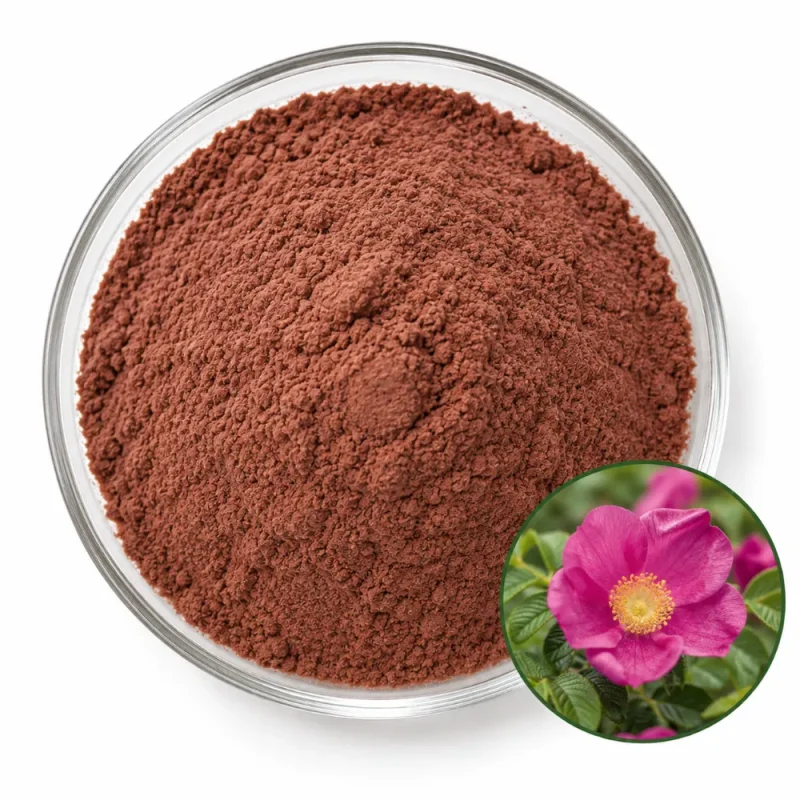
Rose Petal Polyphenol Standardization & Grades
Rose petals are unusually rich in hydrolyzable tannins. In Rosa rugosa these are ellagitannins such as the rugosins and tellimagrandins, which sit beside flavonol glycosides of quercetin and kaempferol, phenolic acids and, in dark-flowered forms, anthocyanins. Rose petal extract is standardized to total polyphenols because the class covers the tannin and flavonol families together, and the class figure is stable from lot to lot.
The botanical entity is Rosa rugosa Thunb., and the part is the flower petal. The scented volatile fraction of the petals, with citronellol, geraniol and phenylethyl alcohol, is not part of the standardized fraction, and it is largely lost in drying and ethanol concentration. Rose petal is also supplied as a 10:1 ratio extract, the Rose Flower Extract Powder, as the milled flower, Rose Petal Powder, and in a hydrolyzed protein form, Rose Peptide Powder.
| Grade | Assay & Method | Where It Fits |
|---|---|---|
| 10% Polyphenols | UV (Folin-Ciocalteu) | Drink powders, bulk blends |
| 50% Polyphenols | UV (Folin-Ciocalteu) | Capsules, tablets, effervescent |
The 50% grade carries five times the polyphenol load of the 10% grade per gram, so a capsule or an effervescent tablet reaches its target with a small charge. The 10% grade is bulkier and more floral in color, and it suits blends in which the purple-red tone of the powder is useful. Both grades share the same reagent basis, so a formulator can scale between them by weight, and the choice depends on how much color and bulk the formula can carry.


