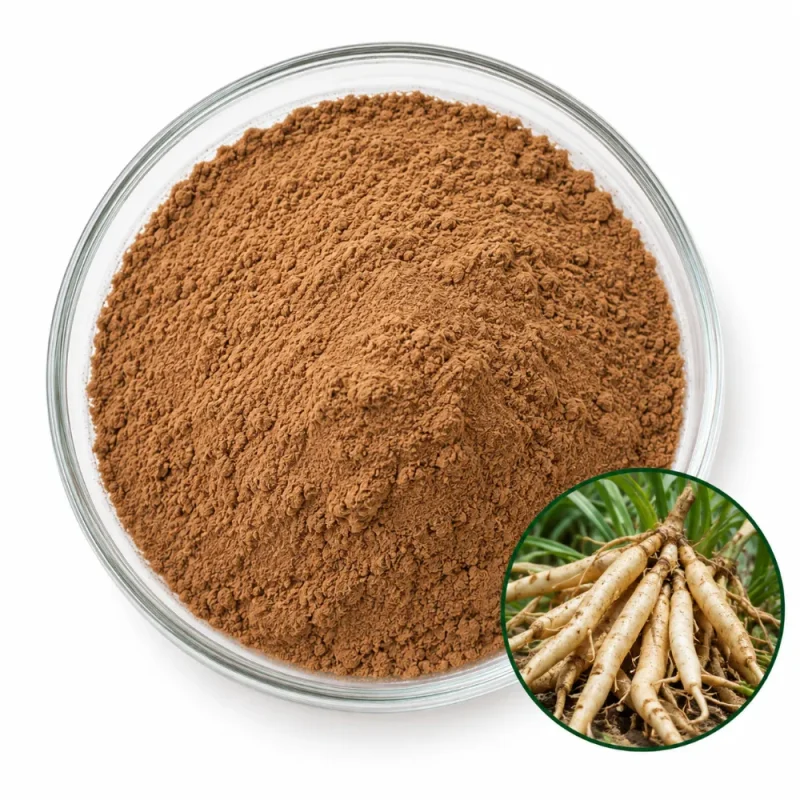
Safed Musli Extract 20–40% Saponins

Safed musli extract is prepared from the tuberous roots of Chlorophytum borivilianum Santapau & R.R.Fern., a perennial herb of the family Asparagaceae native to India. Ethanol extraction concentrates the saponin fraction of the root, and the concentrate is dried to a light brown powder.

Total saponins are measured by UV spectrophotometry, with a primary grade of 40% and a lower grade of 20%. The powder is 80 mesh and water soluble. The 40% grade suits capsules and tablets, while the 20% grade suits drink powders and blends.

Safed Musli Saponin Standardization & Grades

Saponins are glycosides in which a steroidal or triterpenoid aglycone carries sugar chains. The saponins of safed musli root are of the steroidal type, and they sit in a tuber that is mostly carbohydrate, with fructans and starch as the bulk. Safed musli extract is standardized to saponins because the extraction step removes much of the starch and sugar, and the saponin share is the measurable index of how far the root has been concentrated.

The botanical entity is Chlorophytum borivilianum, and the part is the tuberous root, which is peeled before drying. The same root is supplied as a 10:1 ratio extract with no marker figure, the White Musli Extract Powder, and as the milled root, Safed Musli Root Powder.

GradeAssay & MethodWhere It Fits
20% SaponinsUVDrink powders, bulk blends
40% SaponinsUVCapsules and tablets, small fill

The 40% grade carries twice the saponin load of the 20% grade per gram, so a capsule reaches its target with a smaller fill. The 20% grade is the bulkier powder, and it dissolves with less foam at a given gram weight, which matters in drink mixes where excess head is a nuisance. Both grades use the same reagent basis, so scaling between them is a matter of weight.

Safed Musli Saponin Analysis & Purity Risks

The UV figure is indirect for this root. The steroidal core absorbs little light, so the saponins are converted to a colored product and the absorbance is calculated against a reference saponin. The result is an equivalent tied to that reference, and an HPLC figure for individual saponins cannot be derived from it.

Because the root is rich in fructans and starch, the carbohydrate fraction is the main risk to the assay. Some sugars react with acid-based color reagents and can raise the reading, so the sample is cleaned up before the reaction or a sugar blank is run. An HPLC fingerprint of the saponins, with detection that does not depend on UV absorbance, shows the steroidal pattern that identifies the root.

Purity risks follow from the material class. The trade name safed musli covers more than one plant. Other Chlorophytum species and sometimes Asparagus tubers are sold under the same name, and they have different saponin levels and different chemistry. The peeled tuber of Chlorophytum borivilianum is the defined material. Unpeeled or old roots add fiber and dark skin tissue, which change both the color and the saponin share.

Drying and storage also matter. Roots dried at too high a temperature darken and lose part of the saponin fraction, and humid storage invites mold, so the extract is made from well-dried root and is tested for microbiology.

A third point concerns the grade scale. Between 20% and 40% the saponin share rises as starch and fructan are left behind, so the higher grade is also paler in sweetness and lower in the sticky sugar fraction. That difference is visible in the powder: the 40% grade flows better and takes up moisture more slowly than the 20% grade does in the same room.

Typical Specifications

Specification ItemProduct Information
Latin NameChlorophytum borivilianum
Plant PartRoot & Rhizome
ProcessingEthanol Extraction
Compound ClassSaponins
Common NameSafed Musli, White Musli
Ingredient TypeStandardized Extract
Marker Compound(s)Total saponins (steroidal glycosides)
Primary Grade40% Saponins (UV)
Available Grades20% · 40% Saponins (UV)
AppearanceLight Brown powder
Solubility / DispersibilityWater Soluble
Quality Parameters
Moisture (LOD)≤5.0%
Total Ash≤5.0%
Particle Size80 mesh
Heavy MetalsLead ≤2 ppm · Arsenic ≤1 ppm · Cadmium ≤1 ppm · Mercury ≤0.1 ppm
MicrobiologyTPC ≤1,000 cfu/g · Yeast & Mold ≤100 cfu/g · E. coli Negative · Salmonella Negative/25 g
Shelf Life24 months in unopened original packaging, cool and dry storage

Applications by Grade

40% Grade for Capsule Fills

The 40% grade reaches its saponin target in a small capsule fill. The powder is hygroscopic and sticky when damp, so a dry filling room and a flow agent prevent bridging. A tamping check at the start of a run confirms the fill weight, and the hopper is emptied at the end of a shift.

20% Grade in Drink Powders

The 20% grade dissolves in cold water to a light brown, clear to slightly hazy drink. The saponins foam on stirring, so the mix is built with a mild flavor base and a short stir time, and an antifoam is available for filling lines.

40% Grade in Tablet Blends

Tablets of the 40% grade need a dry binder and a lubricant. The extract compacts as a slightly tacky solid, so a film coat limits moisture pickup and hardness is rechecked after storage. Granulating the powder first improves flow on the press.

20% Grade for Stick-Pack Mixes

Stick-pack mixes use the 20% grade at higher gram weight with a bulking carrier, which helps the filler weigh an accurate dose. The powder takes up moisture, so the packing room is kept dry and the sachet film is chosen for its barrier.

40% Grade in Soft-Chew Bases

Soft chews take the 40% grade where a high-strength ingredient is spread through a large base. Add it after the main cook, because long heating darkens the color, and disperse it in part of the syrup to avoid lumps.

20% Grade for Powder Premixes

Premixes of the 20% grade carry the extract into larger dry blends. Sieve it with the bulking ingredient first, because the sugar-rich fraction clumps once it has absorbed moisture, and lumps stay visible in a pale premix.

Technical & Quality Considerations

Safed musli extract is a light brown powder with a mild, slightly sweet root odor. It is water soluble, and the solution foams when agitated, because the saponins lower surface tension. The foam complicates pumping and filling, so dosing tanks need low-shear mixing or a food-compatible antifoam. The solution is stable across the neutral range, though a strongly acidic medium can hydrolyze the sugar chains slowly over time.

The residual fructans and sugars make the solid hygroscopic. In warm, humid storage the powder cakes and darkens, so sealed liners with desiccant and cool storage keep it free flowing. Iron-containing fillers can discolor the powder, and stainless contact surfaces are preferred.

Fructans dissolve along with the saponins, and in a concentrated solution they raise the viscosity and promote a sticky film on filling equipment. Cleaning cycles for a safed musli line allow for this residue, and warm water removes it more easily than cold.

Fill weight is verified again at each lot change, because the grades differ so much in bulk. A retained sample of each lot is used to compare color, since the tone varies with how completely the root skin was removed before extraction.

Packaging & Commercial Supply

Essencefield supports product evaluation, formulation trials, commercial orders, and ongoing ingredient supply. Packaging, storage, and shipping arrangements are determined by product characteristics, order quantity, stability requirements, and destination-market needs.

Supply ItemGeneral Information
SampleAvailable upon request for formulation, testing, and supplier evaluation
Order Quantities100 g · 1 kg · 5 kg · 25 kg · 100 kg · 500 kg · Bulk
Sample Lead TimeTypically 5–7 days after sample confirmation
Production Lead TimeTypically 15–30 days after order and specification confirmation
PackagingSuitable protective inner packaging with bags, cartons, drums, or other appropriate outer packaging
StorageStore in tightly sealed, suitable protective packaging in a cool, dry environment. Protect from moisture, heat, and direct sunlight. Specific storage conditions follow the approved product specification.
DocumentationCOA · Product Specification · TDS · SDS · Applicable declarations (as applicable)

Final order quantities, lead times, packaging, documentation, and shipping arrangements are confirmed according to the selected product and commercial requirements.

Request Ingredient Specifications & Quote

Share your target specification, application, quantity, and documentation needs. We’ll help confirm suitable options, samples, and commercial supply details.