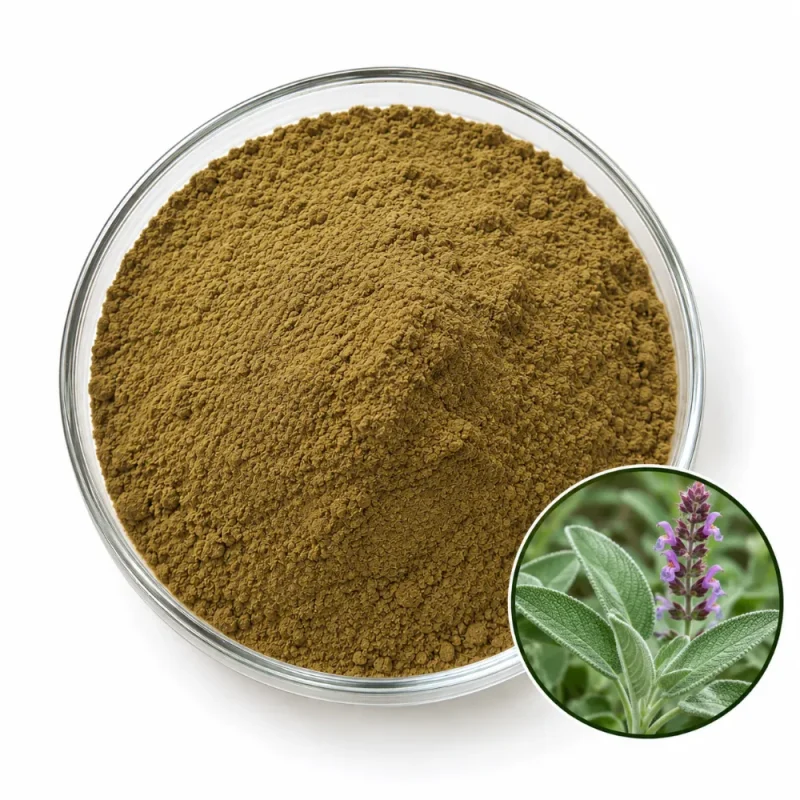
Sage Extract 2.5–10% Rosmarinic Acid

Leaves of common sage, Salvia officinalis L., a perennial of the family Lamiaceae, are the starting material for this sage extract, which is standardized to rosmarinic acid. Ethanol extraction concentrates the phenolic fraction of the leaf, and the concentrate is dried to a light brown powder.

Rosmarinic acid is measured by HPLC, with a primary grade of 10% and a lower grade of 2.5%. The powder is 80 mesh and slightly soluble in water. The 10% grade suits capsules and tablets, while the 2.5% grade suits blends and herbal formats.

Sage Rosmarinic Acid Standardization & Grades

Rosmarinic acid is an ester of caffeic acid and 3,4-dihydroxyphenyllactic acid. It is a typical phenolic acid of the mint family, and in sage leaf it is accompanied by flavone glycosides, carnosic acid and carnosol, and a volatile oil. Sage extract is standardized to rosmarinic acid because it is the single phenolic compound that is both abundant in the leaf and measurable by HPLC on a routine basis.

The botanical entity is Salvia officinalis L., the garden or common sage, and the part is the leaf. The same leaf is supplied as a 10:1 ratio extract with no marker figure, the Sage Extract Powder, and as the milled leaf, Sage Leaf Powder.

GradeAssay & MethodWhere It Fits
2.5% Rosmarinic AcidHPLCHerbal blends, larger inclusion
10% Rosmarinic AcidHPLCCapsules and tablets, small fill

The 10% grade carries four times the rosmarinic acid per gram of the 2.5% grade, so a capsule reaches its target with a small fill. The 2.5% grade is bulkier and carries more of the leaf’s own character, and it suits blends in which a herbal note is acceptable. Both grades are measured on the same basis, so scaling between them is a matter of weight, and the decision turns on how much sage aroma the finished product can carry.

Sage Rosmarinic Acid Analysis & Purity Risks

HPLC separates rosmarinic acid from the other phenolics in the extract and reads it as a distinct peak against a reference standard. The result is a specific compound, not a class equivalent. The basis is the dry powder, and a figure from a sample that has not been dried cannot be compared with it. A UV total polyphenol figure is a different measurement and cannot be converted into an HPLC rosmarinic acid result.

For identity, the HPLC fingerprint is read beside the main peak. Flavone glycosides of luteolin and apigenin, carnosic acid and carnosol, and the ursane triterpenes ursolic and oleanolic acid belong to the sage pattern, and the relative peak heights separate sage from other rosmarinic acid sources. Many Lamiaceae herbs contain the compound, so the peak alone does not identify the plant.

Purity risks follow from the material class. The genus Salvia is large, and Spanish sage (Salvia lavandulifolia), clary sage (Salvia sclarea) and red sage root (Salvia miltiorrhiza) are different plants with different profiles. Sage leaf contains thujone in its volatile oil, which is a controlled constituent in some regions. Ethanol extraction brings part of the volatile fraction along, so the thujone profile of a lot is part of the identity review.

A third risk is adulteration of a low-priced lot with a cheaper rosmarinic acid source. This is why the fingerprint, and not only the single peak, is checked on every lot.

The leaf stage matters as well. Young leaves of the first flush carry more rosmarinic acid and less woody tissue than leaves from a late cut, and the stems that are removed before extraction hold almost none of the marker.

Typical Specifications

Specification ItemProduct Information
Latin NameSalvia officinalis
Plant PartLeaf & Herb
ProcessingEthanol Extraction
Compound ClassPolyphenols
Common NameSage, Common Sage
Ingredient TypeStandardized Extract
Marker Compound(s)Rosmarinic acid
Primary Grade10% Rosmarinic Acid (HPLC)
Available Grades2.5% · 10% Rosmarinic Acid (HPLC)
AppearanceLight Brown powder
Solubility / DispersibilitySlightly Soluble in Water
Quality Parameters
Moisture (LOD)≤5.0%
Total Ash≤5.0%
Particle Size80 mesh
Heavy MetalsLead ≤2 ppm · Arsenic ≤1 ppm · Cadmium ≤1 ppm · Mercury ≤0.1 ppm
MicrobiologyTPC ≤1,000 cfu/g · Yeast & Mold ≤100 cfu/g · E. coli Negative · Salmonella Negative/25 g
Shelf Life24 months in unopened original packaging, cool and dry storage

Applications by Grade

10% Grade for Capsule Fills

The 10% grade reaches a rosmarinic acid target in a small fill, which suits two-piece capsules. The powder carries a camphoraceous sage note and can cling to equipment, so a flow agent and a dry filling room keep the fill weight steady. Airflow in the room is kept low to avoid dust.

2.5% Grade in Herbal Blends

The 2.5% grade blends with other leaf extracts in dry herbal mixes. Its sage aroma is part of the blend character, and the extract is sieved with the carrier first so that the small share spreads evenly through the batch.

10% Grade in Tablet Blends

Tablets of the 10% grade need a dry binder and a glidant. A film coat covers the brown core and limits odor. Tablet hardness is rechecked after storage because the resinous solid takes up moisture and the press tooling needs regular cleaning.

2.5% Grade for Lozenge Bases

Lozenges and pastille bases use the 2.5% grade as a flavor-contributing ingredient. Add it late in the cook so that the volatile sage notes are retained, and test the color against a retained batch, since sugar cooking darkens the tone. A trial at the final pH confirms the taste.

10% Grade in Stick-Pack Premixes

Stick-pack premixes of the 10% grade are diluted with a bulking carrier so the filler can weigh an accurate dose. The extract is only slightly soluble, so it is dosed as a suspended powder and not in clear drinks.

2.5% Grade for Tea-Style Granules

Instant tea-style granules take the 2.5% grade as a dissolved-and-suspended ingredient. The herbal note carries well in hot drinks, and a light haze is normal given the slight solubility. Granulation with a small amount of maltodextrin improves wetting.

Technical & Quality Considerations

Sage extract is a light brown powder with a camphoraceous, slightly bitter herbal odor. It is slightly soluble in water, and the solution is hazy, because rosmarinic acid dissolves partly and the lipophilic diterpenes stay in suspension. Rosmarinic acid is an ester that hydrolyzes in strongly alkaline or strongly acidic conditions at higher temperature, and the free caffeic acid formed alters the profile.

Carnosic acid and carnosol are antioxidant diterpenes of sage that oxidize in light and oxygen themselves, and the powder darkens with age. Phenolic acids bind iron, which turns the powder darker on contact with carbon steel, so stainless equipment and low-iron fillers are preferred. Sealed liners limit moisture pickup and loss of aroma.

Sage leaf is harvested more than once a year in cultivation, and the first cut generally has a different composition from later cuts. Odor and color are therefore compared with a retained sample at each lot, and a lot with a strongly camphor-like note is reviewed against the volatile fraction.

When the line switches grade, the check weight is repeated, since bulk differs widely between them. The green-brown tone of the leaf shifts with harvest time and drying temperature, so color is read in a standard light.

Packaging & Commercial Supply

Essencefield supports product evaluation, formulation trials, commercial orders, and ongoing ingredient supply. Packaging, storage, and shipping arrangements are determined by product characteristics, order quantity, stability requirements, and destination-market needs.

Supply ItemGeneral Information
SampleAvailable upon request for formulation, testing, and supplier evaluation
Order Quantities100 g · 1 kg · 5 kg · 25 kg · 100 kg · 500 kg · Bulk
Sample Lead TimeTypically 5–7 days after sample confirmation
Production Lead TimeTypically 15–30 days after order and specification confirmation
PackagingSuitable protective inner packaging with bags, cartons, drums, or other appropriate outer packaging
StorageStore in tightly sealed, suitable protective packaging in a cool, dry environment. Protect from moisture, heat, and direct sunlight. Specific storage conditions follow the approved product specification.
DocumentationCOA · Product Specification · TDS · SDS · Applicable declarations (as applicable)

Final order quantities, lead times, packaging, documentation, and shipping arrangements are confirmed according to the selected product and commercial requirements.

Request Ingredient Specifications & Quote

Share your target specification, application, quantity, and documentation needs. We’ll help confirm suitable options, samples, and commercial supply details.