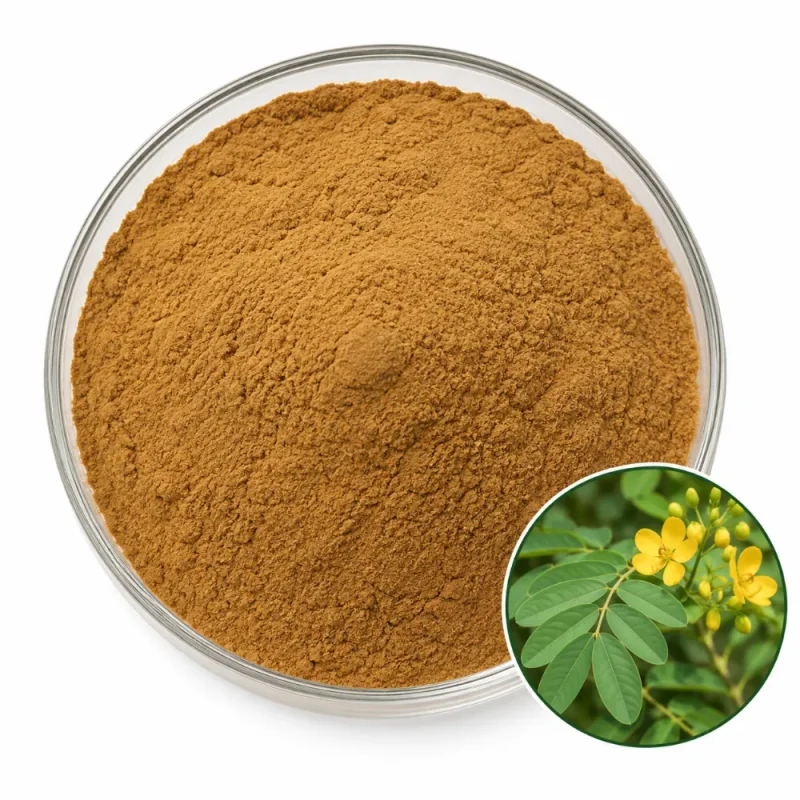
Senna Extract 6–20% Sennosides

Senna extract is prepared from the leaflets of Senna alexandrina Mill., the Alexandrian or Indian senna of the family Fabaceae, and the pods are not part of the starting material. Ethanol extraction concentrates the sennosides of the leaf, and the concentrate is dried to a light brown powder.

Sennosides are measured by HPLC, with a primary grade of 20% and a lower grade of 6%. The powder is 80 mesh and slightly soluble in water. The 20% grade suits capsules and tablets, while the 6% grade suits blends at larger inclusion.

Sennoside Standardization & Grades

Sennosides are dianthrone glycosides, two anthrone units joined through a carbon bond and carrying sugar groups. Sennoside A and sennoside B are stereoisomers of one another, with the same molecular formula and different three-dimensional arrangement at the central bond. Sennosides C and D are heterodimers with a rhein unit and an aloe-emodin unit. The leaf also holds free anthraquinones, flavonoids and mucilage. Senna extract is standardized to the sennoside group because it is the defining class of the leaf and it is measurable by HPLC.

The botanical entity is Senna alexandrina Mill., a species that combines the plants earlier called Cassia acutifolia and Cassia angustifolia. Leaflets and pods are separate pharmacognostic materials with a different sennoside balance. The same leaf is supplied as a 10:1 ratio extract with no marker figure, Senna Leaf Extract Powder, and as the milled leaf, Senna Leaf Powder. The purified compound is available as Sennoside A 90–98%.

Senna extract is made from leaflets that are dried at moderate temperature, extracted and concentrated at controlled temperature. The processing steps are gentle on purpose, because sennosides are heat labile, and the extract is dried by vacuum or spray methods that keep the product temperature low. The resulting powder concentrates the glycosides and leaves much of the mucilage and fiber of the leaf behind.

GradeAssay & MethodWhere It Fits
6% SennosidesHPLCBlends, larger inclusion
20% SennosidesHPLCCapsules and tablets, small fill

The 20% grade carries more than three times the sennoside load of the 6% grade per gram, so a capsule or tablet reaches its target with a small charge. The 6% grade is bulkier and easier to blend, and it suits formulas in which the extract is one ingredient among several.

Sennoside Analysis & Purity Risks

An HPLC assay separates sennoside A, sennoside B and the other sennosides and reads each peak against a reference standard. The total depends on which compounds are counted, and on whether the result is expressed as the sum of the individual sennosides or calculated as a single reference, commonly sennoside B. Two certificates compare only when they state the same compounds and the same basis. An HPLC sennoside total also cannot be converted into a UV hydroxyanthracene figure.

Sennosides are labile. Moisture, heat, light and alkaline conditions change the pattern by hydrolyzing the glycosides and oxidizing the dianthrone, so a sample is protected from light, prepared at neutral or mildly acidic pH, and injected promptly. A shifted ratio between sennoside A and B in a chromatogram is a sign of a handling problem and not of a different plant.

Purity risks follow from the material class. The leaf and the pod have different sennoside balances, and the defined part here is the leaflet. Senna is commonly mixed in trade with similar legumes, such as Cassia obovata, and with stems and leaf stalks that dilute the sennoside share. Free anthraquinone content is also followed as an impurity class, since heat during drying raises it at the expense of the glycosides.

Sample preparation involves an aqueous-alcohol extraction at controlled temperature. Over-heating during extraction converts sennosides and lowers the figure.

Typical Specifications

Specification ItemProduct Information
Latin NameSenna alexandrina
Plant PartLeaf & Herb
ProcessingEthanol Extraction
Compound ClassQuinones
Common NameSenna, Alexandrian Senna
Ingredient TypeStandardized Extract
Marker Compound(s)Sennosides (sennoside A and B)
Primary Grade20% Sennosides (HPLC)
Available Grades6% · 20% Sennosides (HPLC)
AppearanceLight Brown powder
Solubility / DispersibilitySlightly Soluble in Water
Quality Parameters
Moisture (LOD)≤5.0%
Total Ash≤5.0%
Particle Size80 mesh
Heavy MetalsLead ≤2 ppm · Arsenic ≤1 ppm · Cadmium ≤1 ppm · Mercury ≤0.1 ppm
MicrobiologyTPC ≤1,000 cfu/g · Yeast & Mold ≤100 cfu/g · E. coli Negative · Salmonella Negative/25 g
Shelf Life24 months in unopened original packaging, cool and dry storage

Applications by Grade

20% Grade for Capsule Fills

The 20% grade reaches its sennoside target in a small fill. The powder is fine, slightly hygroscopic and mildly irritating to the nose, so a closed filling line, dust extraction and a flow agent protect the operators and keep the fill weight steady.

6% Grade in Dry Blends

The 6% grade works in dry blends with other leaf extracts, where sennosides are one marker among several. Sieve it with the carrier first, and mix in two steps so that the small share spreads evenly through the batch.

20% Grade in Tablet Blends

Tablets of the 20% grade need a dry binder and a lubricant. A film coat limits moisture uptake, which degrades sennosides, and hardness and disintegration are rechecked after storage because the glycoside-rich solid is hygroscopic.

6% Grade for Stick-Pack Mixes

Stick-pack mixes use the 6% grade at higher gram weight with a bulking carrier. The extract is only slightly soluble, so the mix is stirred into a thick base and not into clear drinks, where it would form a hazy suspension.

20% Grade in Granule Formats

Granules take the 20% grade after wet or dry granulation with a binder. Control drying temperature below the point where sennosides degrade, and use packaging with a moisture barrier, because the granule surface is porous.

6% Grade for Tablet Granulates

Granulates of the 6% grade are prepared by dry compaction where possible, since wet granulation exposes the sennosides to water and heat for longer. The bulkier powder flows better than the 20% grade, and the granulate is dried gently and packed with a moisture barrier.

Technical & Quality Considerations

Senna extract is a light brown to yellow-brown powder with a faint tea-like scent and a bitter taste. It is slightly soluble in water, and the solution is a hazy yellow-brown, with the sennosides partly dissolved and the rest in suspension. Dissolution improves as pH rises toward neutral, although alkaline media degrade the glycosides, so the pH window for a liquid format is narrow.

Light and oxygen oxidize the anthrone nucleus, and the powder darkens over time. Opaque, sealed liners with a low oxygen headspace are used, and storage is cool and dry. Phenolic and anthranoid groups bind iron, so stainless contact surfaces and low-iron fillers are the better choice.

Switching grades on the filling line means a new check weight, because the two powders differ widely in bulk. Compare each lot with a retained sample for color. A lot that has turned dark brown after storage is reviewed against its original figure, since darkening goes with a falling sennoside level.

Trace moisture is the usual route by which a stored lot loses potency. Water plus warmth hydrolyzes the sugar groups and then oxidizes the aglycone, so each opened drum is resealed with fresh desiccant, and the headspace is kept small. A senna lot that is stored cool and dry keeps its sennoside profile far better than a lot kept in a warm warehouse.

Packaging & Commercial Supply

Essencefield supports product evaluation, formulation trials, commercial orders, and ongoing ingredient supply. Packaging, storage, and shipping arrangements are determined by product characteristics, order quantity, stability requirements, and destination-market needs.

Supply ItemGeneral Information
SampleAvailable upon request for formulation, testing, and supplier evaluation
Order Quantities100 g · 1 kg · 5 kg · 25 kg · 100 kg · 500 kg · Bulk
Sample Lead TimeTypically 5–7 days after sample confirmation
Production Lead TimeTypically 15–30 days after order and specification confirmation
PackagingSuitable protective inner packaging with bags, cartons, drums, or other appropriate outer packaging
StorageStore in tightly sealed, suitable protective packaging in a cool, dry environment. Protect from moisture, heat, and direct sunlight. Specific storage conditions follow the approved product specification.
DocumentationCOA · Product Specification · TDS · SDS · Applicable declarations (as applicable)

Final order quantities, lead times, packaging, documentation, and shipping arrangements are confirmed according to the selected product and commercial requirements.

Request Ingredient Specifications & Quote

Share your target specification, application, quantity, and documentation needs. We’ll help confirm suitable options, samples, and commercial supply details.