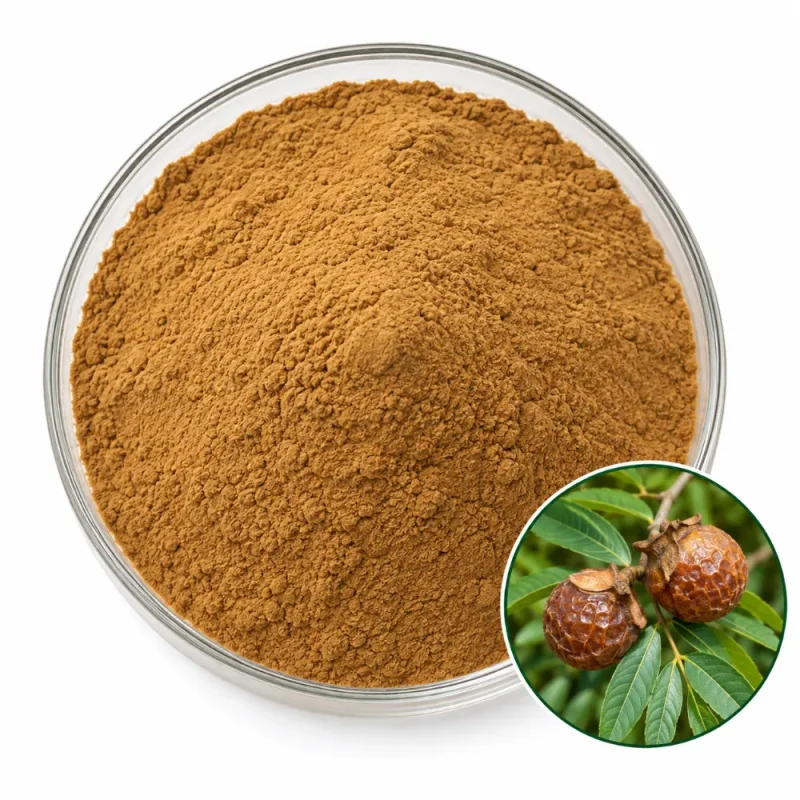
Soap Nut Extract 20–40% Saponins

Soap nut extract is prepared from the fruit of the soapberry tree, Sapindus mukorossi Gaertn., known in India as reetha, a tree of the family Sapindaceae. The saponin-rich fruit coat is extracted with ethanol, and the concentrate is dried to a light brown powder that dissolves in water.

A UV spectrophotometric assay gives total saponins, with a primary grade of 40% and a lower grade of 20%. The powder is 80 mesh. The 40% grade suits concentrated systems and capsule fills, while the 20% grade suits foaming mixes and bulk blends.

Soapnut Saponin Standardization & Grades

The fruit coat of the soapberry is one of the richest natural sources of triterpenoid saponins. Its main saponins, the sapindosides, are built on a hederagenin-type aglycone carrying sugar chains. The sugar side attracts water and the triterpenoid side attracts oil, so a solution foams and cleans oily films. Soap nut extract is standardized to total saponins because surface activity follows the saponin load, and the figure expresses how far the pericarp has been concentrated.

The botanical entity is Sapindus mukorossi Gaertn., and the part is the dried fruit coat, with the hard black seeds removed. The seed carries little saponin and adds weight and oil. The same fruit is supplied as a 10:1 ratio extract with no marker figure, the Soap Nut Extract Powder, and as the milled fruit coat, Reetha (Soapnut) Powder.

GradeAssay & MethodWhere It Fits
20% SaponinsUVFoaming mixes, bulk blends
40% SaponinsUVConcentrated systems, capsule fills

The 40% grade carries twice the saponin load per gram, so a concentrate or a capsule reaches its target with a smaller charge of powder. The 20% soap nut extract is bulkier and gives a gentler foam at a given gram weight, which matters in dry drink mixes where a high head is a nuisance. Both are read on the same UV basis, so the grades scale by weight.

The extract is made from the cleaned fruit coat, which is crushed and extracted, and the extract is filtered, concentrated and dried. The fruit coat is sticky and rich in sugars and gum-like material, and the process leaves much of that behind, so the finished powder is far richer in saponin than the dried pericarp.

Soapnut Saponin Analysis & Purity Risks

A UV assay cannot read saponins directly, because the aglycone has almost no absorbance. The sample reacts with a color-forming reagent, the product is read in the UV-visible range, and the result is calculated against a reference saponin. The percentage is an equivalent tied to that reference, and it cannot be converted into an HPLC figure for single sapindosides.

The fruit coat also holds sugars, and some acid-based color reactions respond to them. A reading therefore needs a sample blank or a clean-up step, and the HPLC fingerprint is read alongside the UV total. The fingerprint shows the group of sapindoside peaks that distinguishes the soapberry from other foaming materials.

Purity risks follow from the material class. Several trees yield soapnut-type fruit, among them Sapindus trifoliatus in southern India and Sapindus saponaria in the Americas, and their saponin patterns differ from that of Sapindus mukorossi. Shikakai pods and soap bark are other foaming materials sold under similar names. The defined part is the dried fruit coat, and lots with many seeds or stalks show a lower saponin share.

Fruit that was harvested unripe or stored damp is weaker. Moisture and microbial growth degrade the saponins, so the dried fruit is checked before extraction.

Soap nut extract is judged by foam as well as by the percentage. Foam height and stability in water of defined hardness are measured beside the UV total, because two lots with the same saponin figure can foam differently when the sugar and acid content of the fruit coat differs. Soap nut lots with a weak foam at a high assay are reviewed for tannin carry-over.

Typical Specifications

Specification ItemProduct Information
Latin NameSapindus mukorossi
Plant PartFruit & Berry
ProcessingEthanol Extraction
Compound ClassSaponins
Common NameSoap Nut, Reetha, Soapberry
Ingredient TypeStandardized Extract
Marker Compound(s)Total saponins (sapindosides)
Primary Grade40% Saponins (UV)
Available Grades20% · 40% Saponins (UV)
AppearanceLight Brown powder
Solubility / DispersibilityWater Soluble
Quality Parameters
Moisture (LOD)≤5.0%
Total Ash≤5.0%
Particle Size80 mesh
Heavy MetalsLead ≤2 ppm · Arsenic ≤1 ppm · Cadmium ≤1 ppm · Mercury ≤0.1 ppm
MicrobiologyTPC ≤1,000 cfu/g · Yeast & Mold ≤100 cfu/g · E. coli Negative · Salmonella Negative/25 g
Shelf Life24 months in unopened original packaging, cool and dry storage

Applications by Grade

40% Grade in Concentrated Systems

The 40% grade serves as a natural surface-active ingredient in concentrated liquid systems. It dissolves to a brown solution, and the pH is kept near neutral so that the sugar chains of the saponins stay intact during shelf life.

20% Grade for Foaming Drink Powders

The 20% grade gives a foam head to dry drink mixes at a gram weight that a stick pack can carry. The taste is bitter and slightly acrid, so strong fruit or spice flavor bases hide it better than mild or milky ones.

40% Grade in Capsule Fills

Capsules take the 40% grade at small fill weight. The powder foams when it meets moisture and is sticky when damp, so a dry filling room and a flow agent are needed, and an early check weight confirms the fill.

20% Grade in Powder Premixes

In premixes, the 20% grade is carried into a larger dry blend. Mix the sticky powder with part of the carrier before the main charge, because direct addition to a large batch leaves lumps that dissolve slowly and foam late.

40% Grade in Tablet Blends

Tablets of the 40% grade need a dry binder and a lubricant that does not foam. Moisture softens a saponin-rich compact, so a film coat and a moisture-barrier pack protect the tablets, and disintegration is rechecked after storage.

20% Grade for Granulated Mixes

Granulated mixes take the 20% grade through dry compaction, which avoids the foaming that wet granulation triggers in the mixer. The granule is packed with a moisture barrier, because the surface of a dried saponin granule is hygroscopic.

Technical & Quality Considerations

Soap nut extract is a light brown powder with a faint caramel-like, fruity scent and a bitter, acrid taste. It dissolves readily in water, and the solution foams on agitation. The foam complicates pumping, filling and conveying, so mixing is gentle and deaeration or a food-compatible antifoam is used at the dosing step. The glycosides remain intact in neutral and mildly acidic water.

The solution is slightly acidic after dissolution, and the pH moves with the sugar and organic acid content of the fruit coat. Hard water reduces the foam, because calcium and magnesium ions bind the saponin and sugar groups, so drink and liquid trials use the intended water. Iron-containing fillers can darken the powder, and stainless contact surfaces are preferred.

The powder takes up moisture from the air, turns sticky and eventually cakes. Sealed liners, desiccant and cool storage preserve flow. Compare each lot with a retained sample for color and foam height, and run a new check weight when the line changes between the two grades, since they differ widely in bulk.

Packaging & Commercial Supply

Essencefield supports product evaluation, formulation trials, commercial orders, and ongoing ingredient supply. Packaging, storage, and shipping arrangements are determined by product characteristics, order quantity, stability requirements, and destination-market needs.

Supply ItemGeneral Information
SampleAvailable upon request for formulation, testing, and supplier evaluation
Order Quantities100 g · 1 kg · 5 kg · 25 kg · 100 kg · 500 kg · Bulk
Sample Lead TimeTypically 5–7 days after sample confirmation
Production Lead TimeTypically 15–30 days after order and specification confirmation
PackagingSuitable protective inner packaging with bags, cartons, drums, or other appropriate outer packaging
StorageStore in tightly sealed, suitable protective packaging in a cool, dry environment. Protect from moisture, heat, and direct sunlight. Specific storage conditions follow the approved product specification.
DocumentationCOA · Product Specification · TDS · SDS · Applicable declarations (as applicable)

Final order quantities, lead times, packaging, documentation, and shipping arrangements are confirmed according to the selected product and commercial requirements.

Request Ingredient Specifications & Quote

Share your target specification, application, quantity, and documentation needs. We’ll help confirm suitable options, samples, and commercial supply details.