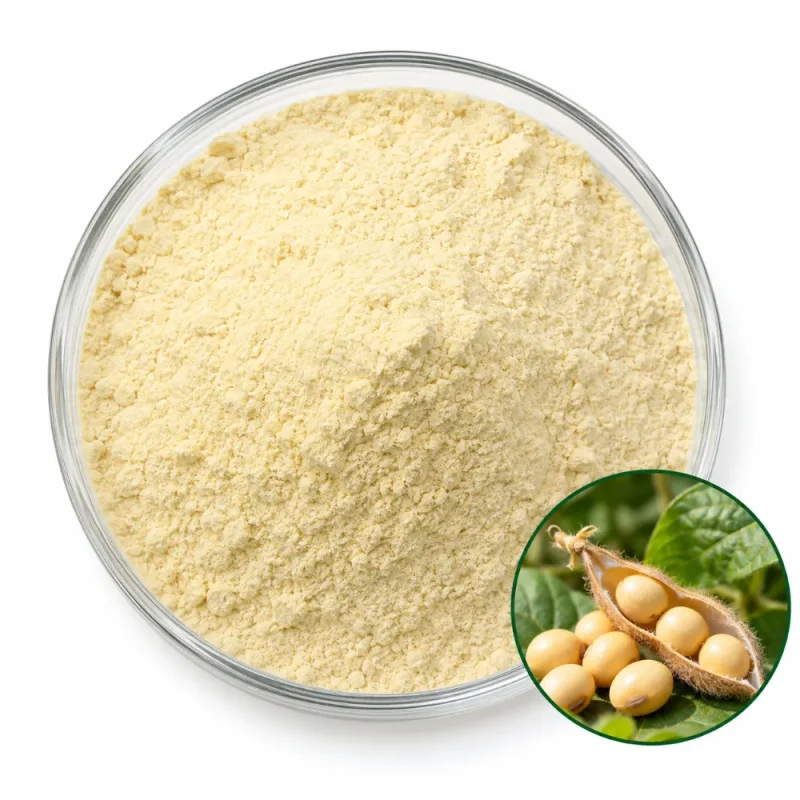
Soybean Extract 20–80% Isoflavones

Soybean extract is prepared from the mature seed of Glycine max (L.) Merr., the soybean of the family Fabaceae, and is standardized to its isoflavones. Ethanol extraction concentrates the isoflavone fraction of the bean, and the concentrate is dried to a light yellow powder.

Isoflavones are measured by HPLC, with a primary grade of 80% and a lower grade of 20%. The powder is 80 mesh and insoluble in water. The 80% grade suits capsules and tablets at small fill, while the 20% grade suits blends where a soy-derived isoflavone profile is wanted at larger inclusion.

Soybean Isoflavone Standardization & Grades

Isoflavones are phenolic compounds built on a 3-phenylchromone skeleton, and soybean is their most important dietary source. The main soy isoflavones are daidzein, genistein and glycitein, and each occurs in the seed as several conjugates: the glucosides daidzin, genistin and glycitin, their malonyl and acetyl forms, and a smaller share of free aglycones. The extract is standardized to isoflavones because the class is stable, measurable and specific to the soy seed profile.

The botanical entity is Glycine max (L.) Merr., and the part is the seed. Closely related are the wild soybean (Glycine soja) and the black soybean, which is the same species with a dark seed coat. Black soybean has its own anthocyanin extract, Black Soybean Extract 5–25% Anthocyanins, and the germ of the bean is supplied separately as Soybean Germ Extract 40% Isoflavones. The 10:1 ratio extract with no marker figure is the Soybean Extract Powder.

GradeAssay & MethodWhere It Fits
20% IsoflavonesHPLCBlends, larger inclusion
80% IsoflavonesHPLCCapsules and tablets, small fill

The 80% grade carries four times the isoflavone load per gram, so a capsule or a tablet reaches its target with a small charge. The 20% grade is bulkier and still carries part of the seed’s other constituents, which suits blends where bulk is not limiting. Both are read on the same HPLC basis, so grades scale by weight.

The extract is made from defatted soybean material. The bean is largely oil and protein, so the oil is removed first, the isoflavones are taken up in ethanol, and the concentrate is purified and dried. Higher grades involve more purification steps, which also remove saponins, sugars and the beany flavor of the seed.

Soybean Isoflavone Analysis & Purity Risks

HPLC separates the individual isoflavones and reads each peak against a reference standard. The basis decides the number. A figure can be expressed as the sum of the free aglycones after hydrolysis, as the sum of all conjugates by their own weights, or as aglycone equivalents calculated from the glycosides. These three bases give three different numbers for the same powder. Two certificates are comparable only when they state the same basis, and an HPLC isoflavone total cannot be swapped for a UV total flavonoid figure.

For identity, the HPLC fingerprint is read beside the total. The ratio of daidzein, genistein and glycitein families is characteristic of soy, and it separates soy from red clover, which is dominated by biochanin A and formononetin. Soy saponins, which are the other major class in the seed, are described as co-extractives and sit outside the isoflavone figure.

Purity risks follow from the material class. Isoflavone content differs with variety, growing year and location, so the starting material is blended and the ratio is checked by HPLC. The seed is the defined part, and extracts from hull, leaf or sprouts have a different pattern. High-grade isoflavones can also be made from other legumes, so the soy-specific glycitein share is part of the identity review.

Heat and enzymes interconvert the forms, so a sample is prepared under controlled conditions to avoid changing the pattern.

Typical Specifications

Specification ItemProduct Information
Latin NameGlycine max
Plant PartSeed & Grain
ProcessingEthanol Extraction
Compound ClassIsoflavones, Flavonoids, Polyphenols
Common NameSoybean, Soy Isoflavones
Ingredient TypeStandardized Extract
Marker Compound(s)Isoflavones (daidzein, genistein, glycitein and their glycosides)
Primary Grade80% Isoflavones (HPLC)
Available Grades20% · 80% Isoflavones (HPLC)
AppearanceLight Yellow powder
Solubility / DispersibilityInsoluble in Water
Quality Parameters
Moisture (LOD)≤5.0%
Total Ash≤5.0%
Particle Size80 mesh
Heavy MetalsLead ≤2 ppm · Arsenic ≤1 ppm · Cadmium ≤1 ppm · Mercury ≤0.1 ppm
MicrobiologyTPC ≤1,000 cfu/g · Yeast & Mold ≤100 cfu/g · E. coli Negative · Salmonella Negative/25 g
Shelf Life24 months in unopened original packaging, cool and dry storage

Applications by Grade

80% Grade for Capsule Fills

The 80% grade of soybean extract reaches its isoflavone target in a small fill, which suits two-piece capsules. The pale yellow powder is fine and tends to stick to equipment, so a flow agent and a dry filling room prevent bridging, and a check weight at the start of each run confirms the fill.

20% Grade in Dry Blends

The 20% grade of soybean extract blends with other soy-based powders and plant extracts in dry mixes. Mix it with part of the carrier before the main charge, because the fine pale particles spread unevenly if they are added in one lot to a large batch.

80% Grade in Tablet Blends

Tablets of the 80% grade need a dry binder and a lubricant. The extract compacts well, and a film coat hides the yellow core. A wetting disintegrant helps the tablet break up, because the hydrophobic compact otherwise resists water.

20% Grade for Bar and Snack Bases

Bars and baked snack bases take the 20% grade in the dry fraction before the syrup is added. The powder is mild in taste at this strength, and the pale yellow color is hidden by cocoa, cereal or nut-based bars.

80% Grade for Softgel Suspensions

The insoluble 80% grade is milled into an oil phase for softgel fills. Isoflavone aglycones and glycosides dissolve poorly in oil, so particle size and viscosity are checked, and a suspending agent keeps the dose uniform.

20% Grade for Stick-Pack Mixes

Stick-pack mixes of the 20% grade are made with a bulking carrier at a higher fill. The powder does not dissolve, so the mix is sold for stirring into thick bases and shakes, where it stays suspended.

Technical & Quality Considerations

Soybean extract is a light yellow powder with a faint beany or nutty scent that weakens as purity rises. It is insoluble in water, so a drink made from it shows a suspension that settles on standing. Dispersion improves with wetting agents, fine milling and a thick carrier. Isoflavone glycosides dissolve better in warm alcohol-water mixtures, and aglycones are the least water soluble of the group.

Isoflavones are stable to moderate heat. Malonyl glucosides convert to simple glucosides when heated in water, which changes the HPLC pattern without altering the total on an aglycone basis. A long hot hold in a wet process therefore needs a comparison of the profile before and after. Phenolic groups bind iron, so stainless surfaces and low-iron fillers are preferred.

Humid air makes the powder clump slowly, which is why liners are kept closed. Sealed liners with desiccant keep the powder free flowing. Compare each lot with a retained sample for color, and run a new check weight when the line changes between the two grades, since they differ widely in bulk.

Packaging & Commercial Supply

Essencefield supports product evaluation, formulation trials, commercial orders, and ongoing ingredient supply. Packaging, storage, and shipping arrangements are determined by product characteristics, order quantity, stability requirements, and destination-market needs.

Supply ItemGeneral Information
SampleAvailable upon request for formulation, testing, and supplier evaluation
Order Quantities100 g · 1 kg · 5 kg · 25 kg · 100 kg · 500 kg · Bulk
Sample Lead TimeTypically 5–7 days after sample confirmation
Production Lead TimeTypically 15–30 days after order and specification confirmation
PackagingSuitable protective inner packaging with bags, cartons, drums, or other appropriate outer packaging
StorageStore in tightly sealed, suitable protective packaging in a cool, dry environment. Protect from moisture, heat, and direct sunlight. Specific storage conditions follow the approved product specification.
DocumentationCOA · Product Specification · TDS · SDS · Applicable declarations (as applicable)

Final order quantities, lead times, packaging, documentation, and shipping arrangements are confirmed according to the selected product and commercial requirements.

Request Ingredient Specifications & Quote

Share your target specification, application, quantity, and documentation needs. We’ll help confirm suitable options, samples, and commercial supply details.