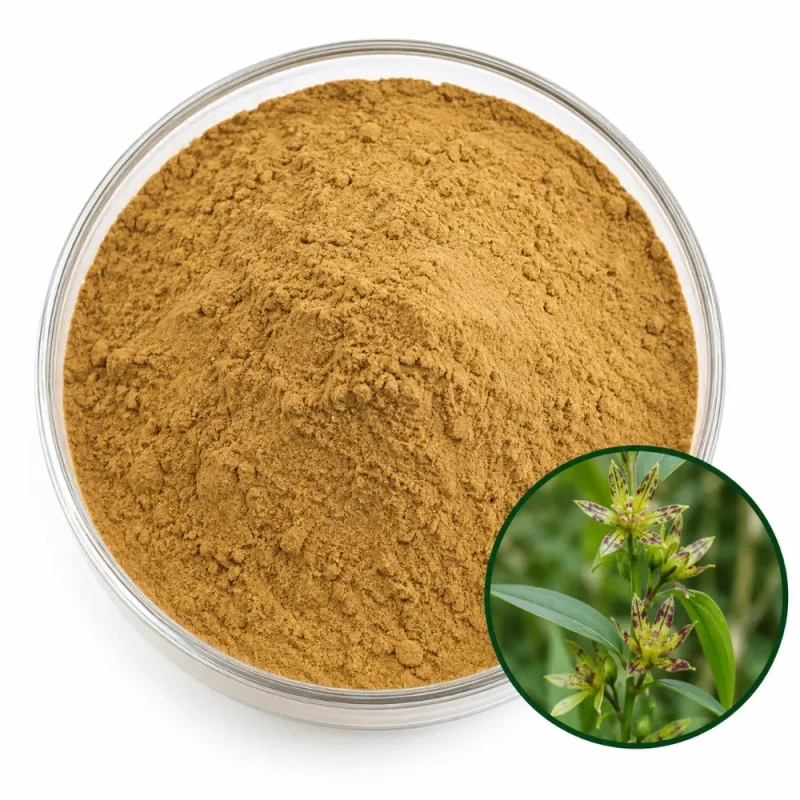
Swertia Chirayita Extract 5–50% Swertiamarin

Swertia chirayita extract is prepared from the aerial parts of Swertia chirayita (Roxb.) H.Karst., the chirata or chiretta herb of the Himalayas, a member of the gentian family Gentianaceae. Ethanol extraction concentrates the bitter secoiridoid glycosides, and the concentrate is dried to a light brown powder that dissolves in water.

Swertiamarin is measured by HPLC, with a primary grade of 50% and a lower grade of 5%. The powder is 80 mesh. The 50% grade suits capsules and tablets, while the 5% grade suits drink powders and blends.

Swertiamarin Standardization & Grades

Swertiamarin is a secoiridoid glycoside, a monoterpenoid-derived compound in which the iridoid ring has been opened and a glucose unit attached. It is one of the characteristic bitter compounds of the gentian family. Chirata herb also contains the extremely bitter amarogentin, the related glycosides sweroside and gentiopicroside, xanthones such as swerchirin, and a flavone C-glycoside called swertisin. The extract is standardized to swertiamarin because it is the most abundant of the group and can be measured against a reference standard.

The botanical entity is Swertia chirayita, and the part is the aerial portion of the plant. The same herb is supplied as a 10:1 ratio extract with no marker figure, Swertia Chirata Extract Powder. Two of the compounds are available as single phytochemicals, Swertiamarin 98% and Amarogentin 98%.

GradeAssay & MethodWhere It Fits
5% SwertiamarinHPLCDrink powders, bulk blends
50% SwertiamarinHPLCCapsules and tablets, small fill

The 50% grade carries ten times the swertiamarin of the 5% grade per gram, so a capsule or tablet reaches its target with a small charge. The 5% grade of Swertia chirayita extract is bulkier and milder, and it suits dissolved formats where the bitter taste is part of the product character. A formulator can scale between the grades by weight.

The extract is made from herb that is collected, dried, extracted and concentrated. Higher strengths come from further purification, which removes the sugars, tannins and chlorophyll of the herb and leaves a pale powder concentrated in glycosides.

Swertiamarin Analysis & Purity Risks

An HPLC assay separates swertiamarin from sweroside, gentiopicroside and amarogentin and reads each as a distinct peak against a reference standard. The reading names a single molecule, not a class of compounds, and the basis is dry weight. A swertiamarin figure cannot be compared with a total bitter value or a total iridoid figure.

The data record names amarogentin as a secondary marker. It is the most bitter natural compound known and is present at far lower levels than swertiamarin, and it is described here without numbers. Its presence and ratio to swertiamarin belong to the chromatographic fingerprint, and a lot without amarogentin peaks is not accepted as chirata.

Purity risks follow from the material class. The name chirata is applied to several plants. Andrographis paniculata, a different herb, is sold as green or Indian chirata and has an unrelated chemistry based on andrographolide. Other Swertia species are also traded under the name, and they differ in their glycoside pattern. The aerial parts of Swertia chirayita are the defined part, and roots or stems from other plants are not accepted.

The wild plant is slow growing, and heavy harvest has made sourcing a concern. Cultivated material is a growing share, and the fingerprint is used to confirm that lots from different sources match.

The harvest stage influences swertiamarin directly. Plants collected at flowering have a higher glycoside content than plants gathered after seed set, and herb that is dried slowly in damp conditions loses part of its glycosides to enzymes. For that reason lots of Swertia chirayita extract are made from herb that is dried promptly, and the harvest period is part of the lot record.

Typical Specifications

Specification ItemProduct Information
Latin NameSwertia chirayita
Plant PartLeaf & Herb
ProcessingEthanol Extraction
Compound ClassTerpenoids
Common NameChirata, Chiretta
Ingredient TypeStandardized Extract
Marker Compound(s)Swertiamarin
Primary Grade50% Swertiamarin (HPLC)
Available Grades5% · 50% Swertiamarin (HPLC)
AppearanceLight Brown powder
Solubility / DispersibilityWater Soluble
Quality Parameters
Moisture (LOD)≤5.0%
Total Ash≤5.0%
Particle Size80 mesh
Heavy MetalsLead ≤2 ppm · Arsenic ≤1 ppm · Cadmium ≤1 ppm · Mercury ≤0.1 ppm
MicrobiologyTPC ≤1,000 cfu/g · Yeast & Mold ≤100 cfu/g · E. coli Negative · Salmonella Negative/25 g
Shelf Life24 months in unopened original packaging, cool and dry storage

Applications by Grade

50% Grade for Capsule Fills

The 50% grade reaches its swertiamarin target in a small capsule fill. The powder is fine, hygroscopic and intensely bitter, so a closed filling line, a dry room and a flow agent prevent dusting and bridging, and a check weight confirms the fill.

5% Grade in Drink Powders

The 5% grade dissolves in cold water to a clear light brown drink with a strong bitter character. Citrus, ginger or tonic-style flavor systems frame the bitterness better than sweet profiles, and a sweetener is chosen to keep the taste from turning harsh.

50% Grade in Tablet Blends

Tablets of the 50% grade need a dry binder and a lubricant. A film coat masks the intense bitterness during swallowing and limits moisture pickup, and hardness and disintegration are rechecked after storage because the glycoside-rich solid is hygroscopic.

5% Grade for Bitters-Style Liquids

Liquid concentrates and bitters-style drinks take the 5% grade dissolved in water or glycerin. The glycosides are stable at mildly acidic pH, so the finished liquid is held in that range, and the bottle is protected from light and heat.

50% Grade for Stick-Pack Mixes

Stick-pack mixes use the 50% grade at low gram weight in a bulking carrier. Because of the extreme bitterness, even a small inclusion is noticeable, so the dose and the flavor are developed together on the bench.

5% Grade for Powder Premixes

Premixes carry the 5% grade in a larger dry blend. Mix the powder with part of the carrier before the main charge, because the pale brown particles spread unevenly when added in one lot, and a bitter hot spot ruins a portion of the batch.

Technical & Quality Considerations

Swertia chirayita extract is a light brown powder with a faint herbal scent and an exceptionally bitter taste. It is water soluble, and the solution is clear brown. Secoiridoid glycosides are stable at mildly acidic to neutral pH, while strong acid, alkali and heat cleave the glycosidic bond or open the ring, and the bitter profile changes. A hot-fill or retort process therefore needs a before-and-after HPLC comparison.

Enzymes of the plant, if active, also hydrolyze the glycosides during wet processing. Dry, sealed storage preserves the profile. The xanthone fraction chelates iron, so the powder darkens on contact with carbon steel, and stainless surfaces with low-iron fillers are the better choice.

The powder takes up moisture and clumps in humid storage. A sealed inner bag, a desiccant packet and cool storage keep the powder pourable. Compare each lot with a retained sample for color and bitterness, and run a new check weight when the line changes between the two grades, since they differ widely in bulk.

Packaging & Commercial Supply

Essencefield supports product evaluation, formulation trials, commercial orders, and ongoing ingredient supply. Packaging, storage, and shipping arrangements are determined by product characteristics, order quantity, stability requirements, and destination-market needs.

Supply ItemGeneral Information
SampleAvailable upon request for formulation, testing, and supplier evaluation
Order Quantities100 g · 1 kg · 5 kg · 25 kg · 100 kg · 500 kg · Bulk
Sample Lead TimeTypically 5–7 days after sample confirmation
Production Lead TimeTypically 15–30 days after order and specification confirmation
PackagingSuitable protective inner packaging with bags, cartons, drums, or other appropriate outer packaging
StorageStore in tightly sealed, suitable protective packaging in a cool, dry environment. Protect from moisture, heat, and direct sunlight. Specific storage conditions follow the approved product specification.
DocumentationCOA · Product Specification · TDS · SDS · Applicable declarations (as applicable)

Final order quantities, lead times, packaging, documentation, and shipping arrangements are confirmed according to the selected product and commercial requirements.

Request Ingredient Specifications & Quote

Share your target specification, application, quantity, and documentation needs. We’ll help confirm suitable options, samples, and commercial supply details.