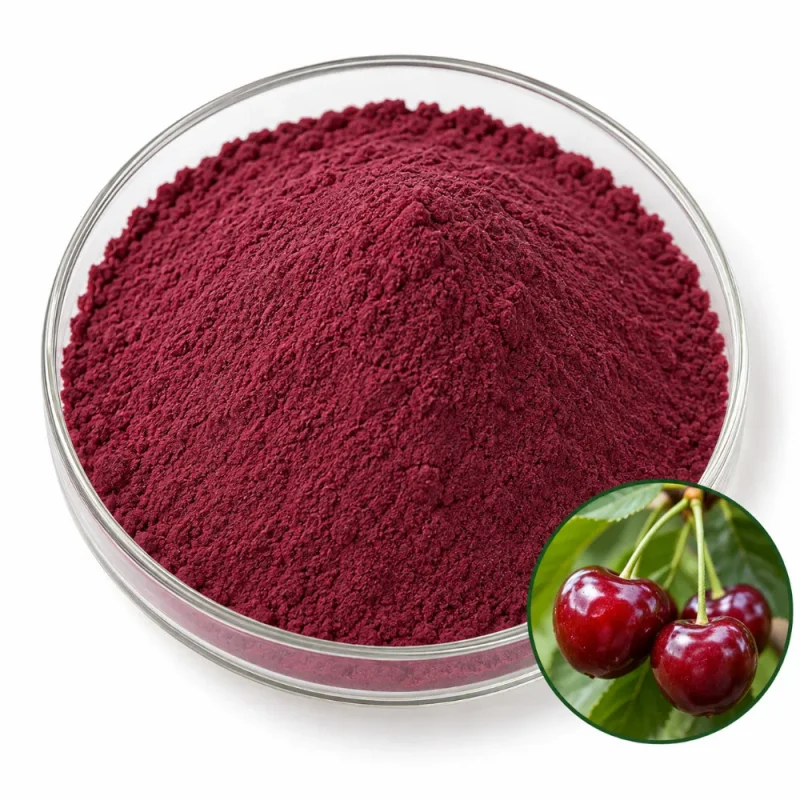
Tart Cherry Extract 1–25% Anthocyanins

Tart cherry extract is prepared from the fruit of the sour cherry, Prunus cerasus L., a tree of the family Rosaceae. Ethanol extraction concentrates the anthocyanin pigments of the dark red skin and flesh, and the concentrate is dried to a purple-red powder that dissolves in water.

Anthocyanins are measured by UV spectrophotometry with the pH differential method, with a primary grade of 25% and a lower grade of 1%. The powder is 80 mesh. The 25% grade suits capsules, tablets and color-sensitive blends, while the 1% grade suits drink powders and bulk mixes.

Tart Cherry Anthocyanin Standardization & Grades

Anthocyanins are the water-soluble pigments that color red, purple and blue fruit. They are glycosides of anthocyanidins, flavylium cations whose color depends on pH. In sour cherry the main pigments are cyanidin glycosides, led by cyanidin-3-glucosylrutinoside and cyanidin-3-rutinoside, with a smaller share of peonidin forms. Tart cherry extract is standardized to anthocyanins because they are the characteristic and measurable pigment class of the fruit, and they control the color of every finished product made from it.

The botanical entity is Prunus cerasus L., the sour or tart cherry, which is a different species from the sweet cherry, Prunus avium. The part is the fruit, and the stones and stems are removed. The same fruit is supplied as a 10:1 ratio extract with no marker figure, Tart Cherry Extract Powder, and as milled fruit, Tart Cherry Powder and Cherry Powder.

GradeAssay & MethodWhere It Fits
1% AnthocyaninsUV (pH differential)Drink powders, bulk mixes
25% AnthocyaninsUV (pH differential)Capsules, tablets, color-sensitive blends

The two grades are far apart. The 25% grade is a deeply colored powder with twenty-five times the pigment per gram of the 1% grade, and a very small inclusion colors a whole batch. The 1% grade is a bulkier fruit extract that carries its sourness, sugars and acids, and it suits dissolved formats where the fruit character is part of the product.

The extract is made from frozen or dried fruit that is pitted, extracted and concentrated. Higher strengths involve purification on resin, which removes sugars and organic acids and leaves a pigment-rich fraction.

Tart Cherry Anthocyanin Analysis & Purity Risks

The pH differential method uses a property of anthocyanins. At pH 1.0 the monomeric pigments are colored flavylium forms, and at pH 4.5 they turn to a colorless form. The difference in absorbance at the visible maximum, corrected for haze at 700 nm, is proportional to the monomeric anthocyanin content and is usually expressed as cyanidin-3-glucoside equivalents. The percentage is therefore an equivalent that counts monomeric pigment and leaves polymerized color out.

This makes the method different from HPLC, which resolves the individual pigments. A pH differential result cannot be converted into an HPLC total, and neither can be compared with a Folin total polyphenol figure. The method is also sensitive to degraded pigment. Browned, polymerized or oxidized anthocyanin does not change color between the two buffers, so a heat-damaged lot reads low.

For identity, an HPLC fingerprint shows the cyanidin rutinoside pattern, which separates tart cherry from sweet cherry, black currant, elderberry and grape. Cyanidin glycosides are common to many red fruits, so the peak pattern, not the pigment class, identifies the fruit.

Purity risks follow from the material class. Cherry species and cultivars differ in pigment level, and a lot that mixes sweet cherry or other red fruit lowers the sour cherry character. Sweet cherries carry a different anthocyanin and acid profile. The fruit is the defined part, and stems or pits dilute the pigment and add woody tannin.

Sample handling matters because anthocyanins degrade in light, heat and neutral pH. Samples are prepared in acidified solvent, kept cool and dark, and read promptly.

Tart cherry extract is also followed for its organic acid profile. Sour cherry is rich in malic acid, and a pigment-rich extract that has been purified on resin carries less of it than the 1% grade. The two grades therefore taste very different in water, with the low grade distinctly sour and the high grade nearly neutral.

Typical Specifications

Specification ItemProduct Information
Latin NamePrunus cerasus
Plant PartFruit & Berry
ProcessingEthanol Extraction
Compound ClassAnthocyanins, Flavonoids, Polyphenols
Common NameTart Cherry, Sour Cherry
Ingredient TypeStandardized Extract
Marker Compound(s)Anthocyanins (cyanidin glycosides)
Primary Grade25% Anthocyanins (UV, pH differential)
Available Grades1% · 25% Anthocyanins (UV, pH differential)
AppearancePurple Red powder
Solubility / DispersibilityWater Soluble
Quality Parameters
Moisture (LOD)≤5.0%
Total Ash≤5.0%
Particle Size80 mesh
Heavy MetalsLead ≤2 ppm · Arsenic ≤1 ppm · Cadmium ≤1 ppm · Mercury ≤0.1 ppm
MicrobiologyTPC ≤1,000 cfu/g · Yeast & Mold ≤100 cfu/g · E. coli Negative · Salmonella Negative/25 g
Shelf Life24 months in unopened original packaging, cool and dry storage

Applications by Grade

25% Grade for Capsule Fills

The 25% grade reaches its anthocyanin target in a very small fill. The deep purple-red powder is hygroscopic and stains equipment, so a dry filling room, a flow agent and prompt cleaning of the line prevent sticking, color carry-over and fill-weight drift.

1% Grade in Drink Powders

The 1% grade of tart cherry extract dissolves in cold water to a clear red to ruby drink with a tart fruit note. Acidic bases keep the red tone, while a neutral base shifts the color toward violet and then gray, so the finished pH is fixed and tested.

25% Grade in Tablet Blends

Tablets of the 25% grade need a dry binder and a lubricant. A film coat limits moisture pickup and staining of the punch faces. Light-protective packs prevent fading of the pigment during storage, and the tablet color is read against a retained sample.

1% Grade for Gummy Bases

Gummies take the 1% grade as a color- and flavor-contributing ingredient. Add it after the main cook, because long heating dulls the red, and keep the gel pH acidic, since a pectin base around pH 3.2 keeps the pigment in its red form.

25% Grade for Color Boosting in Blends

Small amounts of the 25% grade deepen the color of fruit blends without adding much bulk. It is mixed with part of the carrier first, because the intensely colored particles streak a pale blend if they are added in one lot.

1% Grade for Stick-Pack Mixes

Stick-pack mixes use the 1% grade at higher gram weight with a bulking carrier. The mix keeps its color best in a low-oxygen, low-light pack, and the pack interior is inspected for staining at the seal.

Technical & Quality Considerations

Tart cherry extract is a purple-red powder with a fruity, tart scent. It is water soluble, and its color follows pH. In acidic solution the anthocyanins are bright red, around pH 4 to 5 they fade, and above that they shift to violet and blue and degrade faster. Light, oxygen, ascorbic acid and heat all accelerate fading, so clear packs and long hot-holds are avoided and the extract is added late in a thermal process.

Anthocyanins complex with metal ions, and iron, aluminum or tin turn them gray or blue. Stainless equipment and iron-free carriers are therefore used. They also bind proteins, so a drink with whey or casein can show haze or a muted color. The powder is hygroscopic and cakes in humid storage, so sealed, opaque liners with desiccant and cool storage are used.

Compare each lot with a retained sample for hue and strength, because the red-to-violet balance moves with fruit lot and processing. A change of grade on the filling line also calls for a new check weight, since the two powders differ greatly in bulk and tinting power.

Packaging & Commercial Supply

Essencefield supports product evaluation, formulation trials, commercial orders, and ongoing ingredient supply. Packaging, storage, and shipping arrangements are determined by product characteristics, order quantity, stability requirements, and destination-market needs.

Supply ItemGeneral Information
SampleAvailable upon request for formulation, testing, and supplier evaluation
Order Quantities100 g · 1 kg · 5 kg · 25 kg · 100 kg · 500 kg · Bulk
Sample Lead TimeTypically 5–7 days after sample confirmation
Production Lead TimeTypically 15–30 days after order and specification confirmation
PackagingSuitable protective inner packaging with bags, cartons, drums, or other appropriate outer packaging
StorageStore in tightly sealed, suitable protective packaging in a cool, dry environment. Protect from moisture, heat, and direct sunlight. Specific storage conditions follow the approved product specification.
DocumentationCOA · Product Specification · TDS · SDS · Applicable declarations (as applicable)

Final order quantities, lead times, packaging, documentation, and shipping arrangements are confirmed according to the selected product and commercial requirements.

Request Ingredient Specifications & Quote

Share your target specification, application, quantity, and documentation needs. We’ll help confirm suitable options, samples, and commercial supply details.