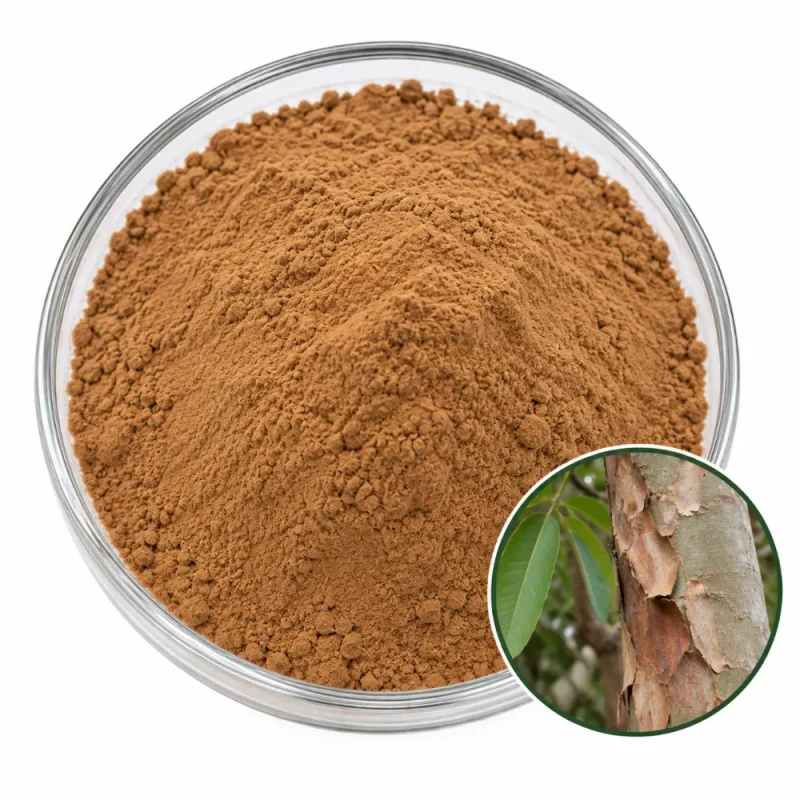
Terminalia arjuna Extract 0.5% Arjunolic Acid

Terminalia arjuna extract is prepared from the stem bark of the arjuna tree, Terminalia arjuna (Roxb.) Wight & Arn., a large riverside tree of the family Combretaceae native to the Indian subcontinent. Ethanol extraction concentrates the triterpenoid and tannin fraction of the bark, and the concentrate is dried to a light brown powder.

The extract is offered as a single grade of 0.5% arjunolic acid, measured by HPLC. The powder is 80 mesh and slightly soluble in water. It suits capsules, tablets and herbal blends where an arjuna bark extract with a stated marker figure is specified.

Arjunolic Acid Standardization & Grades

Arjunolic acid is an oleanane-type pentacyclic triterpenoid carrying a carboxylic acid group and several hydroxyl groups. In arjuna bark it occurs beside arjunic acid and arjungenin, as aglycones, and as glycosides such as arjunetin and arjunoglucoside, together with a large share of tannins and calcium oxalate crystals. Terminalia arjuna extract is standardized to arjunolic acid because the compound is characteristic of the bark and can be followed by HPLC against a reference standard.

The botanical entity is Terminalia arjuna (Roxb.) Wight & Arn., and the part is the stem bark. Other Terminalia species, among them Terminalia chebula and Terminalia bellirica, are used for their fruit and have a different chemistry. The same bark is supplied as a 10:1 ratio extract with no marker figure, Arjuna Bark Extract Powder, and as the milled bark, Arjuna Bark Powder.

This is a single grade, so there is no grade table. The 0.5% figure is a modest marker level, and the rest of the powder is made up of the tannins, polyphenols and glycosides of the bark. It is the grade to specify when the formula calls for a numerical arjunolic acid figure, and inclusion rates are calculated from it. The extract is made from bark that is cleaned of outer cork, ground, extracted, filtered and dried.

Arjunolic Acid Analysis & Purity Risks

An HPLC assay separates arjunolic acid from arjunic acid, arjungenin and the other triterpenoids and reads it as a distinct peak against a reference standard. The figure belongs to a single compound, and it is calculated on the dry powder. Because triterpenoid acids absorb weakly, detection is at low wavelength, and the baseline must be stable to measure a figure as low as 0.5%.

The basis requires care. Arjunolic acid is present partly as free aglycone and partly as glycosides. A figure for the free compound counts only what is already present, while a figure after acid hydrolysis releases the aglycone from arjunetin and similar glycosides and gives a higher number. Two certificates are comparable only when they state the same basis, and an HPLC result cannot be converted into a UV total tannin figure.

Identity rests on the HPLC fingerprint, which is read together with the main peak. The group of oleanane acids, the glycosides and the tannin pattern distinguish arjuna bark from other barks. Identity values for arjuna are checked at source and are not copied between documents.

Purity risks follow from the material class. Bark of other Terminalia species and of unrelated trees is sometimes sold as arjuna, and bark with a thick outer cork dilutes the triterpenoid share. The stem bark is the defined part, and leaves, fruit or heartwood are not accepted. Bark that was stripped from very young or very old trees varies in marker level.

Terminalia arjuna bark also varies with its age and season of collection. Bark collected from mature trees in the cold season carries more of the triterpenoid fraction than bark taken in the monsoon, when the tissue is wet and heavily colonized by mold. A Terminalia arjuna extract made from well-dried, season-collected bark gives a steadier figure from lot to lot.

Typical Specifications

Specification ItemProduct Information
Latin NameTerminalia arjuna
Plant PartBark & Stem
ProcessingEthanol Extraction
Compound ClassTriterpenoids, Terpenoids
Common NameArjuna, Arjun Bark
Ingredient TypeStandardized Extract
Marker Compound(s)Arjunolic acid
Primary Grade0.5% Arjunolic Acid (HPLC)
AppearanceLight Brown powder
Solubility / DispersibilitySlightly Soluble in Water
Quality Parameters
Moisture (LOD)≤5.0%
Total Ash≤5.0%
Particle Size80 mesh
Heavy MetalsLead ≤2 ppm · Arsenic ≤1 ppm · Cadmium ≤1 ppm · Mercury ≤0.1 ppm
MicrobiologyTPC ≤1,000 cfu/g · Yeast & Mold ≤100 cfu/g · E. coli Negative · Salmonella Negative/25 g
Shelf Life24 months in unopened original packaging, cool and dry storage

Applications by Grade

Capsule Fills at 0.5%

The 0.5% powder fills two-piece capsules at moderate to large fill weight. The powder is fine, tannin-rich and hygroscopic, so a dry filling room and a flow agent prevent bridging, and a check weight at the start of each run confirms the fill.

Tablet Blends with Bark Extract

Tablets of the 0.5% powder need a dry binder and a lubricant. The tannins make the compact astringent, so a film coat masks the taste and limits moisture pickup, and hardness is rechecked after storage because the polyphenol-rich solid is hygroscopic.

Herbal Powder Premixes

Premixes carry the 0.5% Terminalia arjuna powder with other bark and root extracts in a bulking carrier. Mix the brown particles with part of the carrier first, because the astringent powder clumps and spreads unevenly if it is added in one lot to a large batch.

Stick-Pack Herbal Mixes

Stick-pack mixes use the 0.5% powder at higher gram weight with a carrier. The extract is only slightly soluble, so it is dosed as a suspended powder in thick bases and not in clear drinks, where tannins give an astringent, hazy cup.

Granulated Formats

Granulated formats take the 0.5% powder after dry compaction or light wet granulation with a binder. The tannin fraction darkens in moist conditions, so drying is gentle and the granule is packed with a moisture barrier.

Decoction-Style Instant Granules

Instant granules for hot water carry the 0.5% powder with a soluble carrier. The tannin-rich fraction dissolves in hot water, while part of the triterpenoid stays in suspension, so a light haze is normal and the sachet label calls for stirring.

Technical & Quality Considerations

Terminalia arjuna extract is a light brown powder with a woody, astringent scent and a bitter, drying taste. It is slightly soluble in water, and the solution is hazy brown, with the tannins dissolved and the triterpenoids partly suspended. The triterpenoid acids dissolve more readily at higher pH, where they form salts, and precipitate again as the pH falls.

Tannins bind iron and proteins. The powder darkens on contact with carbon steel, and a drink that includes whey, casein or gelatin can turn cloudy as the tannins complex with the protein. Stainless equipment, low-iron fillers and a protein-compatibility trial are the usual precautions. The bark also carries calcium oxalate crystals that remain in the ash, and the total ash limit is part of the standard parameters.

The powder takes up moisture and clumps in humid storage. Dry, cool storage in a sealed liner with desiccant stops the powder from clumping. Compare each lot with a retained sample for color and odor, since darker bark gives a darker powder, and run a new check weight whenever the filling line is restarted with a new lot.

Packaging & Commercial Supply

Essencefield supports product evaluation, formulation trials, commercial orders, and ongoing ingredient supply. Packaging, storage, and shipping arrangements are determined by product characteristics, order quantity, stability requirements, and destination-market needs.

Supply ItemGeneral Information
SampleAvailable upon request for formulation, testing, and supplier evaluation
Order Quantities100 g · 1 kg · 5 kg · 25 kg · 100 kg · 500 kg · Bulk
Sample Lead TimeTypically 5–7 days after sample confirmation
Production Lead TimeTypically 15–30 days after order and specification confirmation
PackagingSuitable protective inner packaging with bags, cartons, drums, or other appropriate outer packaging
StorageStore in tightly sealed, suitable protective packaging in a cool, dry environment. Protect from moisture, heat, and direct sunlight. Specific storage conditions follow the approved product specification.
DocumentationCOA · Product Specification · TDS · SDS · Applicable declarations (as applicable)

Final order quantities, lead times, packaging, documentation, and shipping arrangements are confirmed according to the selected product and commercial requirements.

Request Ingredient Specifications & Quote

Share your target specification, application, quantity, and documentation needs. We’ll help confirm suitable options, samples, and commercial supply details.